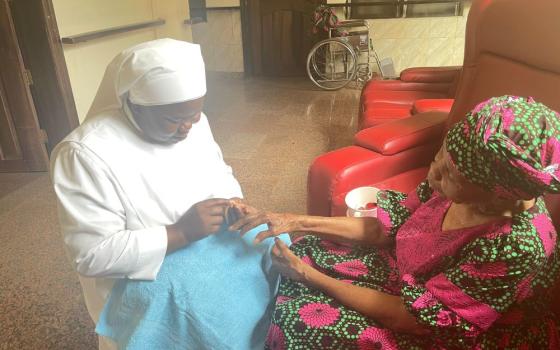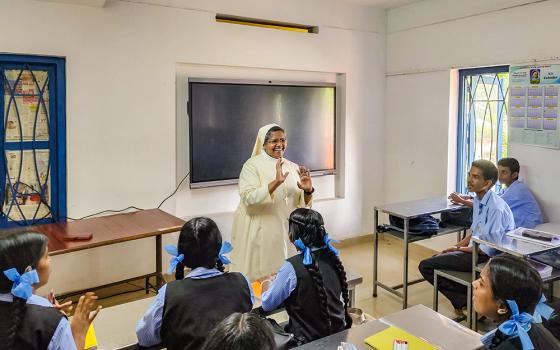
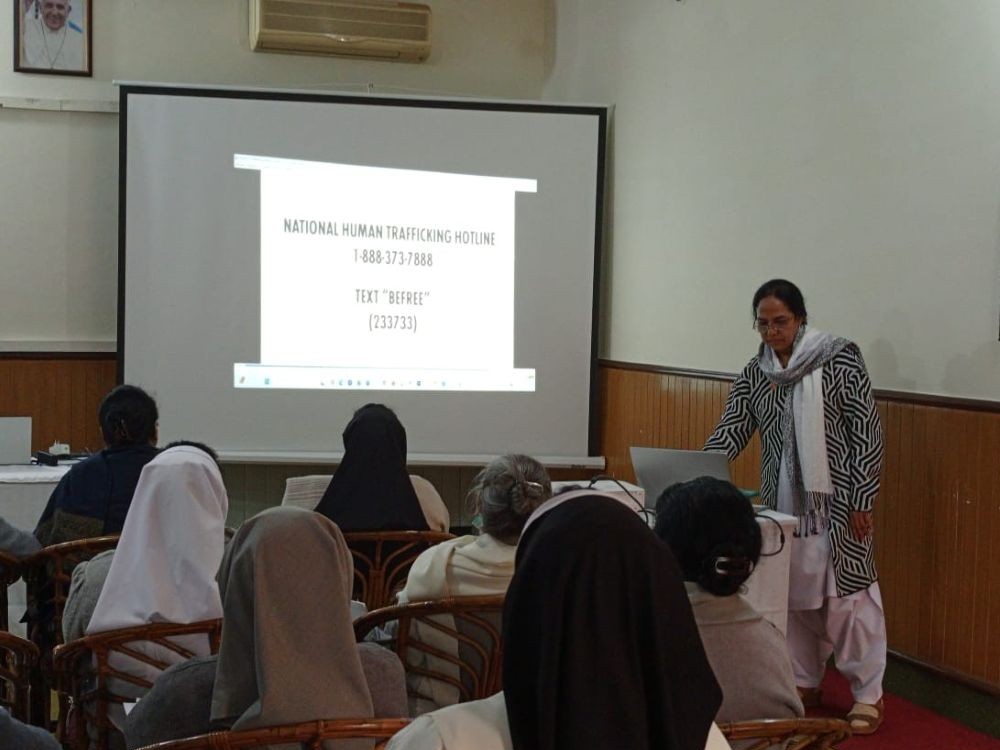
Sr. Catherine Gill leads an orientation session on Talitha Kum with major religious superiors in Lahore, Pakistan, on Feb. 4, 2025. (Courtesy of Catherine Gill)
Sr. Catherine Gill walks alone through the noisy, cramped streets of Karachi and the sun-baked, forgotten towns of southern Sindh province in Pakistan to save people trapped by human traffickers, who move freely out in the open.
The victims are often poor — a man struggling to feed his children, a young person seeking work, or a family striving to break free from crippling poverty.
Gill, a Franciscan Missionary of Mary and the principal of an all-girls school in Karachi, says victims include young women from marginalized Christian neighborhoods who are trapped by promises of domestic work in a wealthy area, quick online work, or even a marriage proposal from abroad.
In a region where church leaders openly warn of security threats to women, Gill has chosen a quiet, grassroots path to save youth through Sunday school classes and faith formation, before their lives are ruined.
Gill, 59, told Global Sisters Report how local traffickers operate, described her experiences fighting human trafficking, and explained why, despite danger, she still looks out at the chaotic streets of Karachi with hope.
GSR: What made you take up the fight against human trafficking, despite your full-time exhausting job as a school principal?
Gill: It all happened by accident. Sr. Rosey Yacoob of the Franciscan Missionaries of Christ the King was Talitha Kum's first coordinator in Pakistan, serving from 2019 until her passing in 2023.
Two years before her death, in 2021, she invited me to join an online training program on human trafficking offered by the network. It required only two hours per week for a year, so I happily agreed.
I remained in the network and eventually became the country coordinator for Talitha Kum in 2024. For me, balancing this role with my school job isn't just NGO work but a mission of Jesus Christ, bringing those who are lost and broken back to life.
Alongside our school classrooms, we focus on building character and courage in our Christian youth, especially young girls. We teach them Christian values, show them how to walk with Jesus through their hardest moments, and empower them to lift up those who have fallen.
What is Talitha Kum, and what is its work here in Pakistan?
Talitha Kum is a global network led by Catholic nuns that combats human trafficking. The name itself comes straight from the Gospel, meaning "Little girl, arise."
In Pakistan, our mission is to provide spiritual strength and courage to those who feel crushed. My work involves visiting poor families and meeting with young people. We pay special attention to protecting teenage girls from being deceived by traffickers' beautiful lies.
I explain to them how to see through the traps, help them realize how precious they are to God, and help them find the inner strength to resist manipulation.
With the help of parish priests, I also organize awareness-raising gatherings in the most neglected neighborhoods and slums, focusing on real-world dangers and how neighbors can protect one another.
Also, such training is conducted in school classrooms. Training schoolteachers, young nursing students, Sunday school children and parish youth groups also take up my time.
We teach them to spot the warning signs — like a stranger offering quick, easy money or a neighbor pushing too hard to take a girl away for work. We also teach families and youth to be on guard for one another.
Advertisement
What does human trafficking actually look like in Pakistan?
In Karachi and elsewhere in Sindh, you can see teenage and preteen girls from poor villages or slums being taken into wealthy homes to work as child maids. Once inside, they are completely cut off from their families and left unpaid, overworked and physically abused.
The recruiters use trust, not force, to trap them. Often, the recruiter is a trusted insider — a neighbor, a distant relative, or someone from the same village — posing as a kind person trying to help the struggling family. They offer a safe home, good food for the young girl, and a steady income for the family through her salary.
The recruiters also publish fake social media job postings for office assistants or receptionists, offering high salaries. When young people appear for an interview, their identification documents and phones are confiscated, and even their marriage records are forged to entrap them.
Most victims are girls from poverty-stricken families, whose parents believe that a job at least ensures their daughters' safety and well-being. Some also knowingly push their daughters into this slavery for a few hundred rupees because of their poverty.
Why do you focus on preventing trafficking and rescuing its victims?
The painful truth is that once a girl or a young man disappears into a trafficking network, finding them is a nightmare in Karachi, a city of some 20 million people. Dealing with courts and police stations is incredibly exhausting and difficult.
A dramatic rescue operation sounds wonderful, but by the time we track a child down, the trauma has already broken their spirit. They are deeply scarred, and their innocence is shattered. That is why prevention is our only real shield.
How can training and faith formation help young people protect themselves from these predators?
In our society, traffickers prey heavily on the deep sense of worthlessness that many poor minority youths carry. Faith formation cultivates a deep sense of dignity and self-respect from within.
When a Christian girl believes in God and takes pride in who she is, she gains inner strength. That spiritual root becomes a shield. She is far less likely to believe a trafficker's false promises because she already knows exactly what she is worth.
This is not abstract theory. I have seen it work; I lived through these exact pressures myself.
Back in 2008, long after I had taken my vows as a nun, I was attending a management course in Hyderabad. A group of young men approached me. They were polite but openly challenged my faith and invited me to convert. They told me, "You are so educated, well-spoken, and good-looking — you really must accept Islam."
I didn't get angry, and I wasn't rude. I replied in a calm, respectful voice. But that moment never left me because it opened my eyes to the everyday pressures our young Christian girls and women face here.
If a Catholic nun wearing a full habit can be targeted that way in public, imagine how vulnerable an ordinary, uneducated, impoverished young girl could be to seduction if she hasn't been strengthened in her faith.
Isn't your work against trafficking hurting the profits of trafficking gangs, who can target you?
Pakistan can be a very frightening place for work resisting trafficking because it threatens the profits of the trafficking mafia. Many nuns are terrified to join this work because they fear for their lives.
While I haven't had a gun pointed directly at my face yet, I live with the heavy weight of being a target. The threat is always breathing down our necks, but we cannot let that fear lock us in our rooms.
Whenever I meet Archbishop Benny Mario Travas of Karachi, he warns me, "Be careful, Catherine. Your convent should not be stoned." That danger always lurks in the shadows.
Often, sisters want to get involved in the work, but they step back because of the life-threatening realities of confronting these mafias.
What keeps you going?
What keeps me going is my deep, agonizing worry for the lives and dignity of our young Christian girls. I know I am small; I cannot fight or compete with these powerful, wealthy trafficking mafias. So my entire strategy is to go slow, quiet and steady — winning the battle through grassroots prevention.
What do you need most right now to move forward with your work against trafficking?
The biggest hurdle to our future is that Pakistan has absolutely no safety infrastructure for victims. We desperately need a secure shelter home for rehabilitation — a dedicated, secret and safe space where children who have been abused by traffickers can truly heal.
It is not just young girls. Often, the mothers and fathers are also deeply traumatized and need intensive counseling and comfort. But we simply do not have adequate facilities to provide them with the relief they need.
I know that through faith and the kindness of others, we will one day build a safe haven to protect and restore these broken families.
How would you describe Karachi?
It is a megacity with broken roads and deafening noise. The poor in the city lack basic infrastructure and services such as water and electricity, and they often live under constant threat of all kinds of crime.
However, it is also a beautiful city where people come together in times of grief. We see this in countless free food stalls feeding thousands of starving laborers daily and in countless nongovernmental groups, including dozens of Christian nuns, working to improve human lives.
The poor people here are incredibly generous. Years ago, I met a poor widow in Hyderabad who was homeless with two children. I appealed to the local community to help build a home for her. Although they were themselves poor, they raised 400,000 rupees (USD $1,438) within weeks to build her a proper house. Despite all the pain and structural failures, I look at Karachi with profound, unshakable hope.
What was your own childhood like, and when did you first think of becoming a nun?
I was born in Karachi into a devout Catholic family. Because our little home was so close to the parish, priests and sisters were regular visitors. My father played the organ at the church, so I naturally grew up singing in the choir and loved helping the sisters set up the altar for Mass.
At the time, the Sri Lankan sisters of the Good Shepherd served in our parish. When I was in eighth grade, I took part in a "Come and See" discernment program. Watching those sisters work moved me. They offered a quiet sanctuary to marginalized and broken women — the kind of women who felt completely discarded and unloved by the rest of society.
The tiny seed of my vocation was planted during that eighth grade experience. But I entered religious life much later, making my first profession in 1990 and my final vows in 1997.
I wanted to join the convent after my 10th grade, but elders advised me to finish my intermediate education and to spend time with two or three religious orders before making a decision. Having seen the Good Shepherd Sisters, I also spent time with the Franciscan Missionaries of Mary and the Franciscan Missionaries of Christ King.
After completing my intermediate education, I chose to join the Franciscan Missionaries of Mary for their specific charism. I appreciated their commitment to educating poor children and their focus on social justice.