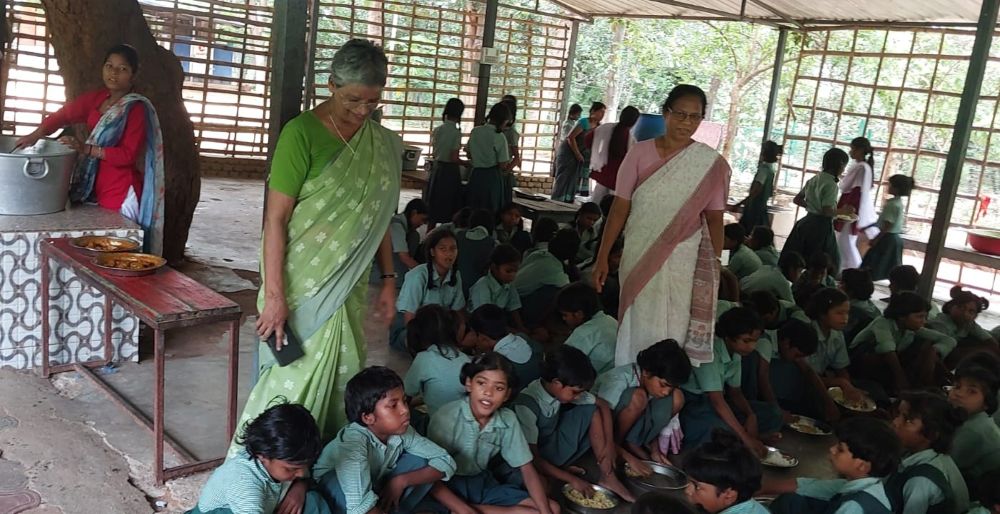
Students of Chirag Vidyalaya in Rajgir, in the eastern Indian state of Bihar, eat lunch in Chetanalaya Hostel Hall, just opposite the school building. Overseeing the lunch distribution are Nazareth Srs. Rose Plathottam (left) and Jyoti Kerketta. (Jose Kalapura)
by Jose Kalapura
Without Nazareth Sr. Rose Plathottam, Rani Kumari would still be in poverty as a member of the Musahar (rat eater) community in the eastern Indian state of Bihar.
"Whatever I have achieved in my life, is because of Sister Rose. Had I been in my village, I would have been married off years ago," said the 23-year-old nurse who works at Holy Family Hospital in Patna, the state capital.
Kumari completed 10th grade at "Chirag Vidyalaya" (Lamp School) which Plathottam manages in an area with crime and bandits 2 miles outside Rajgir, some 70 miles south of Patna, the capital.
Plathottam supported Kumari to continue her studies and attend the nursing course.
Currently, some 240 girls from low caste communities study in the school, founded in 2010.
The students stay in a nearby hostel called "Chetanalaya" (House of Life), a socio-medical and educational center run by the Sisters of Charity of Nazareth, a congregation founded in Kentucky. Plathottam and her companion, Sr. Jyoti Kerketta, along with a few lay staff, oversee the hostel, which was founded in 2000.
"Education helps the girls escape poverty and a bleak future," Plathottam told Global Sisters Report.
The 77-year-old nun, who joined the Nazareth congregation in 1968, said that after her first profession she was trained as a homeopathic doctor and a physiotherapist.
"For some 20 years I worked mostly in our hospitals and dispensaries and social service centers, before being assigned to Chetanalaya in 2000," she said.
She said she was touched by the plight of the Musahar, the poorest among Bihar's 22 lowest caste groups, who together form 16% of the state's 133 million people.
Hindu society is divided into four major castes — Brahmin, Kshatriya, Vaishya and Sudra — and those outside the castes are called Dalit (untouchable). These groups face severe social exclusion and marginalization due to traditional designations. The lowest among the Dalit group are the Musahar, also known as rat catcher or rat eater, as community members have historically been forced to eat rodents from the fields during times of extreme poverty, landlessness and severe hunger.
As the number of patients coming to Chetanalaya declined, Plathottam said she shifted her focus to educating Musahar girls through Chirag Vidyalaya.
Kumari, who graduated from the Chirag Vidyalaya school in 2019, is among 12 former students who now work as nurses or other professionals in various parts of Bihar.
Kumari said girls from her village who can't go to school are married at an early age.
Another alumnus, Rukmani Kumari, who too works as a nurse, said before the school opened, the village parents did not bother to educate their girl children, even though other schools were nearby.
"But with Sister Rose, our parents felt secure. Today my younger sisters are also studying there," she told GSR.
Advertisement
Plathottam said the nuns ensure that parents support their children's education. Each child pays 500 rupees (US$5.25) for hostel fees and 300 rupees (US$3.15) for school fees a month, she said.
Plathottam said she has had to pay a price for her mission.
"Little did I know how challenging and dangerous this place would be. There was a problem of security for women, in running a center there," she said.
Chetanalaya, a 7-acre walled campus, has been attacked and looted in 2000, 2004 and in 2007.
"In the first attack, some staff members were attacked. In the second, some hostel girls were molested and the convent was looted. In the third attack, armed bandits attacked the convent," Plathottam said.
She suffered head injuries as she was sleeping on the terrace with 11 handicapped girls to escape the summer heat.
A bleeding Plathottam was taken to a local hospital by police officers who responded to the call nearly 45 minutes after the incident.
"I recovered gradually, but never gave up my mission to educate my girls," she said.
Sr. Sangeeta Ayithamattam, who was the provincial then, commended Plathottam for single-handedly continuing her mission despite the threat to her life.
"The continuous attacks on our convents and people were a matter of serious concern for us," said Ayithamattam, who later served as the congregation's president for six years.
She said few nuns volunteered to work in Chetanalaya. "For nearly 10 years, [Plathottam] managed the center alone. Hers is a heroic courage blended with faith in a liberative God who would save the low caste girls," said Ayithamattam.
Anil Kumar, a staff member at Chetanalaya since 2005, said the attacks stopped because of Plathottam's "courage to withstand threats and hold her head high against all odds."
Plathottam said initially it was challenging to motivate the girls to pass high school examinations, but now more than 200 girls have graduated.
"But when some of them passed the examinations, more girls got motivated. Now the parents are more motivated, as they see their children doing well with jobs," she said.
Sanchu Kumari, a former student who works as a nurse in a Patna hospital, said they also learned life skills such as hygiene, discipline, saving money and environment preservation.
Plathottam said although other priests and nuns in India have faced allegations of forced conversions, she hasn't experienced that.
"People know that we never converted anybody. Not a single girl is Christian," she said.
She said sometimes outsiders walk into the campus to find out what is happening inside. "But we tell them to see for themselves, invite them to join in our prayer and meals," she said.
Plathottam said the continuity of the center is a worry, as she advances in age.
"My provincial is aware of it. So, junior sisters are appointed. We need the right orientation and commitment to work here," she said.