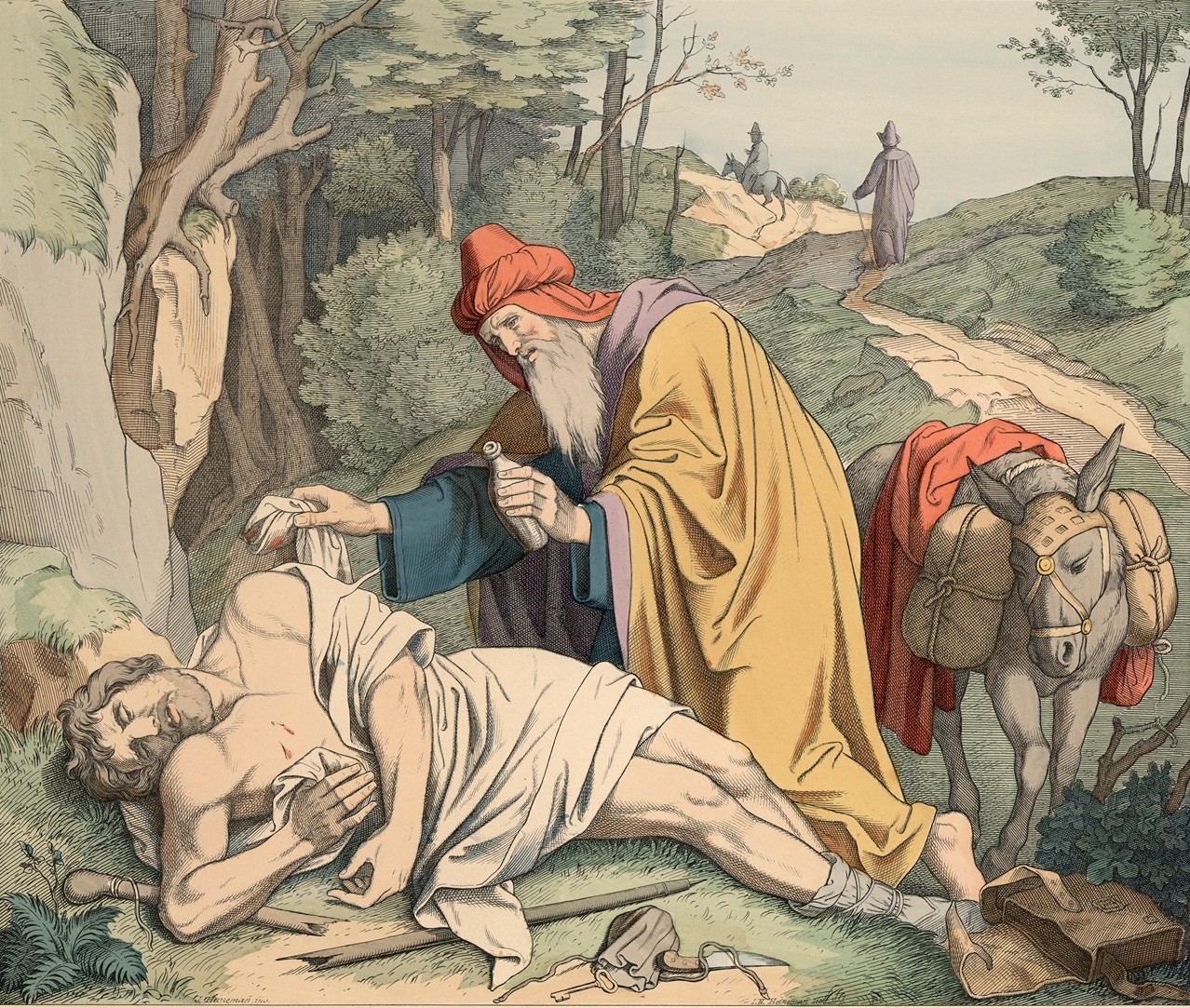
"The good Samaritan" (19th century) by Johann Nepomuk Heinemann (Artvee)

by Stephanie Ann Puen
Editor's note: Welcome to Theologians' Corner, where each week a different woman theologian from around the world offers a fresh reflection on the Sunday readings.
Thirtieth Sunday in Ordinary Time
October 25, 2026
This Gospel today, together with the parable of the prodigal son, remain some of my favorite parables in how they subvert expectations and ideas on morality and ethics. While God is a God of justice who cares for the poor, as the first reading and responsorial psalm emphasize, God is also a God of mercy. God is merciful even to those we might not think are worthy of mercy, who makes the "sun rise on the evil and on the good and sends rain on the righteous and the unrighteous" (Matthew 5:45).
For many of us, we want to think we are good, kind, competent, ethical and smart. We want to think that we are — for the most part! — righteous. We might not be as brazen as the tax collector in the Gospel reading, who thanks God that he is not like the rest of humanity, but we nevertheless still would like to think that we are not bad people. We'd rather not think about the times where we, perhaps, did something that caused harm (even with good intentions!) or were the villain in someone else's story. We would like to think that we are the good and righteous people in the Gospel verse of Matthew mentioned earlier, rather than one of the unrighteous and evil.
However, not only are there times that we may have done something that caused harm, but we may have even done so unconsciously. We won't often see or be the very big bombastic evil acts, but we may end up participating in evil in the smallest and subtlest of ways in what we say, think or do, contributing to what philosopher Hannah Arendt calls the banality of evil. This may be seen in how we can be silent in the face of evil, complicit in how we fail to bother to show up — thinking that we are weak or without freedom when we do something wrong, as the theologian and ethicist Jesuit Fr. Jim Keenan discusses in his work on sin as the failure to bother to love. We may be asked to be obedient, but in being obedient we may end up causing harm to other people and to creation. Unnuanced theologies and remarks said without care or thought may hurt and harm just as much, if not more, than actively intended malice.
This reflection is meant to be an invitation to reflect not just that we can be the Pharisee in the Gospel, but also that this can happen in very unconscious ways, reflecting a disconnect in what we think and believe with what we say and do, propped up by the kind of culture and systems we inhabit. Instead of the actual theology of love, justice and mercy that we are to espouse, we may instead be teaching and doing the opposite unconsciously through what educational theory refers to as a "hidden curriculum." A hidden curriculum refers to the lessons and ideas that people learn and practice, even if not openly intended. This includes norms and actions that are not explicitly taught, but very much imbibed and cultivated.
In light of this, I invite us to reflect on our own "hidden curriculums" in what we say, think or do, and to unveil the assumptions, ideas, theologies and values that can drive our actions, and how we might unknowingly also be teaching or showing these to others. What kind of spirituality, religiosity or theology underlies who we are and what we say and do? Is it still the God of justice and mercy for all, both the good and evil? Or has it already morphed into something else unconsciously?
Advertisement