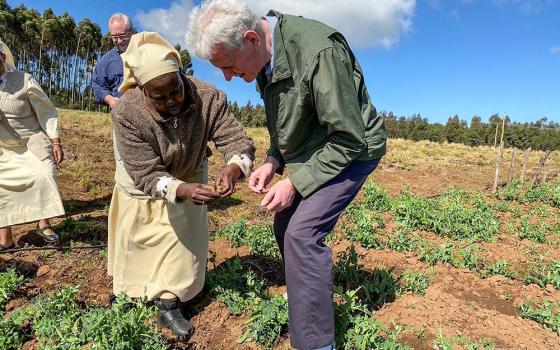
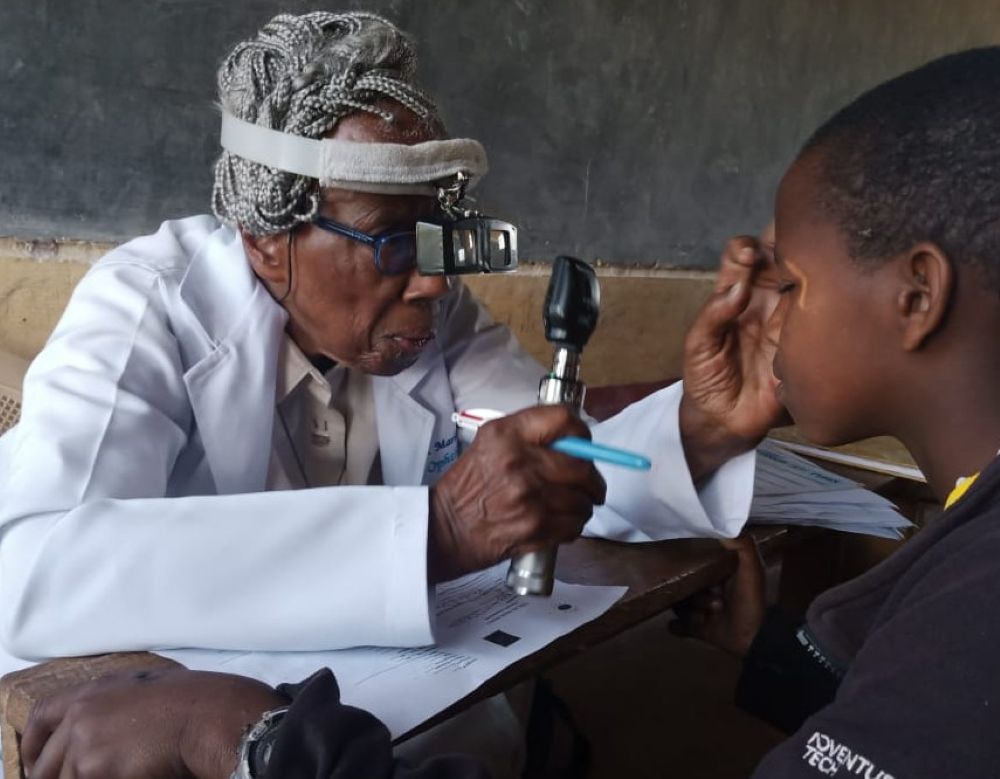
Dr. Sr. Marlene Long gives a patient an eye exam during the Primary School Eye Health Project in Ngong, Kenya in the early 2000s. (Courtesy of Marlene Long)
by Lori Shridhare
To sit across from Dr. Sr. Marlene Long is to witness a rare intersection of absolute precision and boundless compassion. At 89 years old, and despite facing recent mobility challenges, Long remains a vibrant, articulate force of nature. She is quite possibly the world's only Black Catholic nun who is also a fully credentialed general, reconstructive and ophthalmic surgeon.
Her life's arc is nothing short of exceptional. Graduating at the upper half of her class as an award-winning medical student from Howard University in 1963, she navigated the competitive medical world as a Black woman during the height of the Civil Rights Movement (and attended the famous March on Washington). Driven by a family belief in the power of education to lift people out of poverty, and anchored by a profound Southern Baptist — and later, Catholic — faith, she chose a path of radical service.
Combining her advanced surgical training with her vocation as a Franciscan Missionary of Mary, Long has spent decades providing critical, life-altering healthcare to underserved populations in Madagascar, Papua New Guinea and parts of Africa. She has helped train the next generation of surgeons around the world, especially in India, Pakistan and Nepal where she visited in the mid-1970s through the mid-2000s. By restoring sight through cataract operations and performing intricate reconstructive surgeries for leprosy (Hansen's disease) and other patients in need of life-saving or limb-sparing care, her hands have reshaped thousands of lives.
Recently, Long moved from Kenya to Jirapa, Ghana, near the border of Burkina Faso. While technically semi-retired and working part time three days a week at St. Joseph's Hospital, she continues to provide general eye care and treat trauma cases. Fresh off publishing her latest research on ocular health in the International Journal of Ophthalmology, she is preparing to present her work before the upcoming African Ophthalmology Council Congress in Cape Town, while contemplating how she might acquire mobile equipment for glaucoma testing at her hospital, and design an epidemiological study based on existing large datasets.
In this edited conversation, Long reflects on her medical journey, the realities of providing "real" reconstructive surgery in developing countries, and why her medical coat and religious habit are fundamentally one and the same.
Global Sisters Report: Let's start at the beginning. How did you decide to combine a demanding career in surgery with a religious calling, especially during your early days at Howard University in the 1960s?
Long: Our family was deeply Christian, and at a very early age, I wanted to be a missionary. As I evolved through my schooling, I was drawn more and more to science and math. I actually started college at San Diego State just around the time Sputnik was launched into space. Americans wanted engineers to catch up, so I initially thought about engineering. But I realized I wanted to work with people, not machines or labs.
When I was in middle school, I transferred to a Catholic school and met the sisters. They deeply inspired me, and I realized, "That's how I am going to be a missionary. I will be a missionary sister." My family was Southern Baptist, so I had to wait until I was 21 to be re-baptized as a Catholic before entering religious life.
I went to Howard University College of Medicine — an institution with incredibly high standards. We were only seven females in my class, but we had excellent Black female professors as role models. There, I could just focus strictly on my studies.
Did you face significant barriers as a Black woman entering the surgical field at that time?
You met prejudices all along the way. I remember an anatomy paper in college where I wrote a perfect paper and the instructor gave me a 99 instead of a 100.
The real hurdles came when trying to secure internships and specialty training. As a woman, and as a Black woman, you had to be two or three times as smart as your counterparts just for them to even look at you. I did my internship at a Catholic hospital in Los Angeles. I tied for the top prize in OB/GYN with a young Jewish guy, and I won the top prize in surgery alongside another African American man. Yet, because of systemic antisemitism and racism, they denied him the OB/GYN residency and they denied me the surgical residency because a white counterpart wanted it.
But the barriers didn't stop me. I went on to complete my religious formation with the Franciscan Missionaries of Mary sisters in Rhode Island, did further surgical training, and eventually received permission to pursue reconstructive surgery. In my day, you were a general surgeon. Today, young physicians who choose to be surgeons go directly into subspecialties quite early, so they don't really become good generalists. The thinking at that time was that you had to be a good generalist before you became a specialist.
You spent decades performing reconstructive surgery, particularly for leprosy patients. Where did your compassion come from?
Compassion for leprosy patients has been with me since childhood from reading the Scriptures. Our Lord had compassion on the lepers because they were outcasts. Later, while running a tuberculosis and leprosy clinic in Papua New Guinea, I looked at the severe claw hands and facial deformities of the patients and felt powerless to correct them.
While rotating in an emergency room in Australia, a registrar suggested I look into plastic surgery. In the U.S., people immediately think of "plastic surgery" as boob jobs, nose jobs and cosmetic eyelids. But he explained the reconstructive aspect of the specialty. When I returned to the States, I wrote a careful letter to my religious superiors explaining "reconstructive surgery" — I intentionally omitted the word "plastic" so they wouldn't get the wrong idea!
They granted permission, and I trained at an affiliate hospital of Wright State University in Dayton, Ohio, and then at Carville, Louisiana, which was the only leprosarium in America (the leprosarium closed in 1999, though a small group of elderly residents chose to live out their lives on the grounds cared for by the Daughters of Charity until 2005). There, I learned to surgically correct claw hands and eyelids for leprosy patients. I later brought those skills to Madagascar and East Africa, eventually leading the Leprosy Reconstructive Surgery Outreach with the African Medical and Research Foundation Flying Doctors in Nairobi, Kenya.
Your work also expanded into ophthalmology. How did that evolve?
When I was a child, the three parts of the body that fascinated me most were the eye, the heart and the hand. In Africa, you see a massive volume of eye disease, but there has always been a shortage of specialists. There is a saying that "in Africa, we do everything with nothing."
Leprosy patients experience severe ocular morbidity, and I was also seeing 2- and 3-year-old children with massive, terminal retinoblastomas. It broke my heart. I wanted to operate more intelligently, so I sought out formal training. I took an intensive course at the University of Texas at Houston, practiced cataract techniques in Addis Ababa, and during the COVID-19 pandemic, I completed an advanced online program through the University of Edinburgh, earning my master's degree with distinction. Cataract surgery is a miracle — an eight-minute operation that instantly restores sight using minimal equipment.
Advertisement
Reconstructive surgery on the frontlines often means dealing with the trauma of war. What were some of your closest calls?
The danger is always there, but you just get on with your work. I remember operating in the hills of Western Uganda, close to the borders of the DRC and Rwanda. Suddenly, gunshots rang out right outside the operating theater. Some of my staff panicked and disappeared — and I don't blame them! But I was mid-operation; it was just me, the anesthetist and the patient. We had to stay and finish.
In Rwanda and Uganda, I reconstructed horrific injuries from artillery, hand grenades and landmines. I remember a case where a man's leg was partially blown off by a landmine. In the West, they might amputate and provide a high-tech prosthetic with months of rehab. But an amputee in rural Africa faces an incredibly harsh reality; amputation is no favor. We worked tirelessly to salvage his leg, harvesting an abdominal muscle and using microsurgery to attach and graft it. We saved his leg. That is real reconstructive surgery.
You are currently in Jirapa, Ghana, at St. Joseph's Hospital. Is it true you are wearing a piece of your past there?
It is a beautiful, crazy irony. Fifty years ago, I did part of my medical training at St. Joseph's Hospital in Providence, Rhode Island. Today, I am working at St. Joseph's Hospital here in Jirapa, Ghana. I brought my old lab coats from America with me. So every day, I walk into the clinic wearing a coat that reads: "Dr. Marlene E. Long, St. Joseph Hospital."
Looking back over your decades across the globe, how do you see the relationship between your medical profession and your vows as a nun?
I consider myself entirely one. My service as a Christian, a religious sister and a missionary is the sole motivation for all of my medical work.
People are generally good, accepting and respectful wherever you go — whether in Africa, India or Pakistan. Even when people are initially skeptical of what a Black woman surgeon can do, they quickly realize you are there to transfer skills and help their people. There are voices today sowing division and hatred, but my experience has shown me that when you approach people with genuine compassion, boundaries disappear. Every day I step into the clinic, I am simply living out my calling.
As a true pioneer, what advice do you have for young people, especially young Black women, who are just starting out on their own journeys?
First and foremost, keep the faith. Never let anyone tell you what you cannot do. You will meet prejudices and people who want to put you in a box, but you must look beyond them. Keep your eyes on the goal, study hard and prepare yourself completely so that when the door of opportunity opens, you are ready to walk through it.
Second, remember that true success is not measured by wealth or social status, but by how you use your talents to serve others. Whether you choose medicine, science or any other field, approach your life with genuine passion and genuine compassion. When you focus on helping people and erasing the boundaries that divide us, you will find a purpose that sustains you for a lifetime.