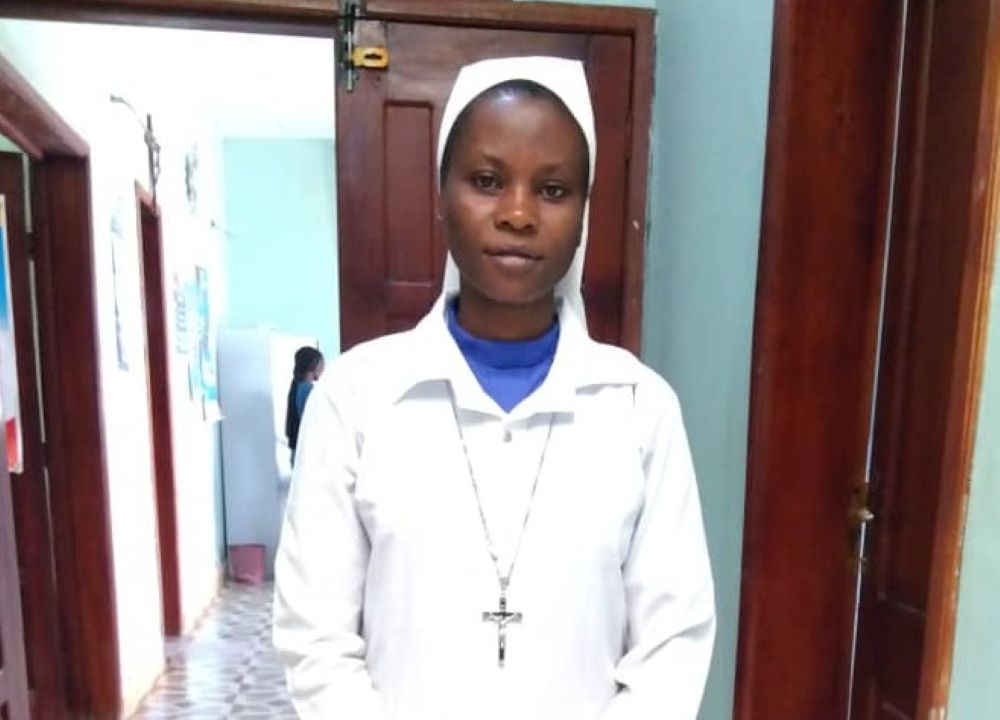
Sr. Francine Katho of the Congregation of the Servants of Jesus in Bunia, eastern Democratic Republic of Congo, ministers to patients with Ebola. (Courtesy of Francine Katho)

by Ngala Killian Chimtom
With over 2,600 people dead, a Catholic nun in the Democratic Republic of Congo has issued an impassioned plea for help to enable the country to deal with an epidemic that is killing one person every 30 minutes.
For Sr. Francine Katho of the Congregation of the Servants of Jesus in Bunia, eastern Congo, donning personal protective equipment each morning is a stark reminder of the deadly stakes for both her patients and her fellow healthcare workers, some of whom have already succumbed to the virus.
Driven by her faith and the belief that life is sacred, Katho bears what she calls a "very heavy cross," risking her own life and the safety of her convent to treat the sick, including taking in Ebola orphans.
Beyond the staggering death toll, the epidemic is quietly eroding the very fabric of human connection, with families forced to grieve through social media and prayer rather than traditional funerals, says Katho in an exclusive interview with Global Sisters Report.
Yet, amidst the darkness, Katho refuses to waver, issuing a desperate plea to the world to provide the resources, treatments and vaccines needed to stop the dying and restore the compassion she says the virus has stolen.
The following are excerpts of that interview.
GSR: Can you describe what a typical day is like for you at the moment? When you put on your personal protective equipment (PPE), what thoughts go through your mind?
Katho: When we put on our PPE, the thoughts that cross our minds are all about strict protection — for you as healthcare workers and for our patients — to prevent infection.
I imagine you have lost patients you were caring for. How are you coping with this loss? Have you lost any colleagues or friends because of this pandemic? What impact has this had on your community?
Yes, we have lost patients, and some healthcare colleagues too, but so far no female colleagues. The impact is still one of fear; I would even say that this situation has somewhat diminished the sense of camaraderie amongst us.
Do you ever feel afraid? If so, how do you overcome that fear whilst you're working?
Yes, the fear is still there because we don't yet have a fully established treatment to eradicate the virus.
When a patient dies, they often have to be buried quickly and safely, which prevents families from organizing traditional funerals. How do you support families through their grief at such times?
Physical support isn't possible. We try to do so via social media, but we support them more through prayer.
In the Congo, foreign healthcare workers often provoke fear and mistrust. Why do you think the community trusts you and the other sisters? What do you bring to the fight against Ebola that others cannot?
What we bring to the community is mainly raising awareness about strict adherence to protective measures, vigilance and the flexibility to go to hospital if one feels unwell.
I have read that the sisters often step in to care for Ebola orphans (children whose parents have died). What becomes of these children, and how do you support them?
Of course, the sisters do step in to look after orphans, but so far, we haven't had many cases. Our sisters at the orphanage took in one, but unfortunately, he didn't survive.
Have you ever faced hostility or violence from people who misunderstand the epidemic or your work? How did you react?
We faced a great deal of resistance at the start because the local community didn't yet understand, but after organizing many awareness-raising sessions, and thanks to our ongoing dialogue with families, there is now hardly any resistance at all. Everything is proceeding peacefully.
People often ask, "Why would you risk your life for this?" How does your faith respond to this question?
Life is sacred and we must protect it. We are doing our best. We provide care, but it is God who heals. So we still hold on to our faith.
Advertisement
Faced with so much death and darkness, where do you see God? Does your faith sometimes waver? Have there been times when you have asked yourself, "Why is this happening?"
Faced with such a situation, which is deeply unsettling, there is no shortage of questions. But we always tell ourselves that God is present. We remain hopeful that this may come to an end at some point, according to his will.
Your vows include serving the poorest of the poor. Does this epidemic strike you as the profound fulfilment of that vow, or as a particularly heavy cross to bear?
At the moment, it really is a very heavy cross we are bearing. Just imagine: We work in our own facility; there are seven of us nuns. In this line of work, on the one hand, we are exposed ourselves first and foremost, and the community is also at risk because we live together. On the other hand, we must save lives wherever possible, and our conscience won't let us rest when faced with someone in need of our help.
What does the Congo urgently need right now, and what is it lacking?
All we can ask for is to find a way to eradicate this virus. We need to be equipped with adequate resources and, above all, find medicines to treat those who are infected but still fighting the disease, as well as a vaccine for prevention.
When this epidemic is finally over, how do you think your community will have changed? How will you have changed?
The change will take two forms. Positively — it teaches us about, or reinforces, our standards of hygiene in every respect.
Negatively — this virus has really put an end to good habits amongst us as brothers and sisters, amongst other things, closeness and compassion. For example, we no longer really know how to sympathize with someone who is affected. … We bury our loved ones without being able to pay our last respects. … It's really difficult.