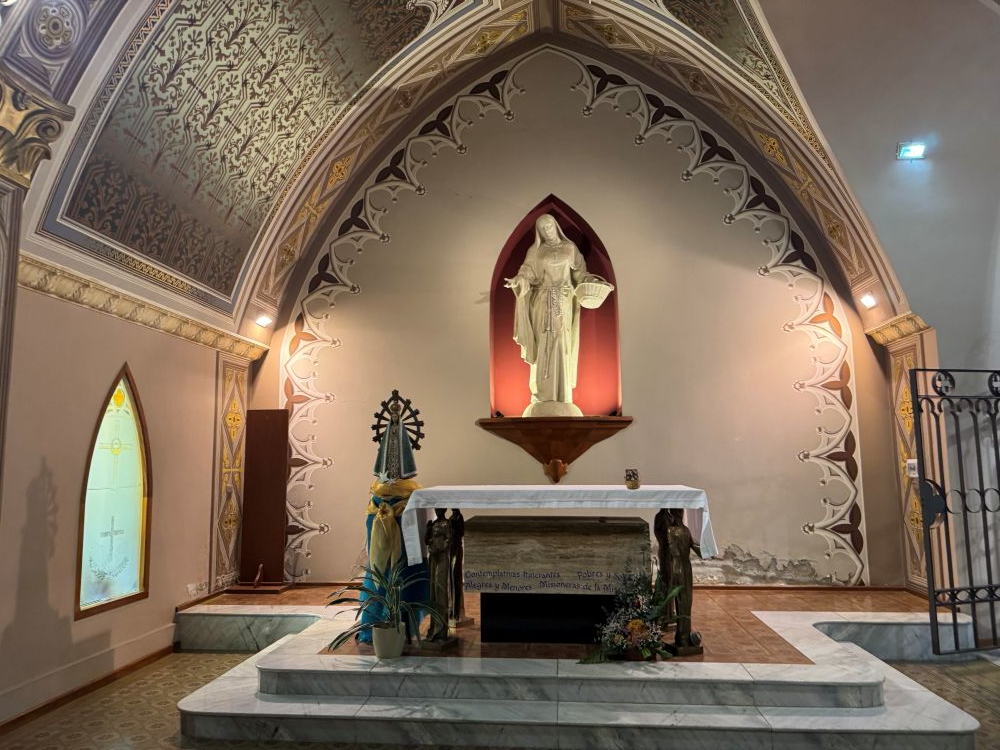
A marble sculpture depicting Blessed María del Tránsito Cabanillas with her little basket stands at a shrine at the motherhouse of the Franciscan Tertiary Missionary Sisters in Córdoba, Argentina. (GSR photo/Helga Leija)

Sr. Claudia Navarro
"On a scale of 1 to 10, how would you rate the pain you're feeling right now?" Álvaro, a doctor, asked a young woman he was treating. He had first asked her to think of the worst pain she had ever experienced and call that a 10. She paused and asked, "Physical or emotional?" He answered, "Physical," adding that she could talk about the emotional pain afterward.
It sounds like a straightforward question. But pain is anything but simple. How do we measure it? How do we recognize another person's suffering and know how to accompany them through it? It seems that as many people as there are, there are just as many ways of experiencing pain. Suffering is woven into the human experience, and religious faith does not place us outside of it.
I hear this in a song about the life of Blessed María del Tránsito Cabanillas, born in Córdoba, Argentina, in 1821: "With reeds of pain and reeds of love, you weave the basket of your whole life." A patient and joyful pilgrim on the paths of God, known as "the saint of the little basket," she made of her life a basket woven from pain and love, each one intertwined with the other.
When I think about her life, I see her caring for poor families suffering from cholera. I see her caring for her orphaned niece like a mother, visiting the hospital and teaching catechism. But I also see her on her knees, pleading to receive Communion; alone in her room, punished because she had placed too much trust in divine providence; removed from her role as foundress; and largely alone, without complaining and yet unwilling to give up on her dream. I see a woman who recognized opportunities to serve God's kingdom and chose love over any claim to reason, fairness or personal rights.
Perhaps this is one of the keys to understanding her life. We live with the constant temptation either to spiritualize suffering or to become so immersed in it that we lose hope. At the same time, our culture urges us to eliminate pain at all costs, while another temptation is simply to accept suffering without searching for meaning that might shed light on our lives.
María del Tránsito's legacy offers another way of living with pain, one that did not prevent God's plan for her life from unfolding and did not allow suffering to make her rigid or bitter. That may be one of the most remarkable things about her story. Trials, difficulties and deep humiliations did not destroy her trust in a God who sustained her and remained faithful to the deepest desires of her heart.
In one of her letters, she wrote, "Let us make use of every means God uses to lead us safely to him." Some of those circumstances did not come from God's goodness but from human selfishness and closed hearts. Even so, she believed that God could use them for a greater good. She trusted and waited. And that is what happened.
The French philosopher Simone Weil wrote that loving our neighbor means being willing to ask what is tormenting them. It means having the courage to draw close to human suffering rather than turning away from it. Biographies recount that, as a child, María del Tránsito once freed a political prisoner who had been placed in the stocks. From an early age and throughout her life, she learned to recognize suffering, to see the torment in another person's eyes and draw near, looking for a way to help. She did for others what she had experienced God doing for her in her own moments of deepest abandonment: staying and caring for her.
One of her greatest trials came when she tried to fulfill her desire to consecrate herself to God by entering the Carmelite convent in Buenos Aires. Because of her poor health, she was asked to leave. Physical suffering was joined by the spiritual and emotional pain of having to leave the house of God. In her autobiography, she wrote: "I suffered greatly, both because of the illnesses I endured and because of the burden I caused my sisters … But above all, having to leave the house of God was the bitterest thing for me. I imagined that I was among the condemned. I tried to unite my abandonment by human beings with the abandonment that my Lord Jesus Christ suffered from the Eternal Father."
María del Tránsito did not deny her pain or try to hide it. She acknowledged it, gave it a name and was not ashamed to speak about it. At the same time, she placed her suffering alongside the suffering Jesus himself had experienced.
She faced another great trial soon after founding the congregation to which I belong. The Franciscan priest who had helped her in the early days did not recognize her as the foundress. She was falsely accused and reprimanded by the convent chaplain to the point of having to cross a large courtyard on her knees, begging to receive the Eucharist that had been withheld from her as a punishment.
That pain surely would have been a 10. But how did she keep going? How did she continue to pursue the desire God had placed in her heart? Could these have been the very means through which God was leading her closer to him?
Advertisement
Perhaps the reeds of pain and love that shaped the final years of her life were also the ones that bore the most fruit, especially when viewed through the paschal mystery of Christ. By the age of 60, her faith had matured. She trusted the path God had placed before her. There were no new roads to find. It was time to remain in love.
The same love that had led her to the poorest and most vulnerable people, allowing her to know their suffering and draw close to them, now called her to an extraordinary surrender and union with God in the silence and solitude of her room. What happened to her was not just, nor was it what God desired. Yet she chose to draw closer to God without complaining and without losing her kindness. That union sustained her until she could say with hope, "From heaven, I will do much good for you."
The kind woman from Córdoba loved with a mother's love. She saw others not as enemies but as beloved children, echoing the teaching of St. Francis of Assisi: "Let each one love the other as a mother loves and cares for her child." She came to understand that God had led her gently and patiently, even through dark valleys. God had witnessed her suffering, but God was also the one who purified and consoled her, transforming her life into a source of compassion and mercy for others.
As a daughter of Mother María del Tránsito, I believe she asks us today to accompany the many people who experience suffering in the different ministries of our congregation. My sisters and I see, in particular, the pain caused by domestic violence, the sense of meaninglessness experienced by many adolescents, and the discouragement and disillusionment that can touch people at every stage of life. We are living amid a kind of tsunami of loneliness, of being "disconnected in person." As Franciscan Christians, we want to share the beauty of a God who does not turn away from suffering. We want to show the tenderness of a God who does not want us to live isolated lives but as brothers and sisters, weaving our history together with many different kinds of reeds. We want to be unafraid to ask one another: "What is your torment?"
The question at the beginning of this essay is about much more than putting a number on pain. "On a scale of 1 to 10, how would you rate the pain you're feeling right now?" To ask is to draw near. It tells another person that their pain can be named and that they do not have to carry it alone. María del Tránsito learned to do this for those who suffered. And in her own moments of abandonment, she discovered a God who stayed close to her. Perhaps our task today is both as simple and as demanding as that: to stop, to ask, "What is your torment?" and to stay, with tenderness, until that pain is no longer carried alone.