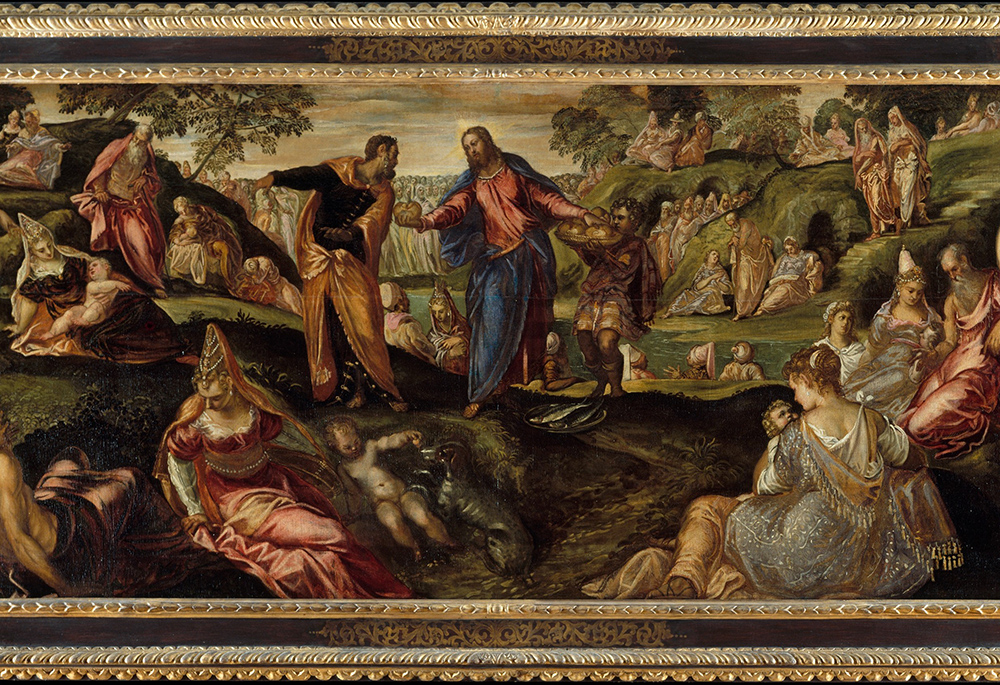
Selection of "The Miracle of the Loaves and Fishes," ca. 1545–50 Italian painting by Jacopo Tintoretto (Jacopo Robusti) (Metropolitan Museum of Art)

by Sr. Rose Uchem
Editor's note: Welcome to Theologians' Corner, where each week a different woman theologian from around the world offers a fresh reflection on the Sunday readings.

18th Sunday In Ordinary Time
August 2, 2026
The headlines of our world today are almost always introduced with the phrase, "Breaking News." Sadly, we have grown used to the fact that such news is rarely good. Yet the Gospel, by its very definition, is Good News. It is news, and it is good. In contrast, we sometimes encounter some Scripture passages that make us wonder: Where exactly is the good news here?
Such a question naturally arises in this Sunday's Gospel, which begins in the shadow of tragedy, the death of John the Baptist. This "breaking news" shakes Jesus deeply. He withdraws by boat to a lonely place; seeking solitude, perhaps to grieve, to pray, and to recollect himself in communion with the Godhead. However, the crowds will not allow him. They anticipate his destination and arrive ahead of him.
What happens next is the first sign of the Gospel as "good news": even in grief, Jesus does not turn inward in self-absorption. Instead, he "saw the vast crowd, his heart was moved with pity for them, and he cured their sick." Divine compassion interrupts human plans.
This movement of compassion connects beautifully with the first reading from the prophet Isaiah: "All you who are thirsty, come to the water! You who have no money, come, receive grain and eat." God's invitation is radically generous. It is not based on merit, wealth or status. It is pure gift. In the Gospel, Jesus embodies this very invitation. He does not send the crowd away to fend for themselves. Rather, he insists: "There is no need for them to go away; give them some food yourselves."
Thus God's generosity does not bypass human participation. It invites it. The miracle is not only that God provides, but that God chooses to provide through us. The disciples are drawn into the logic of divine generosity.
The second reading from Romans brings this even further: nothing "will be able to separate us from the love of God in Christ Jesus our Lord." Not even death, not even loss, not even scarcity. The feeding of the 5,000 becomes a living sign of this truth. In a place of emptiness, God's love proves superabundant. In a moment of grief, life is multiplied.
Advertisement
The story of the feeding itself is so familiar that we risk losing its sharpness. My own reflection on it is shaped by two memories.
The first goes back to my high school days. Our religion teacher offered an interpretation that unsettled many of us. He suggested that perhaps the miracle was not simply that one boy had five loaves and two fish, but that many in the crowd had hidden food. Moved by Jesus' action, they began to share what they had. In that moment, generosity spread, and there was enough for all; indeed, more than enough.
Whether one accepts this interpretation fully or not, it highlights an important spiritual truth: the miracle of transformation often begins in the human heart. When fear gives way to trust, and selfishness to generosity, something extraordinary happens.
The second memory is more recent and closer to home. In my country, it is becoming more common for wealthy individuals to take seriously their responsibility to their communities. During festive seasons like Christmas, they distribute food, host feasts, and sometimes give financial support. I recently heard of an event where, during such a celebration, another person spontaneously invited everyone to continue the feast at their own house. One act of generosity sparked another.
Listening to that story, I could not help recalling both the Gospel and my teacher's interpretation. It seemed like a living parable: generosity is contagious. It grows through inspiration, imitation, and even a kind of holy competition. And perhaps, just perhaps, this is one of the ways God continues to "multiply loaves" in our world today; through hearts that are moved to share.
Yet the Gospel challenges us not to remain observers of such generosity but to become participants. Jesus' command remains direct and personal: "Give them some food yourselves." This is not merely about physical hunger. It is also about every form of human need: emotional, spiritual, social.
The deeper good news, then, is this: God's abundance is already present, and nothing can separate us from God's love. However, this abundance becomes visible and tangible when we allow ourselves to be instruments of that love. The miracle continues wherever compassion overcomes indifference, wherever sharing replaces hoarding, wherever we refuse to send people away empty.
In a world filled with "breaking news" that often brings despair, the Christian is called to become a bearer of a different kind of news; the quiet, persistent, transformative Good News that in Christ, there is enough, we are enough, and love will always be enough.
"There is no need for them to go away; give them some food yourselves."