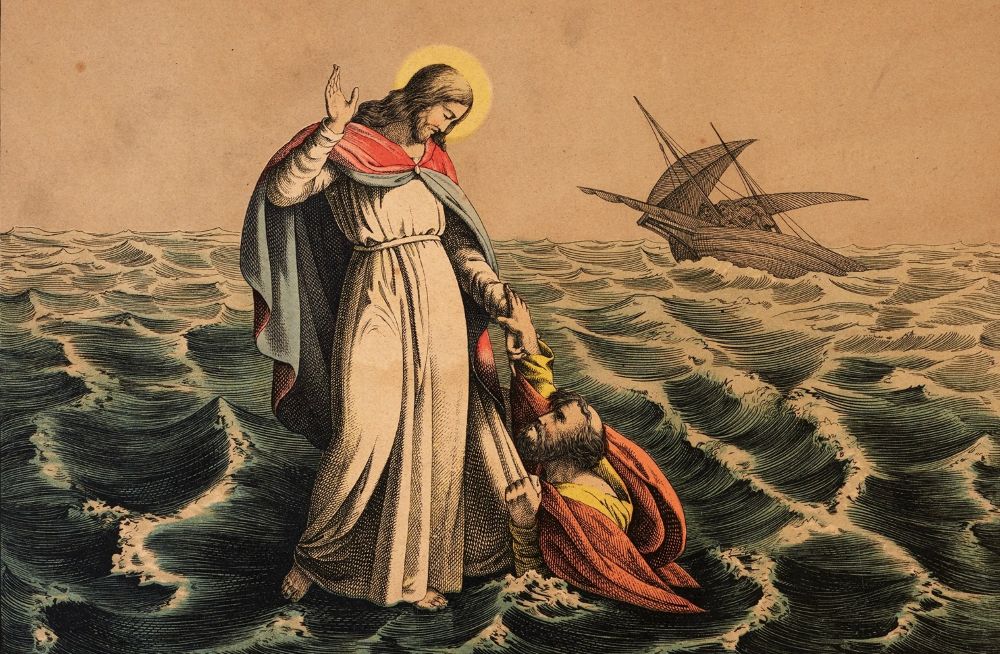
"Peter's walk on water" (1879) by Theodor Eckardt (Artvee)

by Sr. Nancy Mbagara
Editor's note: Welcome to Theologians' Corner, where each week a different woman theologian from around the world offers a fresh reflection on the Sunday readings.

19th Sunday in Ordinary Time
AUGUST 9, 2026
The first reading presents a God who reveals himself to Elijah on Mount Horeb, while the Gospel presents a manifestation of the power of God, dwelling in Christ, to his disciples, especially Peter, on the Sea of Galilee. Mount Horeb, the destination of the prophet Elijah's journey as he flees, is also the setting for the calling of Moses, who on this mountain had the vision of the burning bush and the revelation of the divine name (Exodus 3:1). Wishing to safeguard the covenant and restore the purity of faith, Elijah goes to the same place where the true God had revealed himself to Moses and where the covenant had been concluded (Exodus 19-24; 34:10-28).
In this way, Elijah's work is directly connected to that of Moses. Both figures are brought together in the manifestation of God on Mount Horeb. They will be united again at the Transfiguration of Jesus. Elijah enters the cave, the hollow in the rock where Moses had stood during the divine apparition (Exodus 33:22). The hurricane, the earthquake and the flashes of lightning, which were the signs of the divine apparition, are merely precursors of God's passage. The sign of his presence is instead the murmur of a calm wind, a symbol of the intimacy of God's conversation with the prophet, bringing comfort and consolation that prepare Elijah's soul for the terrible words he will hear.
In the second reading, Paul indicates the privileges of the chosen people. First, he expresses his love for the people who gave him his origin. Then he lists the privileges of that people. His great love for his people is based on Christ and the testimony of the Spirit. He expresses his sorrow for the infidelity of the people of Israel, to which he belongs.
Advertisement
In the Gospel, Matthew presents three crucial moments: Jesus in prayer, his apparition on the waters and Peter's profession of faith. He highlights the fact that Jesus prays. This happens in the solitude of the night and on the occasion of important events. Jesus' prayer manifests his relationship with God the father. He instilled the need for prayer not only with his words and teaching, but also by example. In this passage, Jesus withdraws to the mountains to pray alone as evening gives way to night.
His appearance on the waters at night has the character of a divine manifestation. The wind is contrary, and the disciples' boat is tossed by the waves. Jesus appears, walking on the water. The disciples were already in the fourth watch of the night, between 3 and 6 a.m., exhausted, having worked throughout the night. They did not recognize him, thought he was a ghost, and cried out in fear. Then Jesus said, "Take courage, it is I, do not be afraid!" He presents himself with the majesty of the formula "I am" and encourages them not to fear. Mathew depicts a presentation of Jesus amidst forces of nature, and the calm of his presence is admirable.
At this point, Peter enters the scene. His characteristic temperament is evident: impulsiveness, faith, love for Jesus, fear and doubt. Yet the significance of this passage is eminently theological. Peter twice addresses Jesus as Lord. First, he demonstrates the obedience of faith by walking toward him. Then, as fear and human frailty set in, he cries out for salvation. Jesus saves Peter from the abyss and rebukes him for his lack of faith. This encounter between the Lord walking on the water and Peter foreshadows the post-Resurrection appearances of the risen Jesus.
Then comes the profession of faith in Jesus' identity as the Son of God. Jesus saves those in the boat, which represents the church, and they proclaim their faith in him. The passage is a culmination of Christological and ecclesial revelation. The Lord who manifests himself and his relationship with his disciples become the paradigm for the relationship between Jesus and the church throughout time.
This episode demonstrates the symbolism of the church's journey through history. The storm is connected with the evil spirits that were believed to dwell in the sea. Therefore, when the disciples saw someone walking on the sea amid a storm, their first thought was, "It is a ghost." The boat represents the church, and we are its members. Jesus came to save them from the storm, and once he was aboard the boat, the sea became calm. Our focus must be on Christ; otherwise, we will be tossed about by the waves. In faith, we must trust in the presence and power of Christ, who constantly calls us not to be afraid, for he is always with us.
This journey involves setbacks. Our life as Christians in the church is real, and it is in no way immune from the risks and hardships that every individual and every human community experience. Anyone who thinks that Christian life should be free from toil, suffering and setbacks makes Christ into a spirit (cf. Matthew 14:26), an illusion of one's own imagination, an idealized projection. Such a journey is not an act of obedience to the Gospel but a delusion. The presence of the Lord can be grasped through faith; it is never taken for granted. It must always be discerned, discovered and sought.
We are all present in this nocturnal, turbulent journey where faith easily mixes with doubt. Like the disciples on the boat, we experience the tension between obedience to Jesus' command and our inability to carry it out. Doubts and fears arise in the in-between space.
Therefore, we need to ask ourselves: How often when encountering difficulties do we immediately question the Lord's faithfulness and trustworthiness? The Gospel, on the one hand, clearly shows that the impossible feat of walking on water becomes possible through faith when our gaze is fixed on Jesus, when the goal of our journey is "to go toward him" (cf. Matthew 14:28). On the other hand, it shows how this becomes impossible when the gaze of faith is replaced by the gaze of the flesh: "When he saw the wind, he was afraid" (Matthew 14:30). Then fear takes over, and like Peter we sink into the water.
May our gaze remain fixed on Jesus and not on what is happening around us. And when we lose sight of him, may we remember that he is the Lord and that he is there to hold our hand. May we trust and entrust ourselves to him, especially when difficulties and setbacks beset our lives. And with the psalmist may we acclaim: "Lord, let us see your kindness, and grant us your salvation."