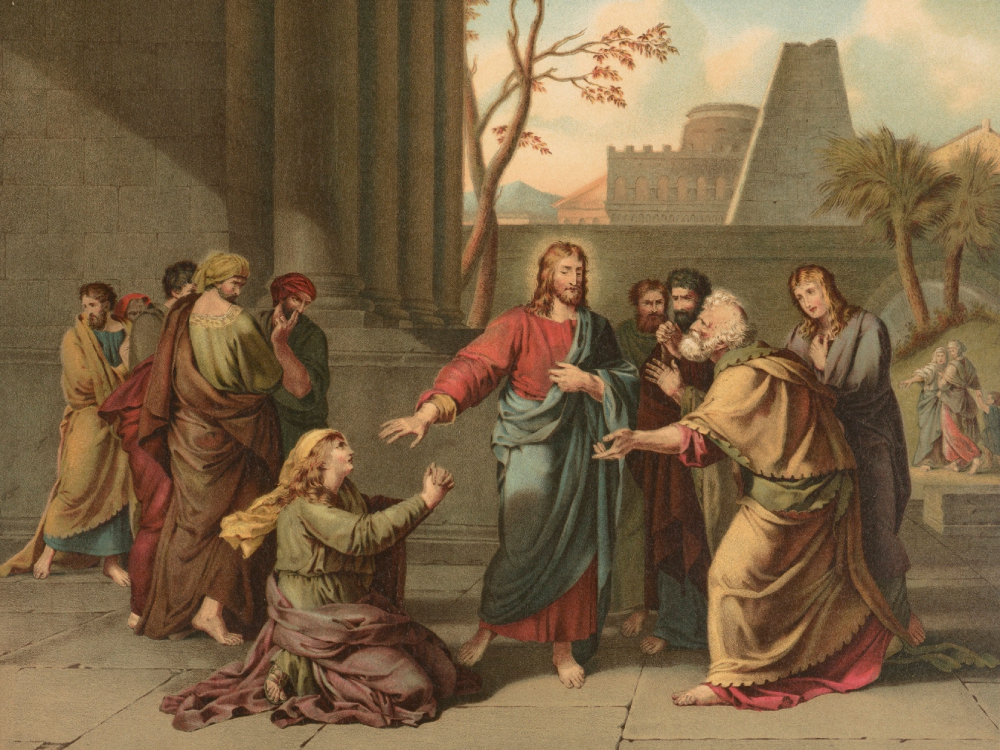
"The Canaanite woman" (1899) by Jan Ladislaw Sýkora. (Artvee/Public domain)

by Sr. Rose Uchem

Welcome to Theologians' Corner, where each week a different woman theologian from around the world offers a fresh reflection on the Sunday readings.
20th Sunday in Ordinary Time
AUGUST 16, 2026
The readings for this Sunday draw us into a powerful and expansive vision of God's salvific plan that stretches beyond the boundaries of culture, and religious identity. In all three readings, the theme that runs through them is: God's mercy is for all. The responsorial psalm captures this universal hope: "Let the peoples praise you, O God; let all the peoples praise you. Let the nations be glad and rejoice."
In the Gospel narrative, Jesus' encounter with the Canaanite woman presents us with a moment of tension that resists superficial interpretation. A woman, a foreigner, a marginalized person, approaches Jesus with a desperate plea: "Have pity on me, Lord, Son of David." Her cry is both a confession of faith and an expression of profound need.
Jesus' initial response of silence and an apparent refusal leaves us in shock: "I was sent only to the lost sheep of the house of Israel." Even more troubling are the words that follow: "It is not right to take the children's bread and throw it to the dogs." In almost any cultural context, such language is unacceptable. It evokes exclusion, and even insult. So, how are we to understand this?
A personal experience once helped me grapple with this question. While studying at Fordham University, I responded spontaneously to a professor's story with the expression, "You don't mean it!" In my own culture, it would have meant engagement. Instead, it was literally received as an accusation. The misunderstanding left me speechless. It dawned on me that words do not always carry the same meaning across cultures.
Later, I had an opportunity to revisit that episode during a faith-sharing session where that same professor was present. Incidentally, this very gospel passage was the focus. My sharing echoed that experience; I had come to realize that both scripture and human interaction are embedded within cultural frameworks that are not always immediately accessible to us. There are often nuances we may never correctly grasp. The most we can do is admit that we do not really understand and that it is okay. This does not diminish the authority of Scripture. Rather, it is an invitation to enter a deeper attentiveness; to sit with the word and allow it to reveal its meaning to us in our context.
Advertisement
In this connection, I remember a word from the Irish Missionary Union's Faith & Mission program co-director, who said that the Canaanite woman, through her persistence, "called forth" something in Jesus. This perspective invites us to take seriously the humanity of Jesus. As Luke said, Jesus "grew in wisdom and in grace," indicating a real human development within the mystery of the Incarnation.
From this perspective, Jesus' initial focus on Israel reflects a genuine stage in the unfolding of his consciousness about the scope and focus of his mission. His encounter with the Canaanite woman then becomes a pivotal moment in which the mission expands. Her response is remarkable: "Even the house dogs eat the scraps that fall from their owner's table." She neither retreats in offense nor stops her plea. Instead, she transforms the very terms of exclusion into an argument for inclusion. Jesus' final response affirms the breakthrough: "Woman, you have great faith! Let it be done for you as you wish." Her daughter is healed, and with that healing, the horizon of Jesus' mission is widened.
What unfolds here is deeply in line with the theology of Paul, the "Apostle to the Gentiles." Paul understood himself called to bring the Gospel to the Gentiles. He believed that mercy, not exclusion, defines the divine initiative.
The Gospel about the Canaanite woman, therefore, is not simply about a miracle. It is rather about the transformation of boundaries, understanding and mission. For us today, the implications are deep and many. We are reminded that faith is not a static possession but a dynamic journey. We are not given all the answers we need in advance. Rather, we are invited, as we go along, to listen, to discern, to grow and to remain open to new possibilities, especially when they come from unexpected quarters.
The call from the prophet Isaiah remains urgent: to act justly, to uphold what is right and to recognize that God's house is indeed a house of prayer for all peoples. In a world still marked by cultural, religious, and social divisions, this message challenges us directly to reconsider: Who are the "outsiders" in our own contexts? Whose voices are we inclined to dismiss? Where might God be inviting us to broaden our vision today?
The Canaanite woman stands as a witness to a faith that refuses to be excluded. Her story invites us to trust that God's mercy transcends every boundary we construct. Ultimately, it is not belonging but believing, not status but faith, that opens the way to grace.