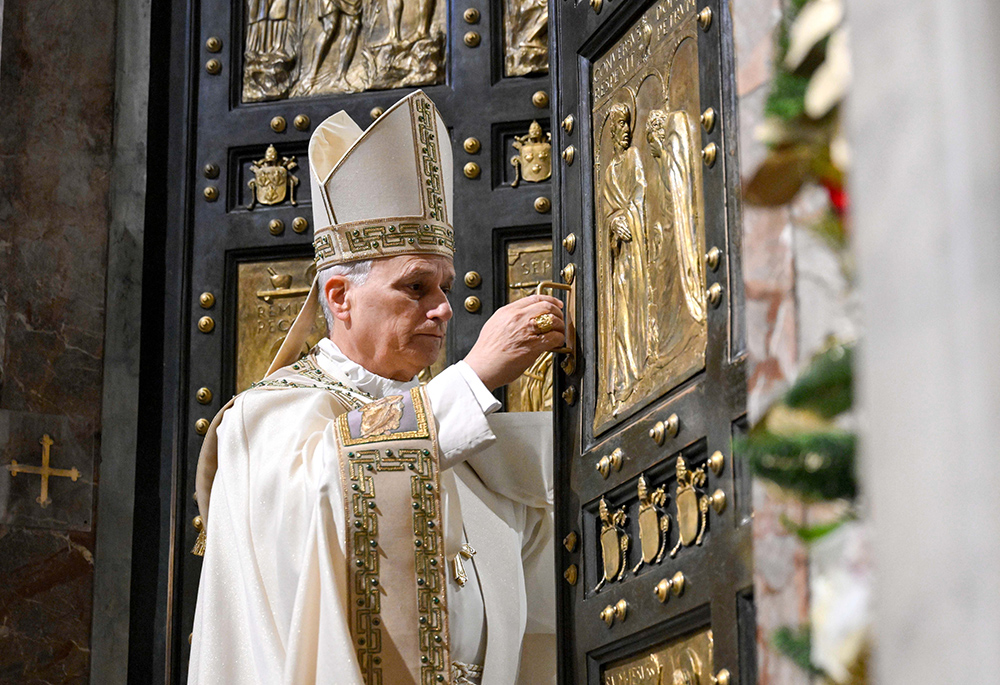
Pope Leo XIV closes the Holy Door at St. Peter's Basilica Jan. 6, 2026, at the Vatican, marking the official end of the Jubilee Year. (CNS/Vatican Media)

by Sr. Kathryn Press
One thing you need to know about me is I am excited for the year 2033. And no, it's not because I will turn 50 that year. I'm looking forward to the great Jubilee. Perhaps you're thinking that I'm confused, referencing the Jubilee of Hope that just finished. But we have a great Jubilee to look forward to in 2033. It's the 2,000th anniversary of the death and resurrection of Jesus.

The Vatican released this logo to mark the Great Jubilee of the Year 2000. The words in Latin read, "Jubilee Year 2000: Christ Yesterday, Today and Forever." (CNS/Vatican)
A website for this event reads: "The year 2033 will be of exceptional significance for the Christian community and the entire world. ... It will be a unique Jubilee, characterized by profound spiritual celebrations and a renewed commitment to the values of peace, reconciliation, and solidarity."
Maybe you remember the Great Jubilee of the new millennium in 2000. This was the first Jubilee that I myself ever experienced. I remember seeing the Jubilee logo on everything in church. For years, this was the only jubilee that I had reference to. After all, I had the rosary with the logo on it as proof! When I entered the convent in 2009, sisters who visited Rome during that Jubilee year spoke about their experience with deep gratitude — as if it had just happened yesterday.
Pope Francis announced an extraordinary Jubilee of Mercy in 2015 that lasted from December 2015 into November 2016. It was extraordinary because it was out of the normal sequence of jubilees happening every 25 years. We celebrated this Jubilee with holy doors in every diocese. In the Archdiocese of St. Louis, where I lived at the time, we had multiple holy doors including our Cathedral of St. Louis the King, the National Shrine of Our Lady of the Miraculous Medal, and doors in convents of contemplative religious communities. Unlike the Jubilee of 2000, this one hit closer to home. Still, I wasn't thinking of the next expected Jubilee in 2025.
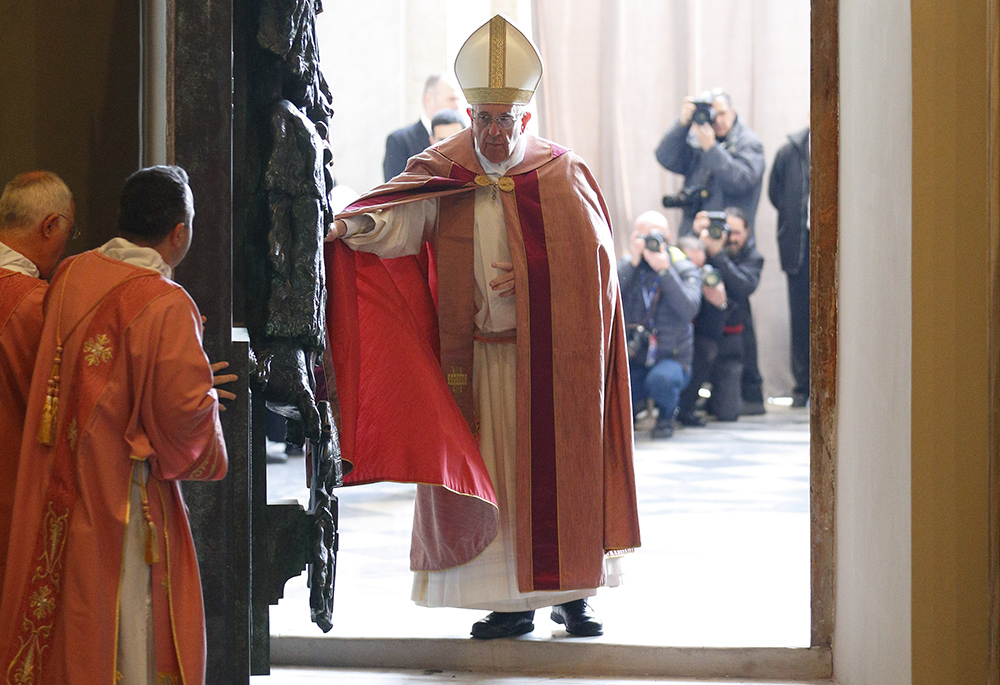
Pope Francis opens the Holy Door of the Basilica of St. John Lateran in Rome Dec. 13, 2015. Holy doors around the world were opened at city cathedrals, major churches and sanctuaries Dec. 13 as part of the Jubilee of Mercy. (CNS /Paul Haring)
Fast forward to 2023. I was gathered at a church in London with Christians from all over the world. We were handed out a postcard which read: "The Next Decade." It was an invitation to pray in a concerted, intentional way for the next 10 years leading up to the great Jubilee of 2033. I was so impressed that my Protestant brothers and sisters were inviting me, a Catholic sister, to think about a jubilee year.
While three years have passed, I still pray with that postcard. And I also wonder if there's still more I can do to ready myself for 2033. Perhaps a few suggestions for how we can prepare for our next extraordinary Jubilee.

The author is pictured with "The Next Decade" postcard. (Courtesy of Kathryn Press)
The first suggestion is entirely practical, and it comes from the global, ecumenical movement Global 2033. Their invitation is to pray every day at 20:33. They continue by suggesting we set an alarm, and when it goes off, simply pray: "Father, your Kingdom come, your will be done on earth as it is in heaven. Come Holy Spirit. Amen." What a practical ask! And aside from getting used to a 24-hour clock, you can also boost your prayer life.
Another practical suggestion: talk about the 2033 Jubilee with others. Let's increase awareness. Ask your parish priest what you can do as a parish to prepare. Then, share your faith. Do we have expectant hope for people to come to faith because of this Jubilee? When we talk about our faith are we sharing Jesus? Or do we whine and complain about the parts of the church we don't like?
The third suggestion: pray. Intercede. Some researchers estimate that over 40% of the world's population has had little to no exposure to Jesus or the Gospel. Jesus' invitation is to preach the Good News. What if the people who will lead the church in 2033 aren't even Christians today? This question came to me after listening to Shaila Visser on Alpha's Circles & Spaces podcast. She asked two provocative questions for those of us who work in the areas of youth and young adult ministry. First, what if the future leaders of the church aren't in the church today? Second, what if the future leaders of the church aren't Christians today?
Do I believe that the harvest is plentiful? (See Matthew 9:37.) The next seven years offer a unique opportunity to live the great commission (Matthew 28:18-20) so that by the great Jubilee of 2033 there will be even more people who have come to know and love and have their lives transformed by the death and resurrection of Jesus.
Advertisement
Lately, I've been praying with the Gospel of John:
[Jesus said:] I'm praying not only for them
But also for those who will believe in me
Because of them and their witness about me.
The goal is for all of them to become one heart and mind —
Just as you, Father, are in me and I in you,
So they might be one heart and mind with us.
Then the world might believe that you, in fact, sent me.
The same glory you gave me, I gave them,
So they'll be as unified and together as we are —
I in them and you in me.
Then they'll be mature in this oneness,
And give the godless world evidence
That you've sent me and loved them
In the same way you've loved me.—John 17:20-23
If the Jubilee of Hope (in 2025) taught me anything, it's that I can trust in Jesus. And that I need to intentionally orient myself to the hope he gives me. I want to give witness to Jesus. I want to evangelize — it's why I'm an Apostle of the Sacred Heart of Jesus. And I know that we need to pray for unity and that we can "mature in this oneness." I hope you'll join me.
Lord, I pray for those who will believe in you. May we give the world evidence of Jesus' mission of love. Amen.