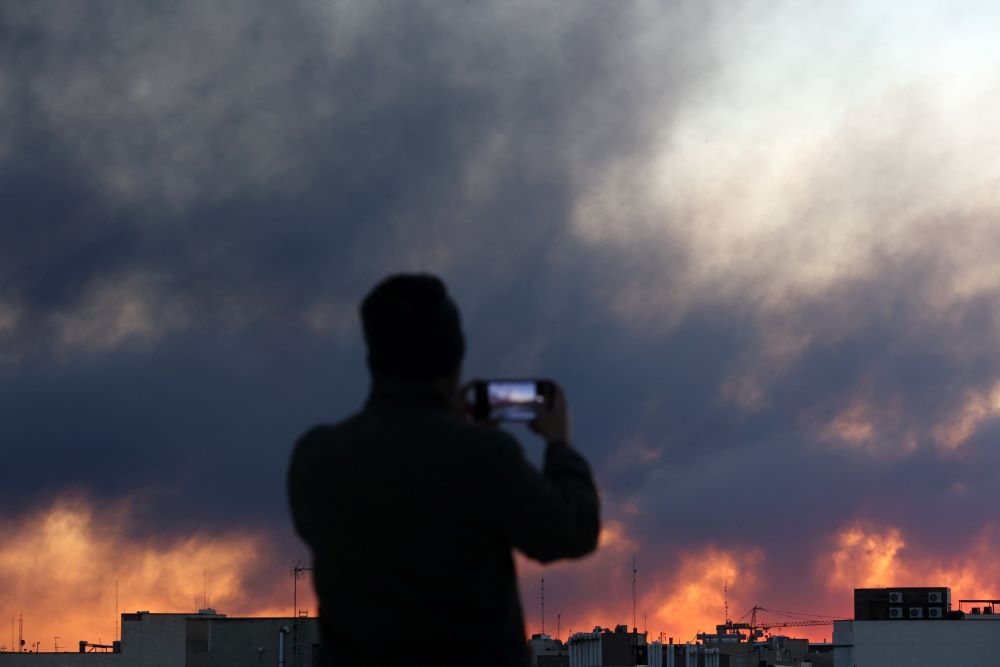
A person uses a phone as smoke rises following an explosion in Tehran, Iran, March 3. Israel and the U.S. launched strikes on Iran Feb. 28. (OSV News/West Asia News Agency via Reuters/Majid Asgaripour)


Sisters and lay representatives of sisters' congregations, as well as leaders of Catholic peace organizations, are condemning in the strongest possible terms the U.S. and Israeli war against Iran, calling it illegal, immoral and potentially destabilizing.
"I condemn what the United States has done," Sr. Barbara Bozak, who represents the Congregations of St. Joseph at the United Nations, said to Global Sisters Report. "It is an act of aggression and goes against the United Nations Charter. We had no right to do it."
The conflict began Feb. 28 when the U.S. and Israel launched airstrikes across Iran, killing its supreme leader and dozens of other high-ranking officials. Attacks by both the U.S. and Israel have continued, killing hundreds, and Iran has responded by attacking Israel, its neighbors, and U.S. assets across the Middle East.
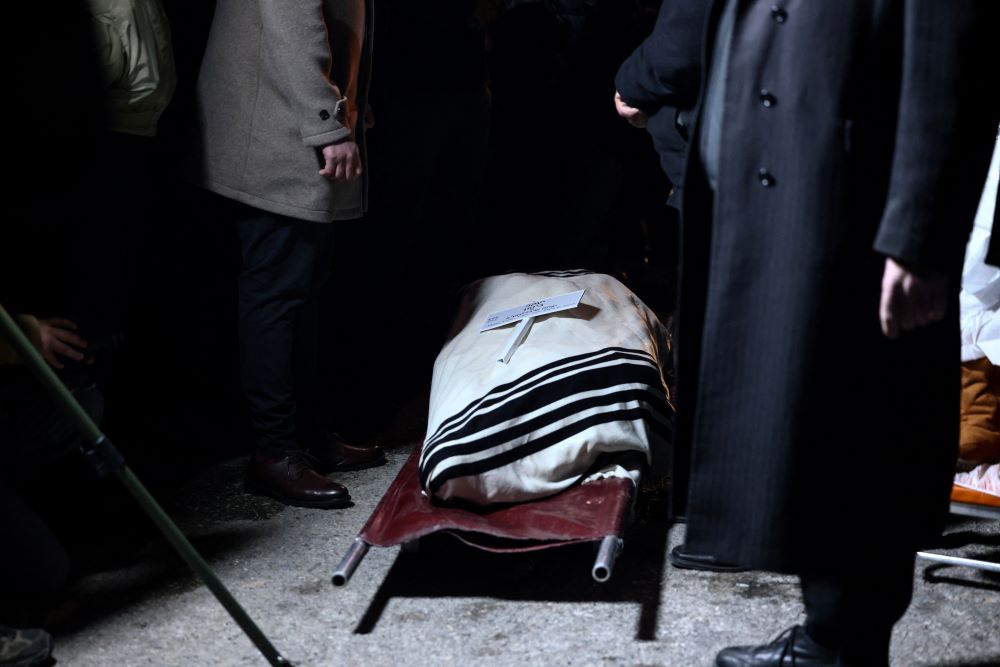
A coffin holding the body of Yaakov Biton is seen during his funeral and the funeral of his two sisters, Sara and Avigail, who were killed in an Iranian missile strike March 1, amid the U.S.-Israel war with Iran, in a cemetery in Jerusalem, March 2. (OSV News/Reuters/Jamal Awad)
Beth Blissman, the Loretto Community's U.N. representative, was equally critical, saying it appeared that the preemptive moves against Iran — done without the approval of the U.S. Congress and without much apparent public support — could likely be in violation of international law. "This doesn't uphold our country's values," she said.
"This is not going to bring security to the region and it's not going to bring peace," Blissman said.
"To bomb a nation is an abomination," said Mary Yelenick, main representative of Pax Christi International at the United Nations. U.S and Israeli strikes are killing innocent Iranian civilians — "the poorest of the poor" — and can in no way be morally justified, she told GSR.
As one of the world's two largest nuclear powers and with a long history of military aggression — including the January incursion into Venezuela — it is the United States, and not Iran, that poses the greatest threat to world peace, Yelenick argued.
"It's evil," she said. "It's all very, very evil," adding that strategically, the U.S. and Israeli-led war "makes no sense."
"This is going to come back and haunt the United States," she said. "It's a disaster on all fronts,"
'We need to pray that people's hearts may be changed, especially in the government. And then we need to act in any way we can.'
—Sr. Donna Dodge
Sr. Jean Anne Zappa, president of the Ursuline Sisters of Louisville, said the response to the attacks should not depend on being Catholic, Christian or of no faith at all: "It's just immoral and it's against humanity."
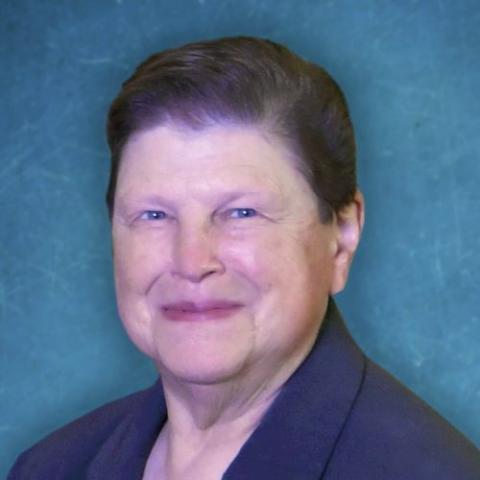
Sr. Jean Anne Zappa is president of the Ursuline Sisters of Louisville. (Courtesy of the Ursuline Sisters of Louisville)
She said that the attacks have removed attention from Russia's war against Ukraine, from the immigration crackdown on America's streets, poverty, and the millions of people about to lose health care insurance.
"It takes all these other issues off the front page," Zappa said. "We have to be attentive to the whole of it, not just this one piece of it."
She said it can be difficult to balance righteous anger with the need to approach the issue with peace, faith and love.
"It's a justice issue, a moral issue, but I can't fight violence with violence — that doesn't help," Zappa said. "We need to come at it with peace and justice, not anger and fury."
Sr. Florence Deacon, a former Leadership Conference of Women Religious president who worked at the U.N. as a member of the Franciscans International NGO, said people should approach the issue the same way leaders should be approaching the issue: with respect and a call to our higher principles.
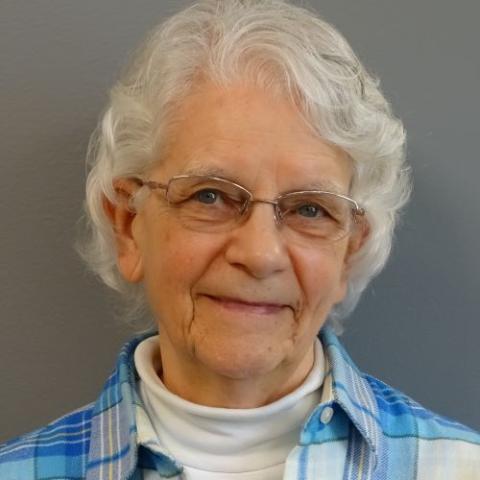
St. Francis of Assisi Sr. Florence Deacon is coordinator of her congregation's Justice, Peace and Integrity of Creation efforts. (Courtesy of the Sisters of St. Francis of Assisi)
"In difficult situations, you always want to make sure the other person feels respected and that they can walk out with their head held high. Instead, we have a bully that is not looking for a real solution," Deacon said, referring to President Donald Trump.
That applies whether you are talking to a neighbor who disagrees with you or you are a diplomat trying to negotiate, said Deacon, a Sister of St. Francis of Assisi and the coordinator of her congregation's Justice, Peace and Integrity of Creation efforts. "We've got to show both sides."
Sr. Susan Francois, assistant congregation leader and treasurer of the Sisters of St. Joseph of Peace, said the terrible cost of the war was made real to her congregation when they learned one of their members, who works in a hospitality house the congregation operates in England, had been speaking to a former resident from Iran whose friend was killed in an airstrike on Tehran.
"It's a human connection and we need to hold fast to that," Francois said. "Once we lose that connection, we lose our humanity."
Keeping that connection is key, she said, because standing against war and violence and in solidarity with the victims encourages bystanders to do the same, which leads to change.
Francois noted that the attacks are taking place during both Ramadan and Lent, holy seasons for two of the world's largest religions.
"Almost half the world's population is fasting and praying for peace, and we do it at this time? It's a scandal," she said. "But we can't lose hope. And if we don't participate in the critical moments of our time, why are we even Christians?"
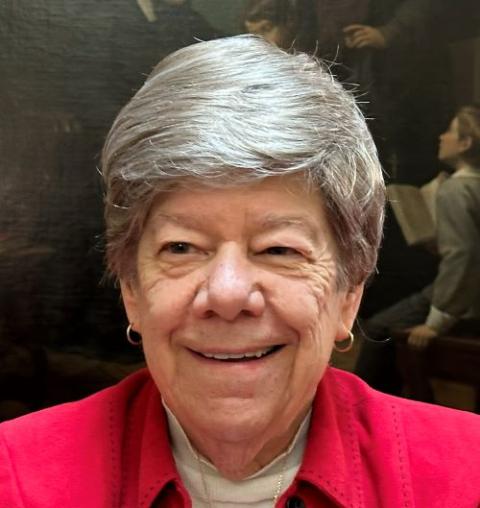
Sr. Donna Dodge is president of the Sisters of Charity of New York (Courtesy of the Sisters of Charity of New York)
Many sisters said that in criticizing the U.S. and Israeli action, they were in no way condoning the Iranian government's human rights record and recent crackdowns on dissent.
At the same time, they all spoke of mourning the loss of innocent lives in Iran and elsewhere in the Middle East, with several speaking of the deaths of some 175 people from airstrikes at a girl's elementary school in southern Iran.
They are also mourning the U.S. military personnel who had been killed.
"We pray for their grieving families and for the safety of all in harm's way," the Adrian Dominicans said in a March 3 statement.
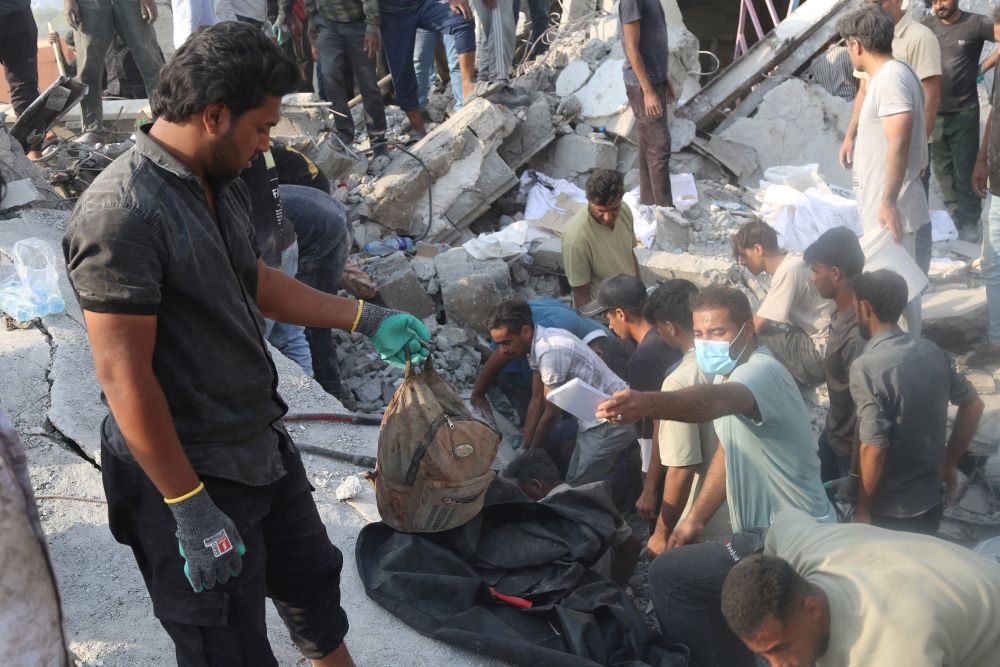
Rescue forces work following an Israel strike on a school in Minab, Iran, Feb. 28. (OSV News/WANA via Reuters/Mehr News/Abbas Zakeri)
Yelenick criticized the justification for the attack — the need to replace an unpopular Iranian regime — adding that if a foreign country invaded the United States to topple Trump, "I'd be very upset," she said. Changes of government must come from a country's citizenry, not an outside power, she said.
Sr. Donna Dodge, president of the Sisters of Charity of New York, said people cannot forget to call on the higher power.
"We need to pray that people's hearts may be changed, especially in the government," Dodge said. "And then we need to act in any way we can. …Our response should not be silence."
She said people need to be reminded of the values they say they hold dear: If we believe life should be valued from conception to natural death, then war cannot be justified.
"This is about a right to life," Dodge said. "I would like to see all the people who say they value life, especially Christian people who say they value life, value life in this situation, too."
Advertisement