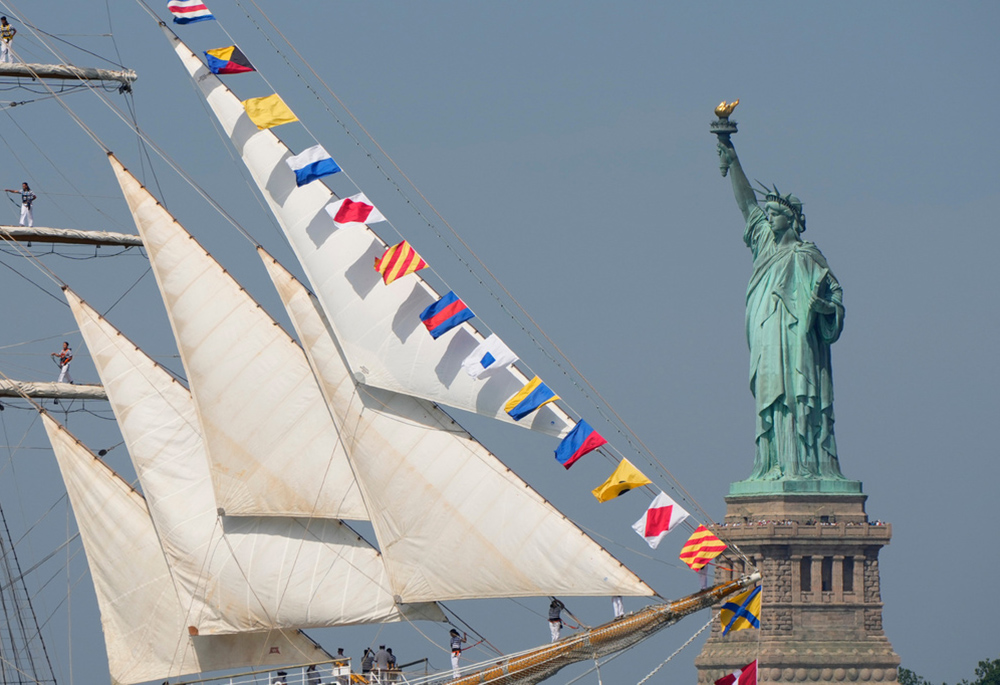
The Statue of Liberty is seen as Argentina's Ara Libertad sails past in the New York harbor during the International Parade of Sail, part of Sail250, a gathering of tall ships and military ships, Saturday, July 4, 2026, in New York. (AP photo/Yuki Iwamura)

I watched some of the coverage of the tall ships passing through the New York Harbor and one picture stays vividly with me. It was taken from high up behind the Statue of Liberty looking down at one of the passing ships.
I found myself wondering what the original captain, crew and passengers would think if they were on that ship today, passing the Statue of Liberty and looking out at the New York Harbor of the present. What would they think of Lady Liberty with her inscription welcoming those who came within her shore yearning to breathe free and lifting her lamp for them beside the golden door?
Could those early navigators of the 17th century arriving on the shores of this land envision that, within the next 250 years, people from every country in the world would arrive here to become part of an experiment to create a pluralistic democracy? Could they have envisioned that crossing the oceans by ships would be replaced by flying ships crisscrossing the skies? Could they have thought it was possible to talk with each other when you weren't sharing the same space? Could they ever have foreseen the internet, the World Wide Web and artificial intelligence?
That got me wondering: What will it be like 250 years from now? What would those of us who celebrated in 2026 be seeing if we came back to celebrate in 2276? Would we have welcomed other sentient beings from far away planets? Would AI robots become as commonplace as cellphones? Would the "Beam me up, Scotty" of "Star Trek" fame be a common mode of transportation? Would nation-states be on other planets? Would there be a New York Harbor if climate change caused the ocean levels to rise? Would Earth still be habitable if nuclear proliferation and climate change are not curtailed?
Given the significant changes that the Industrial Revolution set into motion from the time the first ships sailed into New York Harbor until today, it is hard for me to stretch my imagination 250 years into the future, especially since the rate of change has increased exponentially.
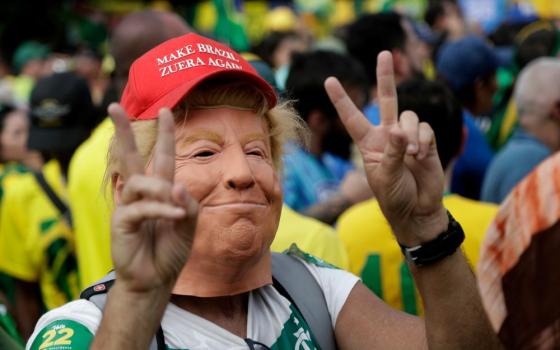
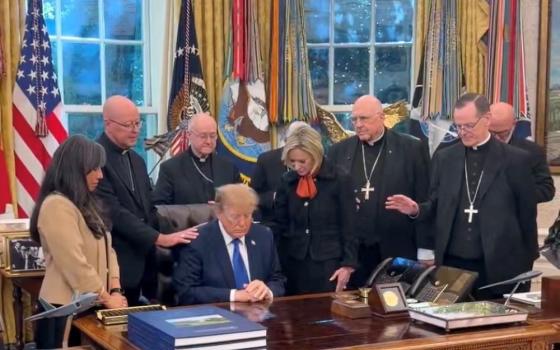
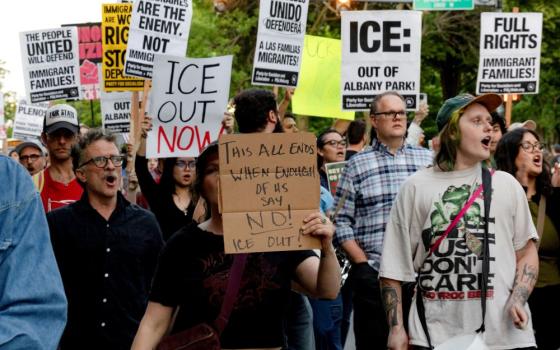
So, I found myself reflecting on how the rapidity of change in our material conditions far outpace the evolution of our human consciousness. Even though we are poised to go to Mars and potentially discover other sentient beings, our nation is divided over whom we accept as "Americans." The fear of the "other" triggers many into an earlier stage of development as a species, a time when humans identified only with one's tribe. A pluralistic democracy threatens the identity of those who believe their gender, religion or race is the dominant one and should remain that way.
Advertisement
Accompanying these attitudes is a rise in "might makes right" rather than diplomacy and civil discourse to engage differences. The growing understanding that everything is connected and our survival depends on working together as a planetary community is sadly being replaced by focus on which country has what resources and what another country can get to remain dominant.
I believe we are experiencing another chaos point in our evolutionary process, in which all the structures and systems of our society that we have known are breaking down. I believe the Industrial Revolution was one of those moments, as is what we are experiencing today. The pace of change makes some people want to go back to the way things were, but systems theory says there are only two options: breakthrough or breakdown.
I believe many of us are hoping to be part of the breakthrough. Even though we might not be able to envision what things will look like 250 years from now, perhaps we can reflect on the values we want for the future to keep evolving.
I invite us to sit in contemplative silence for a period of time and then to allow the values that are important to our future to rise up. Be careful not to focus too much on their precise expression, as that will inevitably change, but on the values themselves. For me, one is that we embrace each other in our differences, acknowledging our dignity and basic needs for survival.
Then imagine if you wish, how that might happen as technology develops through the next decades, what public policies might be envisioned to help make that happen and what kind of politicians we desire to serve us into the future.
Such imagining brings me hope. Imagination is the first step toward making things happen. Lady Liberty emerged from a future that was only being imagined by some who traveled here in the 1600s. Let our imagining today help create a future that she can still be proud of.