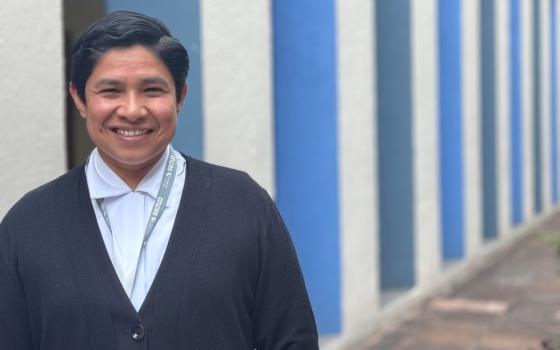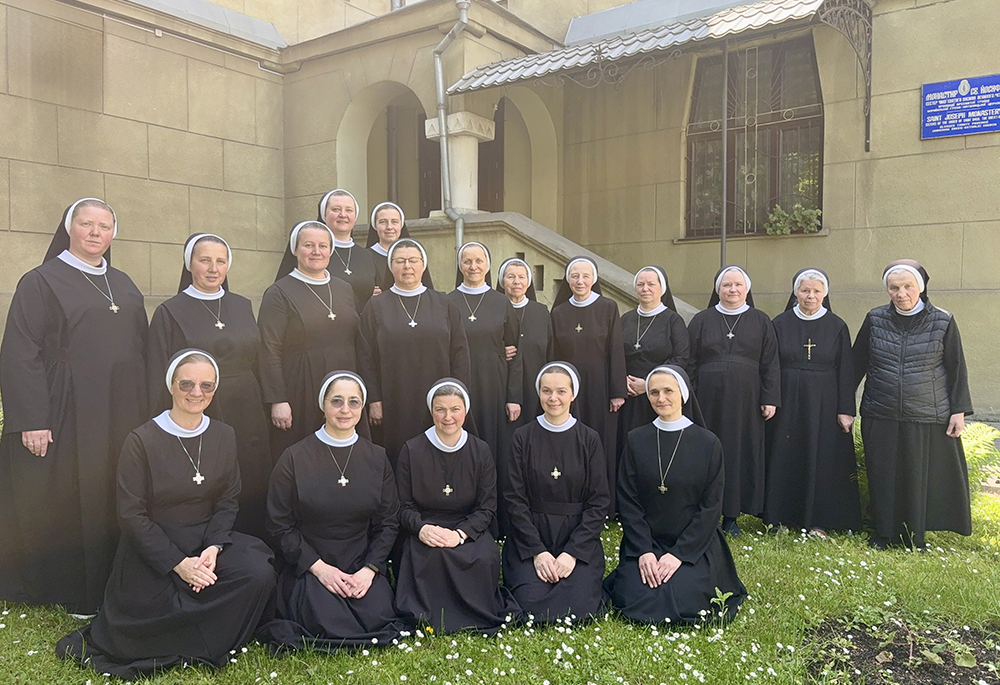
The community of the Basilian sisters gather outside St. Joseph Monastery in Ivano-Frankivsk, Ukraine, after provincial visitation, May 2026. (Courtesy of Sr. Yeremiya Steblyna)
by Sr. Yeremiya Steblyna
I sat down to write this article and realized that I could not do it just then, because somewhere in the kitchen one of my sisters had to wash mountains of dishes alone that day. Before writing about being a superior, my first calling is to be one in real life. I quickly run down to the kitchen and get to work. Only later will I be able to return and calmly continue writing about what it means to be the superior of a large community in a country where drones fly every day, adults and children die, and our brothers, friends, or fathers sit in trenches so that the enemy will not seize our land.
At the age of 36, God called me to serve as the superior of a large community of 22 sisters. When I arrived here, I was the youngest sister.
Our monastery is located in the very center of the city of Ivano-Frankivsk in southwestern Ukraine. Because the monastery is located in the city center, many people come to ask for prayers. There are also those who ask for daily bread for themselves and their children.
St. Basil the Great, whose spiritual heritage Basilian Sisters live by each day, once conceived of the Basiliad. It was a kind of small town, a center of mercy. St. Basil the Great established such a complex in Caesarea in Cappadocia around the year 370. It included shelter for the poor, the sick, and travelers, as well as a hospital and school; at the very center of the Basiliad stood a church, a place of spiritual healing and encounter with God. It was not merely a charitable institution but an embodiment of Christian love: St. Basil saw Christ himself in those in need.
Our monastery in Ivano-Frankivsk closely resembles the Cappadocian Basiliad. On the one hand, the sisters serve and provide leadership at St. Basil the Great Catholic Primary School; on the other, they serve at St. Macrina's Day Center, a place for children who find themselves in difficult life circumstances, and they feed the poor who knock daily at the monastery gate. All these forms of service are united by our monastery church, where dozens of people come each day not only to ask the sisters for prayer but also to pray with us.
My calling in this beautiful and holy place is to bring everyone together, helping this small group of very different women each day to remain a community: a place where Christ is not a beautiful idea, but a living presence among us.
To be a superior is to take into one's hands something very fragile: a person who has given her life to God. Each sister enters the community with the desire to love God and serve him. My ministry touches that profound desire directly. At my side, it can grow, mature, and become stronger, or it can slowly fade. Being a superior also means accepting one's own imperfection, fragility and weakness, which most often reveal themselves amid unexpected events, differing views, and mutual disagreements.
Being a superior does not begin with the right to decide, but with the duty to listen to God. A Vatican document about the exercise of authority in religious communities says authority in consecrated life is above all spiritual authority. A superior must support fidelity to one's vocation, remind us for whom we are here, and help the sisters respond to the working of the Holy Spirit. Therefore, my personal examination of conscience is formed by the question: "Are my decisions born of prayer, or chiefly of haste, fear, fatigue or the desire to control everything?"
Advertisement
One of my most important responsibilities is to make sure that prayer does not fade away in the community. Amid even the noblest ministries, we must not lose what is essential: time for worship and praise of God. Together, we have to reflect and discuss what time is best for communal prayer, so that all the sisters can be present.
As a superior, I am called to listen to every sister. Listening, dialogue and shared responsibility do not remove my duty to discern. For this reason, I cannot shift the burden of the final decision onto the community.
I am also aware that a community is exhausted not only by too much work but perhaps, above all, by a loss of meaning. This is why returning to our deep sources — the Gospel, our founders, our charism, and our history — is a guarantee that we will fulfill our concrete mission today. Some 30 years have already passed since the Ukrainian Greek Catholic Church emerged from the underground, yet we still ask ourselves what in our life is truly Basilian and evangelical, and what we do only because "that is how it has always been."
For example, I asked the sisters to abandon the tradition of greeting only the superior on Mother's Day. It is not my feast day, but that of each one of us — women called to be spiritual mothers. After all, even in times of war, we as a community must learn to celebrate. There is a time to mourn life, and there is a time to celebrate it. And if God grants each of us another year of life or a significant event, this should bring every sister together around a shared table of celebration and gratitude.
Today, when Russian drones fly over our city day and night, it is difficult for me to tell the sisters that everything will be all right. When they wake several times during the night to air-raid alarms and go down to the shelter, how can I demand their presence at prayer? And what if eight children must also be brought to the shelter? Behind every such nighttime attack lie our fatigue, irritation, and feeling of helplessness.
In the midst of all this chaos, I understand that I am not "preserving" an ideal community. Rather, we are a community seeking Christ in this particular historical place and time that we are living in together. That is why it is so important for me to carry within myself the hope that the Lord is at work and present in the darkness and pain of this cruel war.
Finally, being a superior means, for me, remembering the sisters' birthdays and name days, searching for needed medicine even in another city or region, and having the strangest photographs in my phone gallery: an X-ray of a hand, a shoe size, newly born kittens, and the greens growing in our garden.
During these years spent here in the community, despite the difficulties, challenges, and war, I feel above all an immense gratitude. I realize how God loves me, but also refines me through every situation and every person whom I serve here.
This gratitude flows into my constant remembrance of the deceased sisters who once walked these corridors and prayed within these walls. It is gratitude to them for their perseverance and fidelity on the path of vocation, and for the prayer they now offer before the face of the Lord for each one of us.