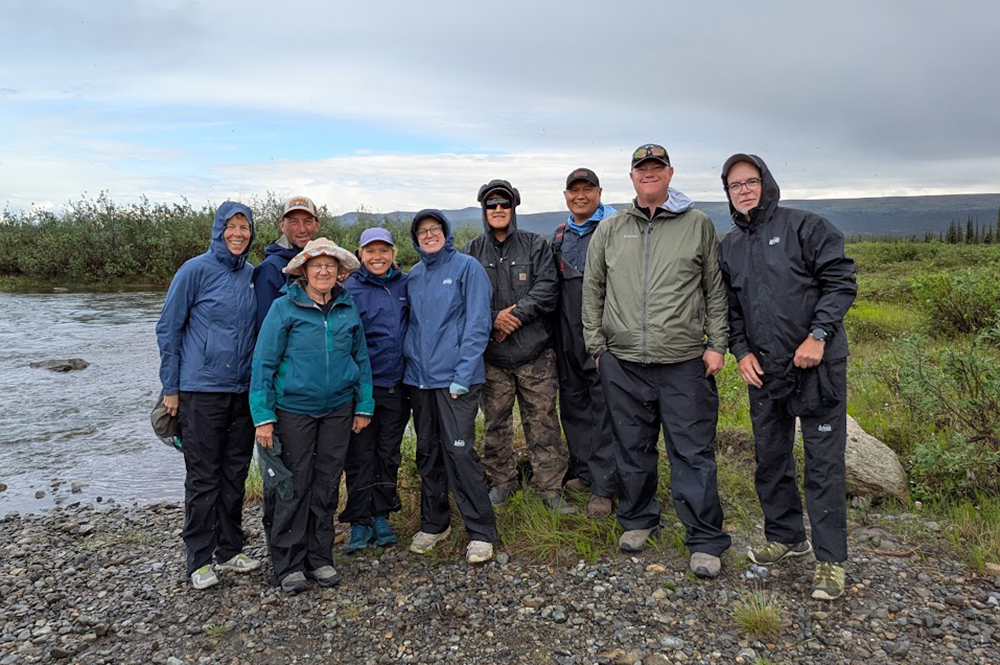
Rochester Franciscan Sr. Joan Brown, front left, poses in Arctic Village, Alaska, with other faith leaders and leaders of the Indigenous Gwich'in people. To the left is a seasonal river, sacred to the tribe, which is fed by glacial runoff. (Courtesy of Sr. Joan Brown)

by Joan Brown
It is fall in New Mexico. Overhead hundreds of ancient lesser sandhill cranes call through an expansive blue sky. They have returned from summer nesting on the coastal plain of the Arctic National Wildlife Refuge (ANWR) in Alaska's Arctic Circle. Six months earlier, during the summer solstice, I was with them there camping at Sunset Pass.
I traveled there in June with four other faith leaders and two guides, sponsored by the American Lands Project, to learn about the refuge and speak with the Indigenous Gwich'in people who call the coastal plain the "sacred place where life begins." I thought this was just part of my work to address climate change. I thought I would educate others about and advocate around the ongoing threat of fossil fuel extraction that threatens life in the coastal plain and in the Permian Basin of New Mexico, near where I live. I thought I would come home and give some presentations and write about this experience as part of my ministry.
But somehow my soul is touched beyond words — in a very sacred "God way" that holds great mystery and responsibility. As a Franciscan sister, I feel a mysterious new call within my life's call that rests within me each day.
My time in Alaska was surreal, filled with eternal daylight, rainbows, mosquitoes, miniature flowers bursting from melting tundra, massive mountains, vast, truly wild, open silent space — and the sacred spirit of a permeating God. Once back in New Mexico, I longed for fall to return along the Rio Grande and Albuquerque because I knew it would return me in memory to the Arctic and allow me to once again honor the sandhill cranes in their cyclical migration.
During the brief polar summer, cranes and some 200 other species of birds nest across the tundra and coastal plains of northern Alaska, Canada, and eastern Siberia. This is also the migration place for porcupine caribou to birth their young. These open, marshy lands are a rich source of vegetation, insects, and small rodents needed for cranes to raise their young. Once the season changes, cranes travel some 3,000 miles to winter in New Mexico.
This fall, as I welcome the sandhill cranes' return to New Mexico, I experience anew that mysterious place of the Arctic National Wildlife Refuge. I understand in a new, deeper way, that we share the same air, water and land. My soul, like theirs, is wed to the refuge thousands of miles away. I did not anticipate such a connection when I said yes to the unusual invitation to journey to this vast and wild land of tundra, and mountains where the top of the world meets the Arctic Sea.
Advertisement
The return of our sister sandhill cranes is a poignant reminder that my life and all of our lives are entangled. We are all one on Earth. We are part of the lesser sandhill crane, the snow geese, the snowy owl and some 200 species of birds who migrate cyclically from six continents back and forth to the Arctic Circle. We depend upon each other for the balance of life. We are all brothers and sisters as St. Francis knew. We all exchange the same breath in our threatened, warming, fragile world.
As I watch these cranes dance gracefully through the grass and cornfield stalks in New Mexico's bosques, or forests, I am in awe. They are one of the oldest living species, estimated to have existed for about 2.5 million years. Holy mystery abounds.
When days are filled with news of many assaults on and by humanity through wars, immigration arrests, famines, climate droughts, and fires, it is easy to focus upon human life alone and not that of all beings in our natural world. The sandhill, like the immigrants I often stand with from Africa or Central America, are infused with Gods' Love. To lose any one of them is to lose, little by little, the radiance of the Sacred Light of Life.
Humans and creatures alike need sanctuary and refuge. We have places like the Arctic National Wildlife Refuge and, in New Mexico, the Bosque del Apache National Wildlife Refuge, as places of safe haven. They are their own sort of sanctuaries, like churches, where we can sit, reflect, pray and be in the beauty of God. It is ironic that sanctuaries have been understood throughout the ages as refuges for people seeking protection from persecution and political unrest. Only recently have we named natural areas "sanctuary" and "refuge."
In this age of climate change with fires and storms, we call places of safety and harbor from storms and flames environmental refugia. Such places hold seeds and provide refuge for creatures to live through a tempest to then revive the devastated area. Are we not also called to be living refugias for people, creatures, and plants? Psalm 90 sings, "In every age O God you have been our refuge, in every age O God you have been our hope."
We are each invited by God to be a refugia, a refuge, and a source of hope, a sanctuary to protect our neighbors — both immigrants and lesser sandhill cranes. They are all our kin and brothers and sisters.