
On a recent late afternoon visit to New York City, a group of Sisters of the Order of St. Basil the Great from Ukraine journeyed from Manhattan, on the right, to the borough of Staten Island, with New Jersey visible on the left. (GSR photo/Chris Herlinger)

Last month I was blessed to spend a late Saturday afternoon in New York with a group of sisters from the Order of St. Basil the Great — a Catholic Eastern rite order I have come to know and admire.
It was a wonderful, enriching experience, and a highlight was taking my Basilian sister guests on the Staten Island Ferry from Manhattan for some sightseeing.
It was a bit windy and cold (hardly a challenge for visitors from Ukraine!) under a cloudless afternoon sky that purpled into night.
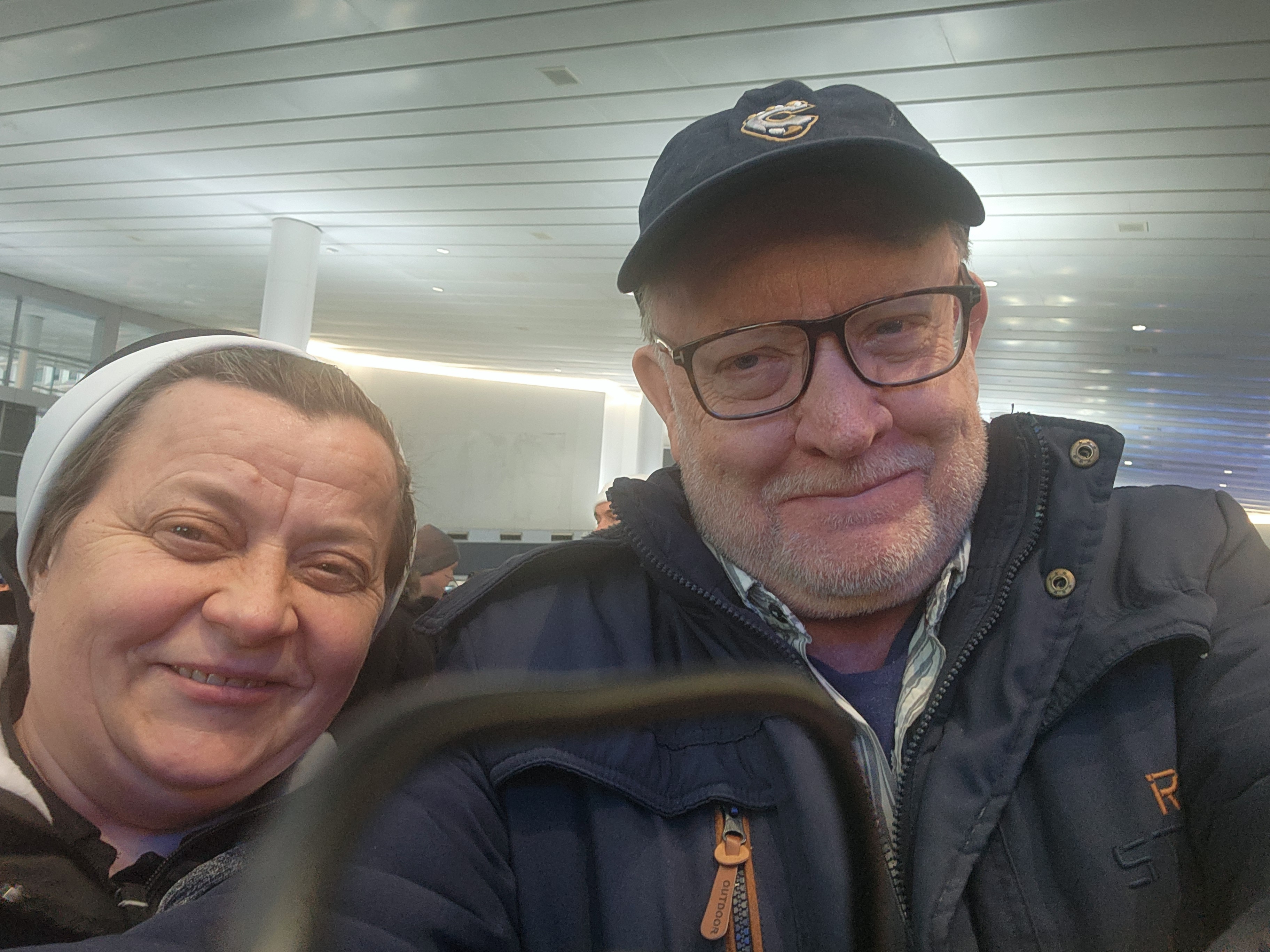
Sr. Lucia Murashko, a member of Sisters of the Order of St. Basil the Great, and GSR international correspondent Chris Herlinger pose for a photo before boarding the Staten Island Ferry in New York City. Murashko and other sisters hosted Herlinger at their convent in Zaporizhzhia, Ukraine, in February 2024. (GSR photo/Chris Herlinger)
On the ferry's deck I began chatting with Sr. Lucia Murashko, who had graciously hosted me when I was on assignment two years ago in Zaporizhzhia, a city in southeastern Ukraine.
But I noticed Sister Lucia was tearing up. With the Statue of Liberty glowing across the water, she told me, "It's so peaceful here. But there's so much violence in the world."
She added that most Americans probably don't realize just how violent the world actually is and take for granted the kind of tranquility we were experiencing on the ferry.
Our outing came just two weeks after the U.S.-Israeli war on Iran began. So, even in that moment of calm on the water, the world's conflicts, tragedies and losses felt close. For Sister Lucia, they always are.
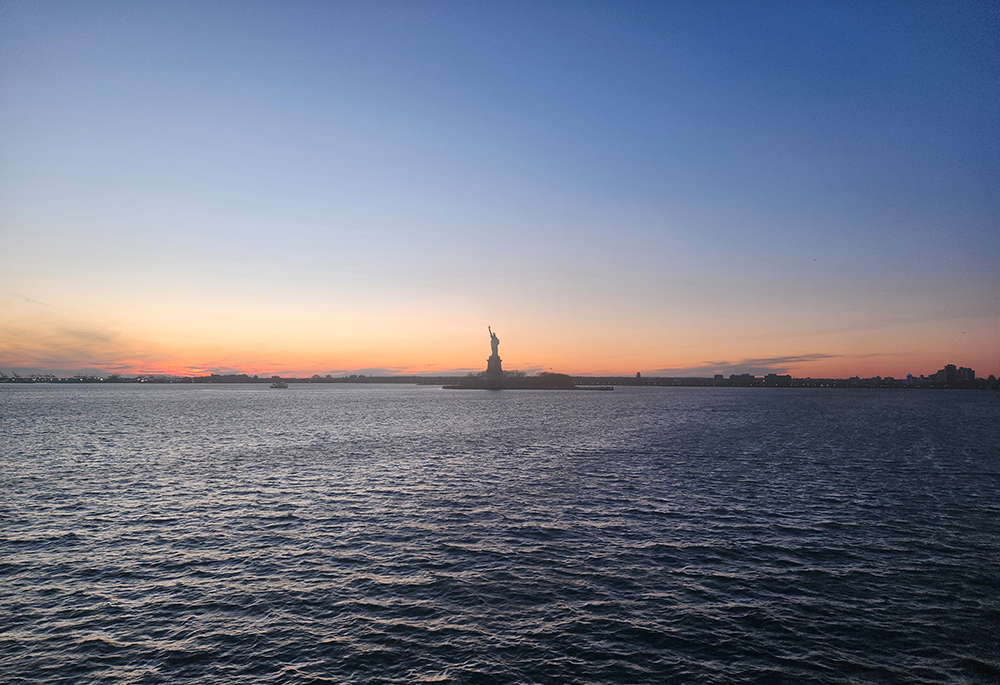
On a recent late afternoon visit to New York City, a group of Ukrainian Sisters of the Order of St. Basil the Great journeyed from Manhattan to the borough of Staten Island, with the Statue of Liberty visible on the western horizon. (GSR photo/Chris Herlinger)
Of course, Sister Lucia was reflecting on her own experiences in Ukraine, something I had witnessed firsthand from my 2024 assignment; I had accompanied her and other Basilian sisters as they provided aid to survivors of Russia's full-scale invasion.
In villages near Zaporizhzhia, not far from the front lines, I heard the distant sounds of bombardment. Residents — many of them elderly, impoverished and trapped — lived with constant uncertainty in the war's pernicious and unwelcome grip.
The sisters' small convent became a welcoming place of refuge for soldiers, the displaced, young and old.
During my 2024 stay, Sister Lucia also shared reflections in the pre-dawn hours over coffee, tea and rolls in her convent kitchen. She described living in the midst of war a "very unnatural state." But she added, "We don't have a choice. We have to live to survive. If I live today, it means a victory; it's a victory over death."
Resurrection language like that was, and remains, a way for Ukrainians to maintain hope in the midst of the Russian onslaught.
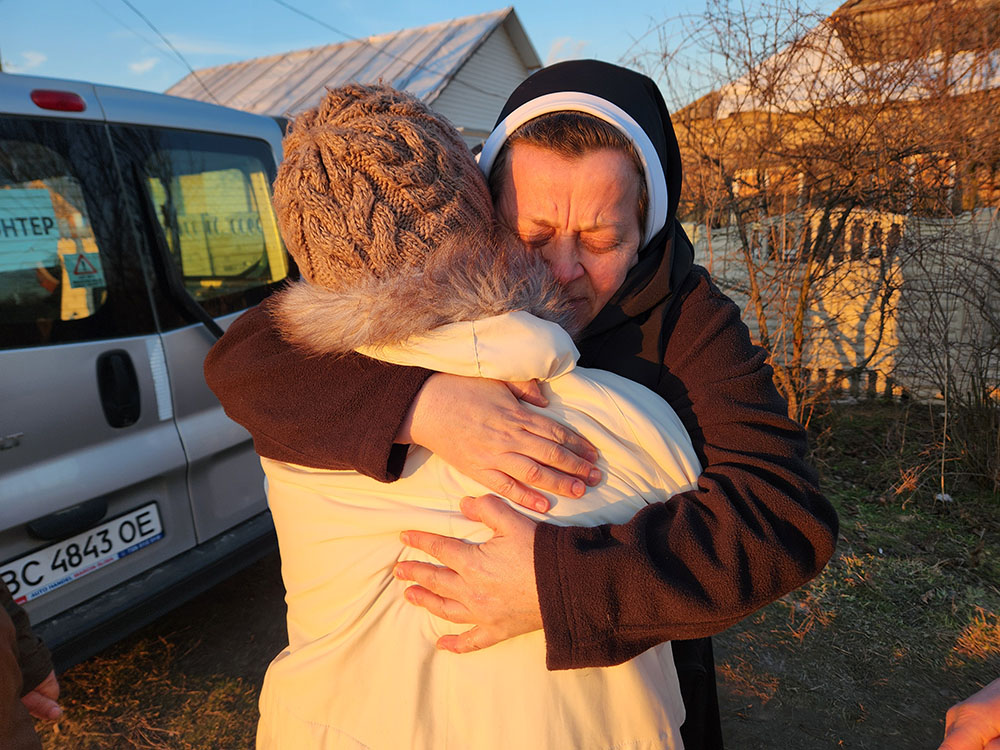
Sr. Lucia Murashko, a member of the Order of St. Basil the Great, hugs a resident of the village of Orihiv, eastern Ukraine, during a delivery of humanitarian supplies in February 2024. (GSR photo/Chris Herlinger)
The war's front line has drawn closer
Two years later, as we resumed our conversation in the basement of St. George Ukrainian Catholic Church in Manhattan, another theme endured: sleep and exhaustion.
She and other Ukrainian sisters came to the U.S. on a mission tour to sustain support and share their experiences with Ukrainian parishes in New York and Chicago.
Before traveling, Sister Lucia had been resting and catching up on sleep at the Basilian motherhouse in suburban Philadelphia. She was trying to recover from what she described as a life of "always running, running, running," adding that not much has changed since I had last seen her.
Unfortunately, some things have changed — and not for the better.
The war's front line has drawn ever closer to Zaporizhzhia; bombardments and blackouts have become frequent, as have Russian drone attacks. "We hear the sounds of drones and rockets constantly," she said.
Sister Lucia did not mention that in December 2024 she, other Basilan Sisters and some 80 children attending a feast of St. Nicholas liturgy narrowly avoided being killed during a Russian bombardment.
Sadly, the worsening situation has made it impossible to continue the ministries to the small villages outside of Zaporizhzhia reachable only on muddy, unpaved roads.
"It's too dangerous," she told me, as the front line stands only about 10 miles from the Zaporizhzhia city borders.
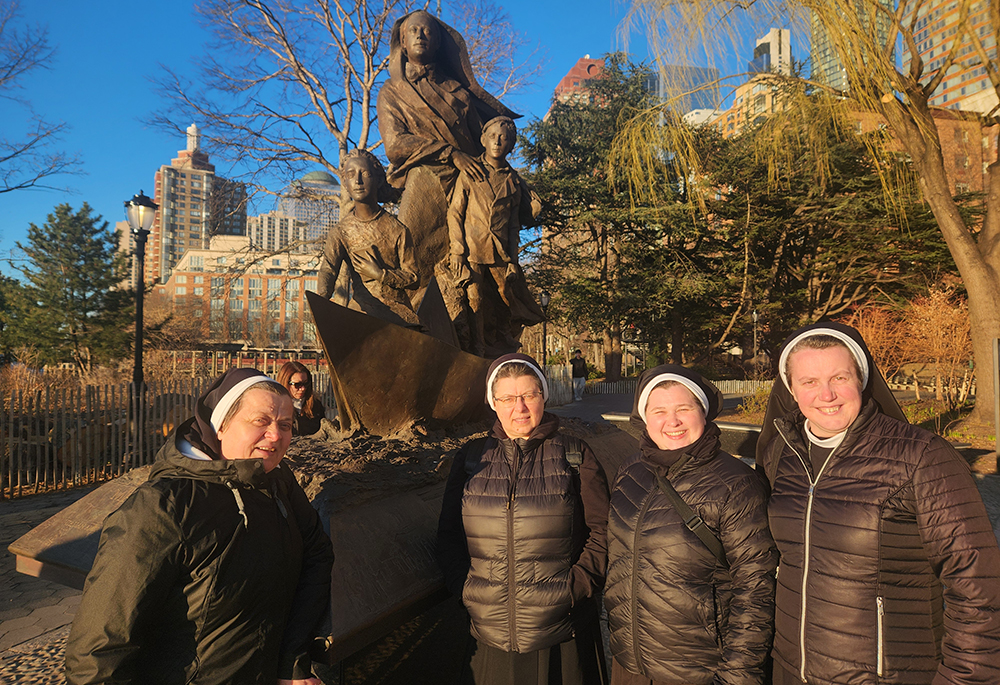
Visiting Ukrainian Sisters of the Order of Sr. Basil the Great in front of a statue to Mother Frances Xavier Cabrini, the patron saint of immigrants in Battery Park, lower Manhattan, New York City. From left to right are Sr. Lucia Murashko, Mother Sevastiana Karvatska, Sr. Anna Andrusiv and Sr. Inokentia Bratziv. (GSR photo/Chris Herlinger)
What happened to the residents I had met? Some have remained in their villages, stubbornly and resolutely staying in their homes despite Russian bombardments. But others have moved to Zaporizhzhia where they have been able to find shelter and are out of immediate harm's way. (I was relieved to hear that Petrova Yevdokia and Diakova Lubov, two displaced women I had met, remained safe at dormitory housing in Zaporizhzhia.)
A ministry for soldiers and supplying soldiers with humanitarian supplies continues. Also continuing and even expanding is a ministry for children and young people — all helping to boost the size of those attending the convent's weekly worship and liturgy, with as many as 80 people now attending.
"That's a big number for Zaporizhzhia," Sister Lucia said, adding that services are drawing people from different backgrounds seeking prayer and stability.
Advertisement
"They are looking for God and the protection of God," Sister Lucia said.
I asked Sister Lucia the uncomfortable question of what might happen if Russian forces draw even closer to Zaporizhzhia, with a real fear being that Catholics would become targets in a Russian occupation.
Sr. Lucia underlined that the order "wants to stay, and we will stay until the time we know that we need to evacuate."
But, she added, "we would not leave before the families, children and older people we know are evacuated."
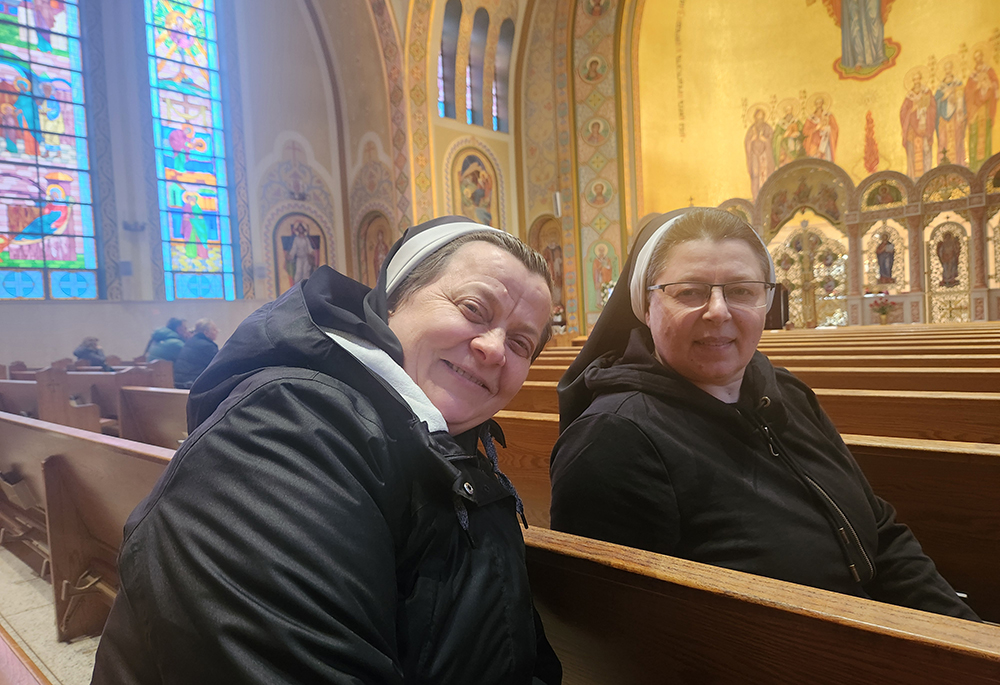
Mother Sevastiana Karvatska, right, the provincial superior of the Sisters of the Order of St. Basil the Great in Ukraine, seen here with Sr. Lucia Murashko following an interview at St. George Ukrainian Catholic Church in Manhattan's East Village during a recent visit to New York City. (GSR photo/Chris Herlinger)
Ukrainians not losing hope or trust in God
The sister leading the U.S. tour was Mother Sevastiana Karvatska, the order's provincial superior in Ukraine, who is based in the western Ukrainian city of Lviv, which though far from the front has not been shielded from Russian attacks.
With Sister Lucia translating, Mother Sevastiana told me that the challenges in Ukraine overall remain considerable. At the same time, she cherishes the support of the Ukrainian American community for the order's ministries in Ukraine.
"When I see people who are open to helping us," she told me, "that gives me a lot of courage and makes us feel that we're not alone."
Mother Sevastiana also said she knows that sisters like Lucia who are on "the front lines" of the order's ministries and "are working terribly hard, and are tired" and have been traumatized themselves by the war's effects.
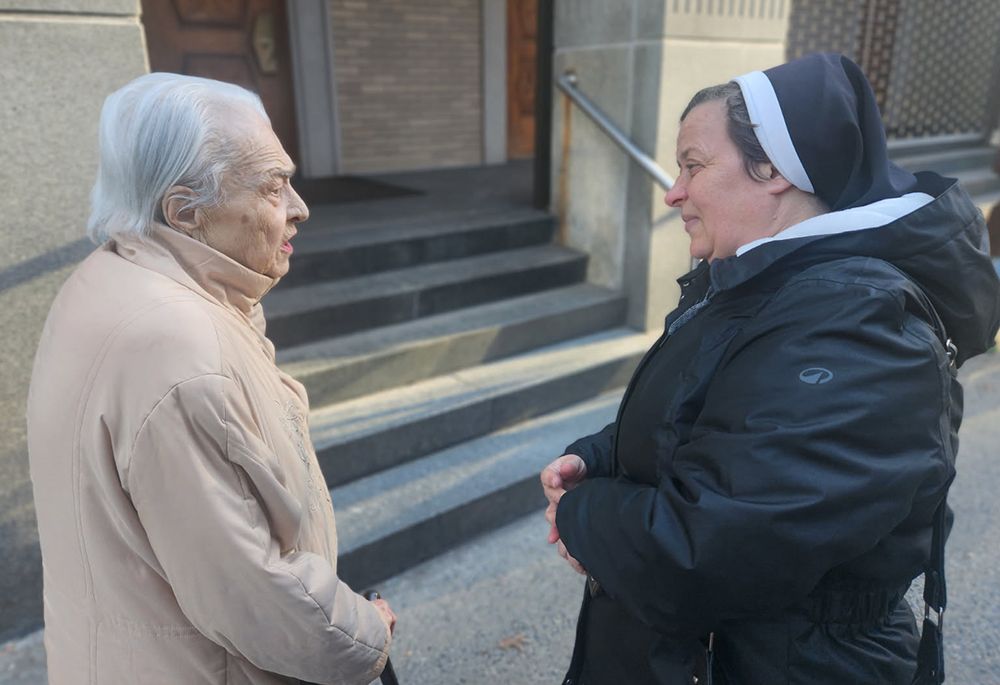
Just as she does back home in Ukraine, Sr. Lucia Murashko, a member of Sisters of the Order of St. Basil the Great, spoke warmly to a parishioner of St. George Ukrainian Catholic Church in Manhattan's East Village during a recent visit to New York City. (GSR photo/Chris Herlinger)
It is important that they find time for renewal and rest — something the larger Basilian family and Ukrainian Catholic Church supports with formal programs of support.
She added that the larger picture for the entirety of Ukraine is sobering.
"The truth is that Ukrainians are all exhausted by the war," Mother Sevastiana said. "But Ukrainians understand that there is no other way than to stand up to [the Russian invasion] and that we believe our justice, our victory, will come. We believe and pray for that and that, in the end, we don't lose hope or trust in God."
Again, resurrection language.
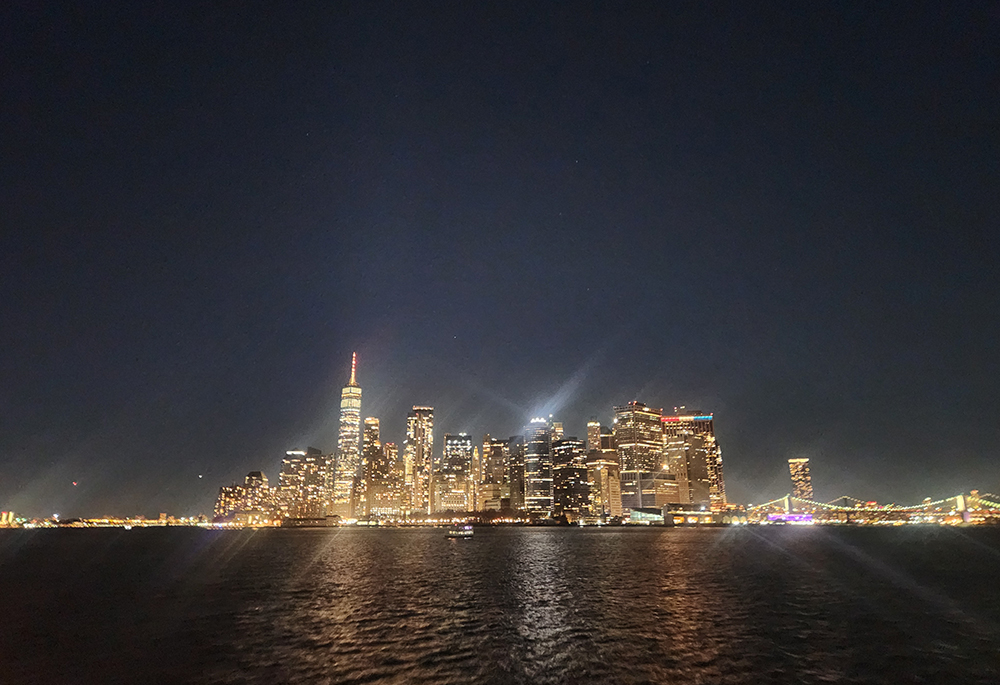
On a recent visit to New York City, a group of Ukrainian Sisters of the Order of St. Basil the Great journeyed from Manhattan to the borough of Staten Island on the ferry. On the return to Manhattan, the lights of lower Manhattan were visible. (GSR/Chris Herlinger)
Our interviews done, Sister Lucia nodded in agreement. But she was eager to unwind and see a bit of New York City. "Come," she said. "Let's go."
After warmly speaking to an elderly parishioner outside the church — much like I had seen her do in Zaporizhzhia and the rural villages — Sister Lucia was on her way, as were we all, for a brief but needed respite on the waters off lower Manhattan.
There, the war in Ukraine seemed far away. But, as Sr. Lucia's tears showed, not fully forgotten.