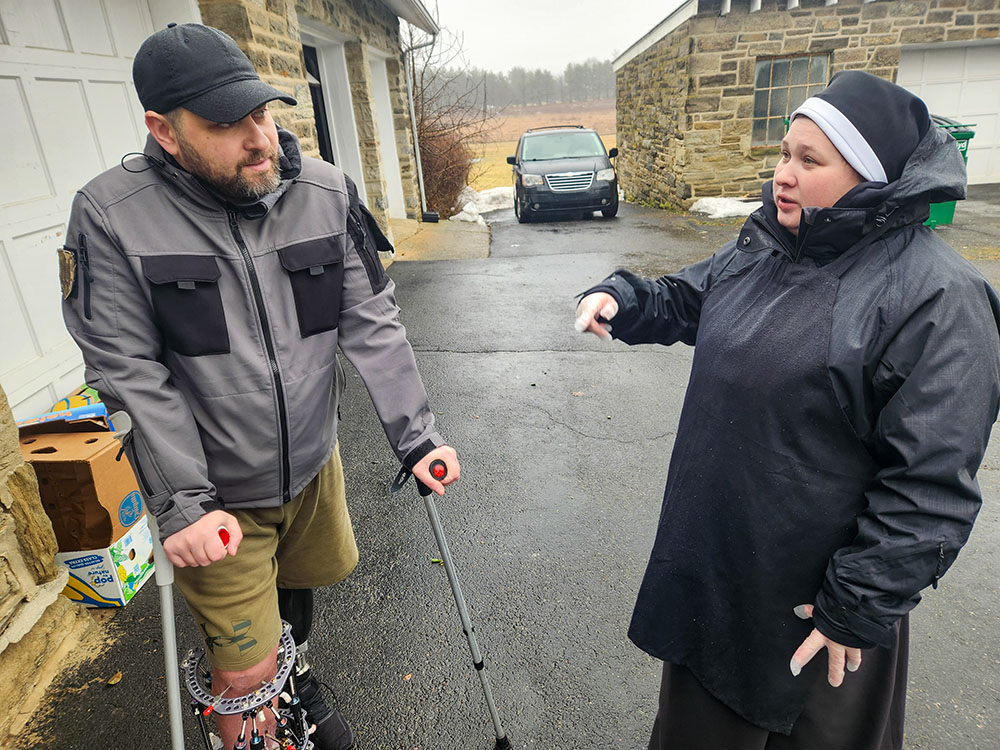
Basilian Sr. Anna Andrusiv, right, who arrived in Jenkintown, Pa., in September after taking final vows in the Ukrainian capital of Kyiv in August, speaks to Ihor Kozak, 40, a Ukrainian soldier undergoing medical treatment at the University of Pennsylvania hospitals. (GSR photo/Chris Herlinger)

On the weekend before the fourth anniversary of Russia's full-scale invasion of Ukraine, Vladislav Yaremenko, a Ukrainian army veteran, recalled that on the eve of the 2022 invasion he had an intuition of what was about to unfold in his country.
"I knew something bad was going to happen," he said, remembering that many Ukrainians did not believe Russia would follow through on its threats of invasion. "I was ready for it."
Ready for any eventuality — including the loss of his own life.
Now a double amputee awaiting prosthetics while living in suburban Philadelphia, Yaremenko, 29, said he has no regrets about his service and would even like to rejoin the army once he returns to Ukraine.
"I will continue to fight even after getting my prosthetic," said Yaremenko, who is now using a wheelchair. "It is my duty."
Fellow soldier Illia Haiduk, 35, who lost his right leg and walks with a fitted prosthetic, concurs. "I've never heard any military man say, 'I've suffered enough.' "
Advertisement
That abiding sense of duty and loyalty to country and culture, nation and land, does not surprise Ukrainian Sr. Dia Zagurska, a member of the Sisters of the Order of St. Basil the Great, who regularly pays pastoral visits to Ukrainian soldiers.
"We don't have a choice," Zagurska said on her way to visit the nearby soldiers. "We stay alive or we die," she said of Ukrainian national resolve.
Four years after the Feb. 24, 2022, full-scale invasion, and 12 years after the start of the Russian occupation of Crimea and the Donbas region of eastern Ukraine, such commitment and steely determination are common among Ukrainians and Ukrainian Americans.
And it is on display in the work of the St. Basil sisters living and ministering in Jenkintown, a Ukrainian American enclave — whether that means visiting soldiers residing in the area, distributing food to recent Ukrainian arrivals, or sending needed humanitarian supplies to the war front.
"We can't disregard it," Sr. Joann Sosler, the provincial superior in Jenkintown, said about the war. "It's part of our lives."
"It's united us as an order and as a concerned community — with concern for the people
of Ukraine and of our sisters in ministry at unsafe locations [in Ukraine]."
Never to surrender
Mother Emanujila Vishka, the order's new general superior who is based in Rome and who had just been visiting the U.S. provincial house, praised the U.S.-based sisters for their support in what has been a trying four years.
"To see sisters facing a great challenge, like war, is not easy for any of us."
Signs of that are evident at the Jenkintown motherhouse, adjacent to Manor College, a private Catholic college founded by the sisters in 1947.
Placards emblazoned with the national colors of yellow and blue declaring support for Ukraine are placed on a fence surrounding a grotto on the motherhouse grounds — the centerpiece being a shrine bearing the image of the Lady of Pochayiv, a revered sacred icon in Ukraine.
On Friday afternoons on the motherhouse grounds, sisters and a group of volunteers greet new Ukrainian arrivals and others needing help with boxes of donated food.
Srs. Teodora Kopyn and Monica Lesnick, present to help distribute the food boxes to about 190 people and helped by other sisters and a core group of volunteers, marvel at what they say is the generosity of donors.
As part of a St. Basil support ministry headed by Kopyn, the sisters and volunteers recently collected more than 50 boxes of medicine, toiletries, candy, socks and hand warmers. With the cooperation of the Ukrainian American Relief Committee, they shipped the boxes to some 600 soldiers at the Ukrainian-Russian front.
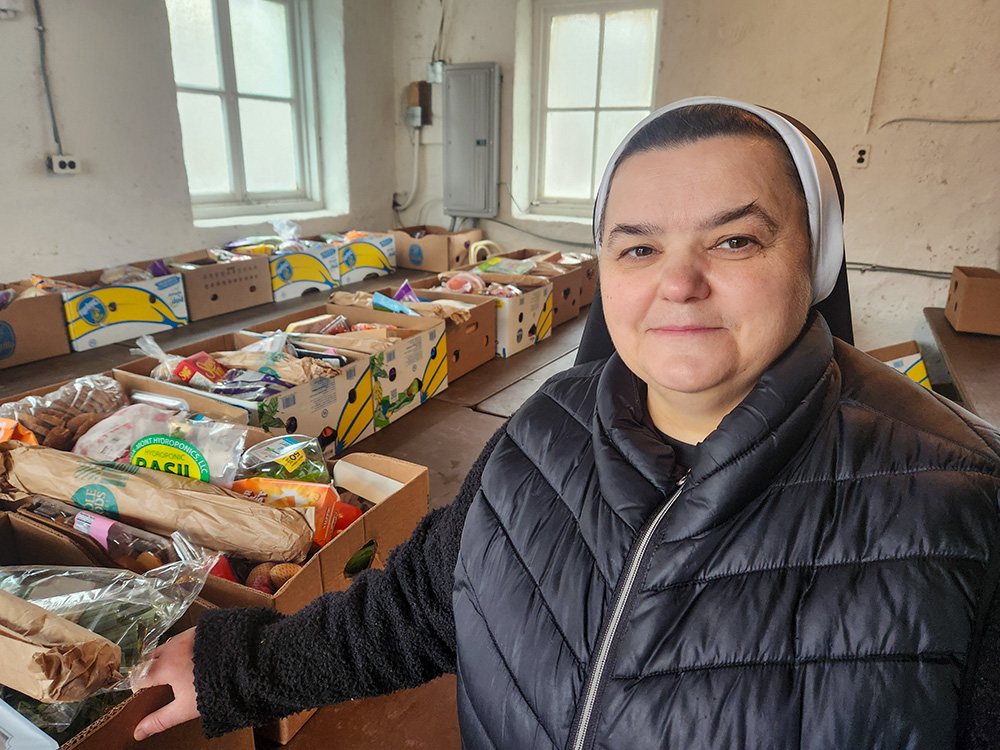
Basilian Sr. Teodora Kopyn helps coordinate food distribution to about 190 people on Fridays on the grounds of the U.S. provincial motherhouse in Jenkintown, Pa. (GSR photo/Chris Herlinger)
"We do whatever we can for Ukrainians," Kopyn said.
On a recent return visit to Ukraine, Kopyn attended a funeral of a soldier in her native Transcarpathia region and said it felt like a "funeral for the whole city."
One of the latecomers to the Friday afternoon distribution was Ihor Kozak, 40, a Ukrainian soldier undergoing medical treatment at the University of Pennsylvania hospitals.
"It's good what the sisters are doing," said Kozak, who was wounded by a land mine. "There's a real need for this kind of support here."
Asked about the invasion anniversary, Kozak said he has not been surprised by the course of the war, which shows no sign of ending soon. As a BBC report recently noted: "The Russian leadership envisaged a short and successful military operation. It didn't go to plan. Four years later, Russia's war on Ukraine grinds on."
"Russia is a country that is not easy to defeat," Kozak said, "and Ukraine is a country that will never surrender."
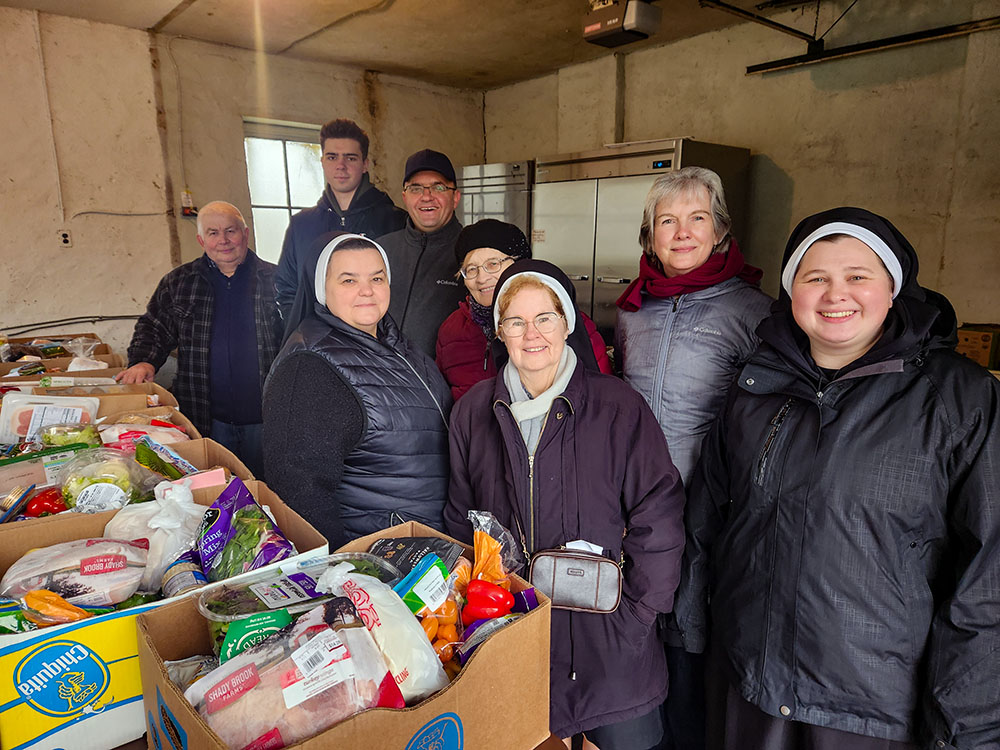
Basilian sisters and volunteers work Fridays on the grounds of the U.S. provincial motherhouse and distribute food boxes to recent Ukrainian arrivals. (GSR photo/Chris Herlinger)
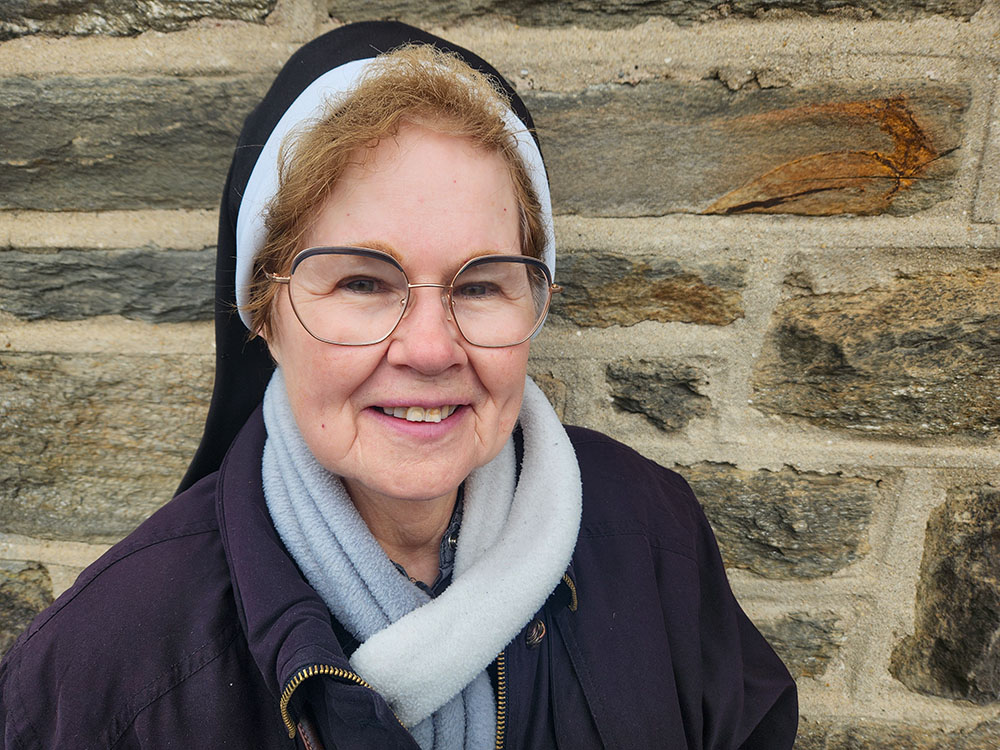
Sr. Monica Lesnick is among the St. Basil sisters helping distribute food boxes to about 190 people on Fridays on the grounds of the U.S. provincial motherhouse in Jenkintown, Pa. (GSR photo/Chris Herlinger)
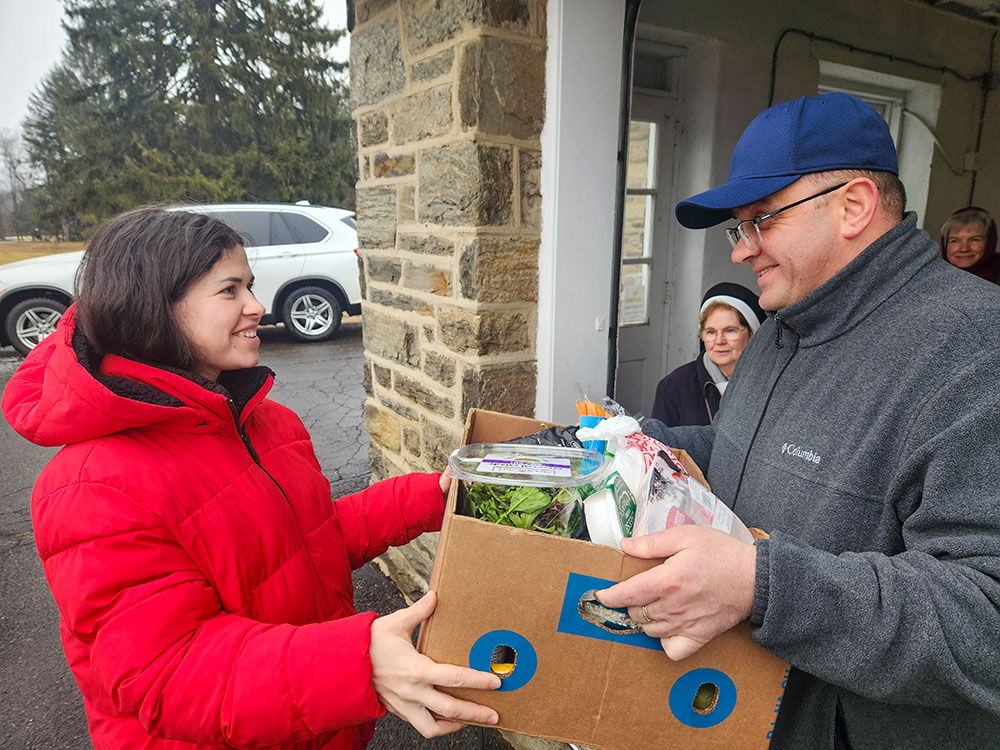
Fr. Vasyl Kopyn, right, is among those assisting St. Basil sisters in the distribution of food boxes to recent Ukrainian arrivals in the Philadelphia area. (GSR photo/Chris Herlinger)
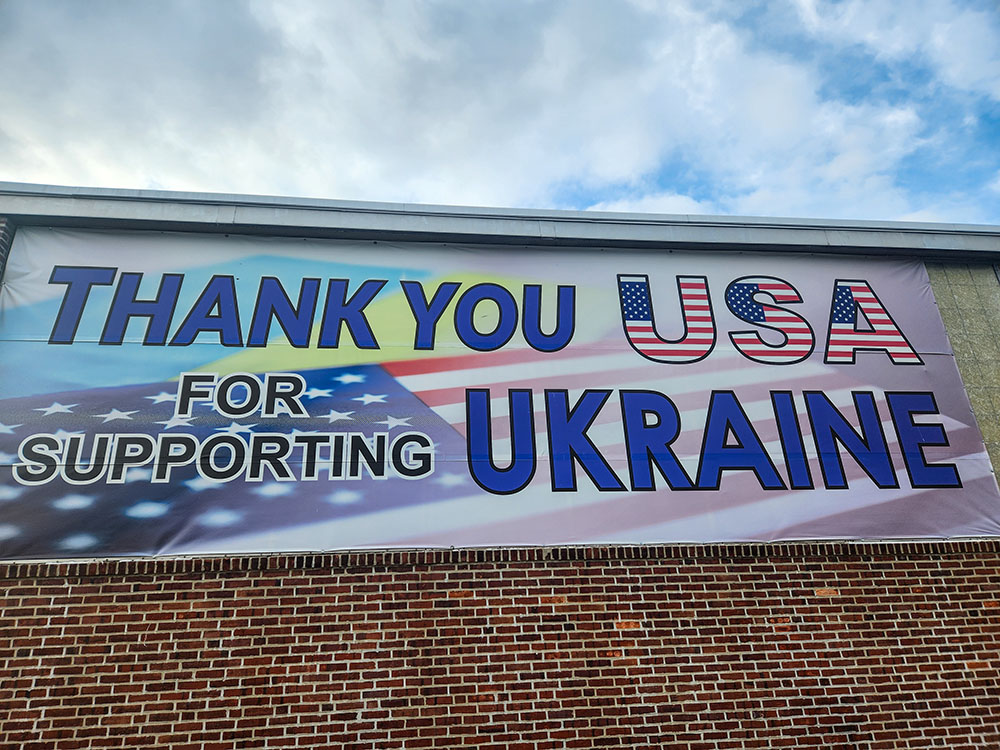
A sign of support for Ukraine at a Ukrainian cultural center in Jenkintown, Pa., a Ukrainian American enclave (GSR photo/Chris Herlinger)
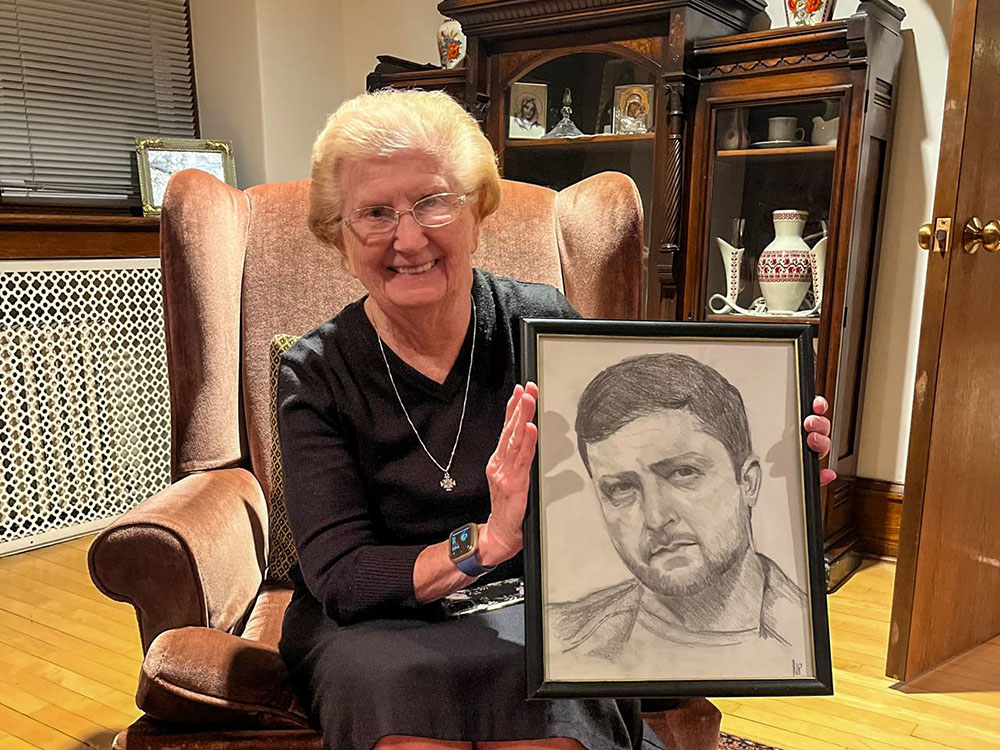
Basilian Sr. Dorothy Ann Busowski proudly displays a gift from a friend — a framed hand-drawn portrait of Ukrainian President Volodymyr Zelenskyy. (Courtesy of the Sisters of St. Basil)
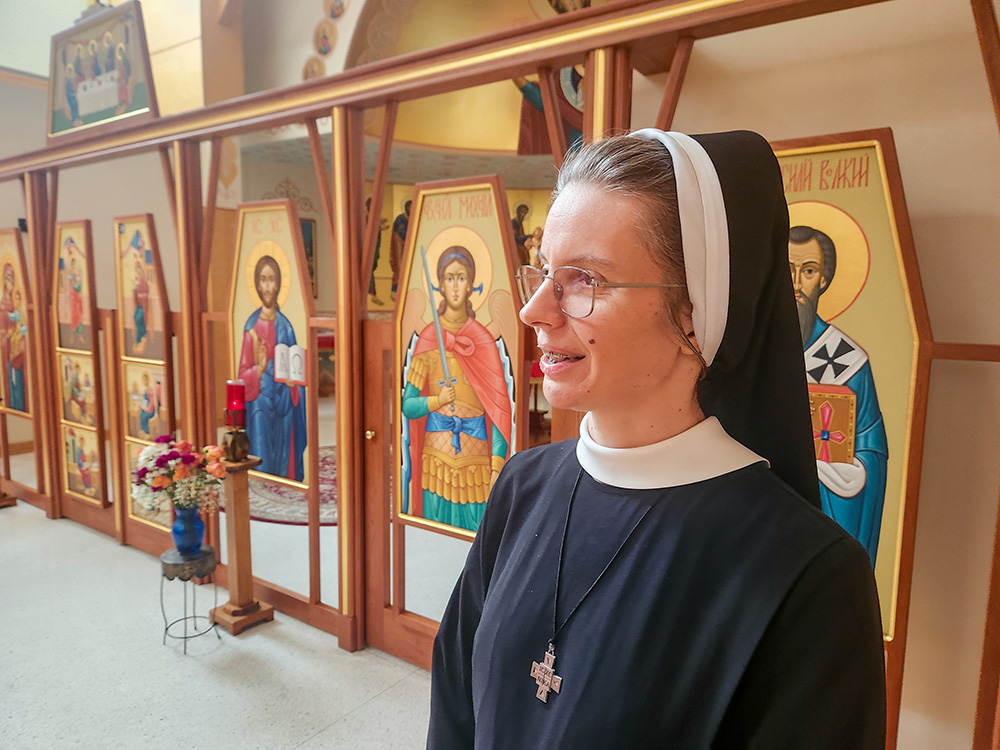
Mother Emanujila Vishka, the new general superior of the Sisters of the Order of St. Basil the Great, praised the U.S-based sisters for their loving support of Ukraine and Ukrainian sisters. (GSR photo/Chris Herlinger)
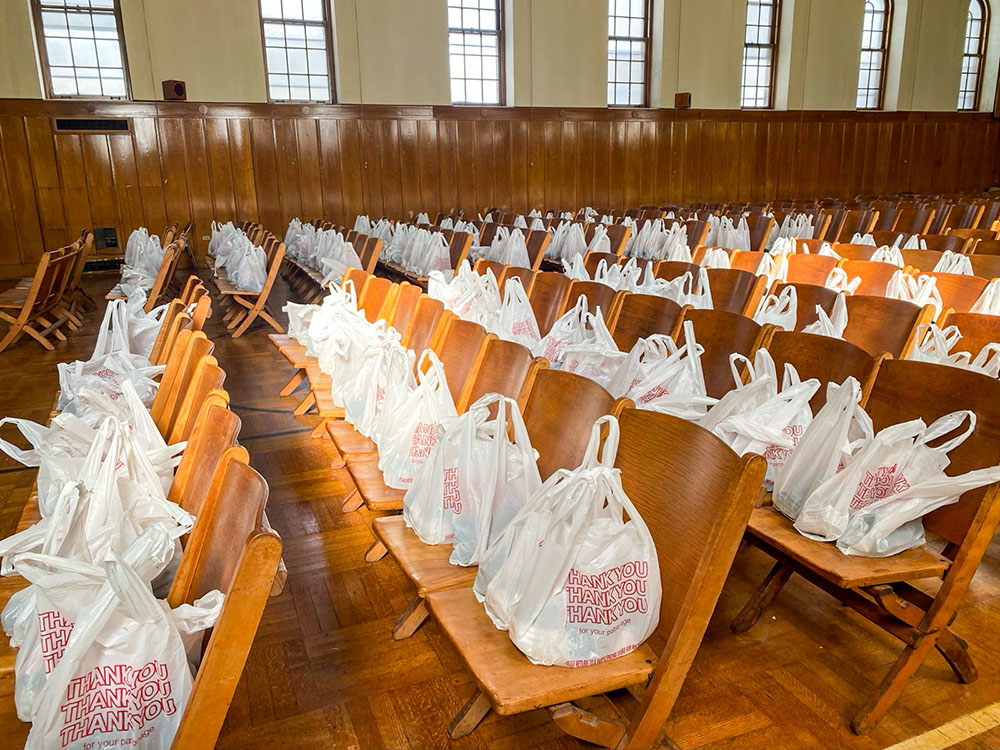
As part of a St. Basil support ministry, more than 50 boxes of medicines, toiletries, candy, socks and hand warmers were shipped to some 600 soldiers at the Ukrainian-Russian front. (Courtesy of the Sisters of St. Basil)
'If Russia wins, that's the end of Ukraine'
Following a Friday dinner at the motherhouse, similar reflections animated an informal talk among a group of Ukrainian and Ukrainian American sisters, who spoke of the war in terms that were, by turns, sober but hopeful.
Sober because of the possible consequences if Russia proves victorious. "Ukraine has to win," said Sr. Ann Laszok, whose parents were born in Ukraine. "If Russia wins, that's the end of Ukraine." She argued that Russia's war is not merely a land grab but a genocidal attempt to eliminate Ukraine as a nation.
"The Russian government is not honorable and [President Vladimir] Putin is not an honorable man," Laszok said. "It's a war of survival."
But the conversation also proved hopeful because the sisters see Ukrainian resistance, resolve and reliance continuing — though fully aware that the last few months have been remarkably difficult for Ukrainian civilians. Russia has been engaging in unrelenting bombardments on Ukrainian power stations, eliminating electrical power and causing great hardship during a bitterly cold winter, even by Ukrainian standards.
"My friends are freezing," said Ukrainian Sr. Anna Andrusiv, who arrived in Jenkintown in September after taking final vows in the Ukrainian capital of Kyiv in August.
Despite those hardships, neither she or any of the sisters have any doubts of the rightness of the Ukrainian cause of resisting the Russian invasion. "I have never, ever thought that was wrong," Andrusiv said of Ukraine's military response. "This is a war against Ukraine."
Asked about ongoing concerns about corruption in the Ukrainian government, the sisters said they still have faith that President Volodymyr Zelenskyy is committed to good governance and the underlying hope for a continued free and independent Ukraine.
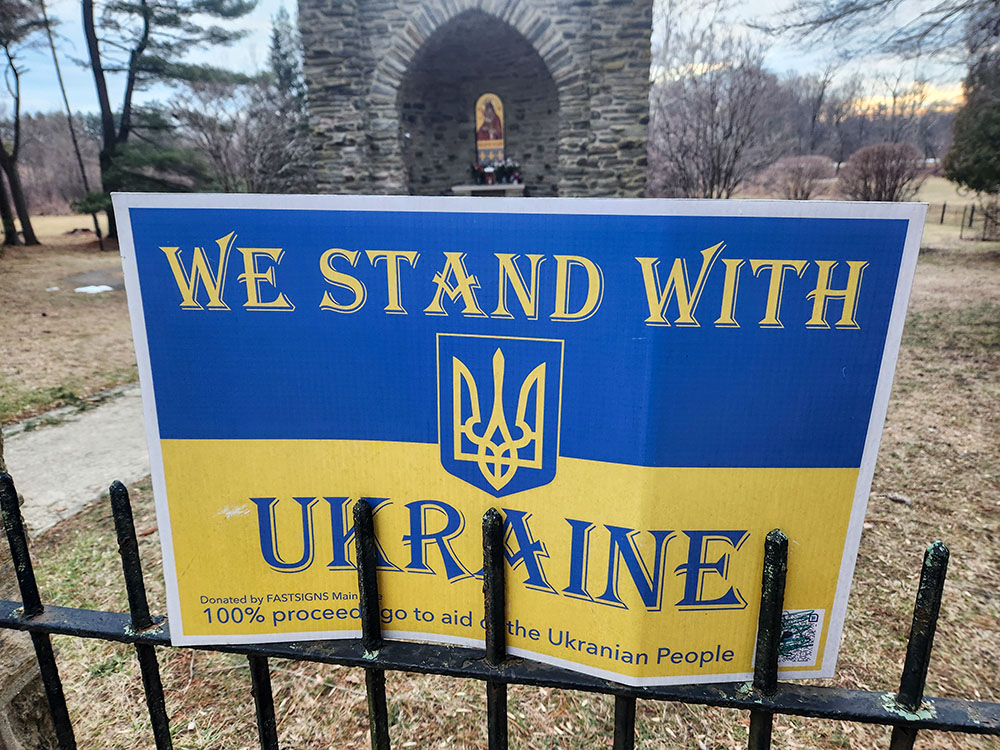
In Jenkintown, Pa., placards emblazoned with the national colors of yellow and blue declare support for Ukraine on a fence surrounding a grotto on the Basilian motherhouse grounds — the centerpiece being a shrine bearing the image of the Lady of Pochayiv, a revered sacred icon in Ukraine. (GSR photo/Chris Herlinger)
When it comes to Russia, Laszok said, "You have to have a strong faith, almost a pure faith to believe that your prayers will have some effect on [Putin], that evil can somehow be contained."
At the home where the soldiers are residing — in a program sponsored by the Florida-based nonprofit Revived Soldiers Ukraine — the concrete, physical and psychological toll of decisions made four years ago in the Kremlin are on full display.
Even in Philadelphia's quiet, tree-lined suburbs, the memories of war are never far away.
The sound of a distant commercial airliner high in the sky can prompt the men to crouch down, arms overhead — the effects of post-traumatic stress disorder, said Yaremenko, chuckling as he demonstrated by crouching down in his wheelchair.
"It's all like, 'Before the invasion war and after,' " said Sergij Sergiyenko, 41, now dependent on crutches.
The lived experiences of Ukrainians in the last four years revolve around basic facts: "They came to our land, they came to our country, to kill," Haiduk said. "We have always known what we're fighting for."
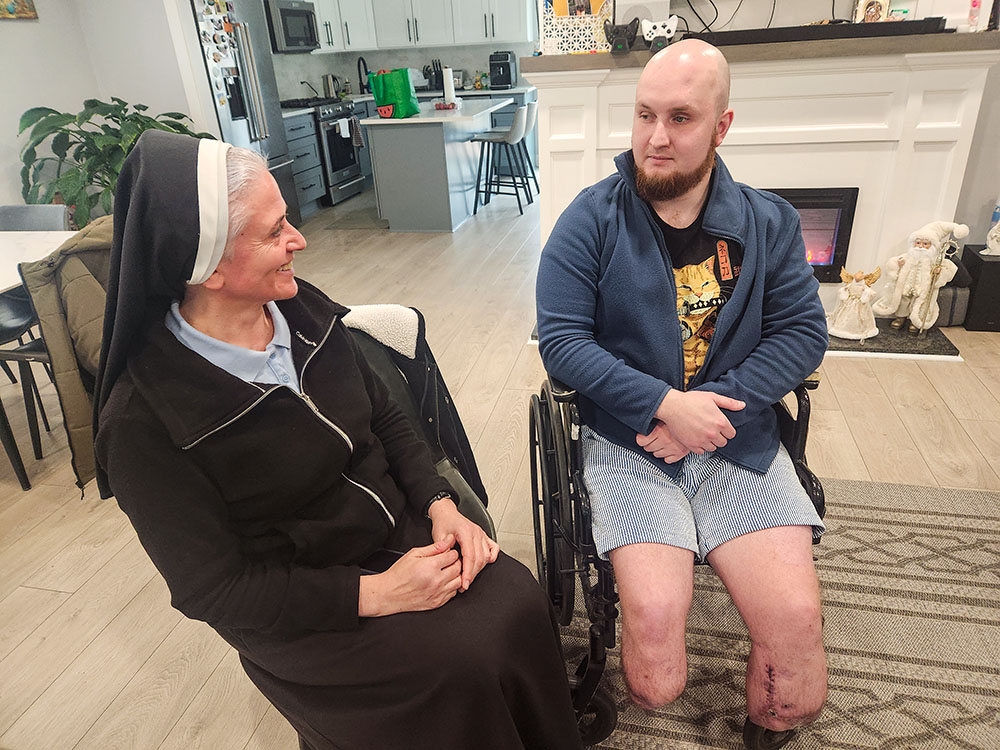
Vladislav Yaremenko, right, a Ukrainian army veteran is now living in a home with other Ukrainian soldiers in a Philadelphia suburb while undergoing rehabilitation. He is joined here by Ukrainian Sr. Dia Zagurska, a member of the Sisters of the Order of St. Basil the Great. (GSR photo/Chris Herlinger)
With days now spent in rehabilitation in Philadelphia, and with hopes that they can return to Ukraine to continue fighting for their country, the five men are thankful for the help, attention and kindness of volunteers and of sisters like Zagurska.
"We're always happy to see people," said Haiduk, smiling. "We could see them every day."
Such connections are also important to the sisters, though Zagurska said on the drive back to the motherhouse that she sometimes finds it challenging listening to the men's stories, partly because of her own experiences.
Zagurska herself has lost family in the war.
"I get very emotional, like I can't contain myself," she said, pausing.
"To think that this young man of 29 had his whole life in front of him and he lost two legs," she said of Yaremenko, her voice trailing off.