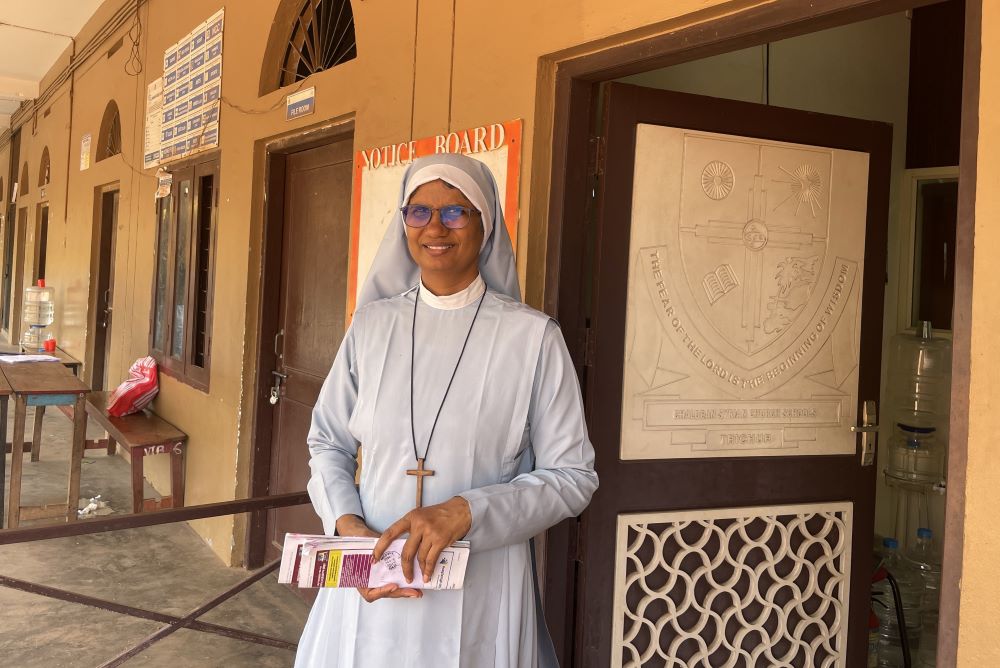
Sr. Jincy Othottil poses for a photo in front of the Chaldean Syrian Higher Secondary School in Kerala, India, where she is the manager. Othottil in 1998 dedicated herself to the lost monastic life in the Chaldean Syrian Church in Kerala. (Binu Alex)

by Binu Alex
In southern India, the lush tropical landscape of Kerala is dotted with imposing buildings housing the headquarters of several major Catholic religious orders. The thousands of members of these orders operate sprawling networks of hospitals, schools and social institutions in the area.
Yet tucked away in the district of Thrissur, the town known as Kerala's cultural capital, is a modest two-story building that houses a small community of nuns — three, to be precise — whose quiet, contemplative presence represents one of the most remarkable historical revivals in modern female monasticism.
They are the women religious of the Chaldean Syrian Church, one of the nine Eastern Rite churches in Kerala that traces its origins to St. Thomas the apostle, who, according to tradition, evangelized the western Indian coast in 52 AD.
The Chaldean Syrian Church resisted the Latinization efforts of the Portuguese missionaries in the 16th century and also refused to be subject to the Antiochian (Eastern Orthodox) bishops in the 17th century. They maintained their independence and the historical roots of Chaldean Church traditions for centuries, until establishing an organizational connection with the patriarch of the Assyrian Church of the East in 1995.
The Chaldean Church's ancient tradition of female monasticism was entirely lost in India as the church struggled to preserve its Mesopotamian heritage amid colonial interventions and historical turbulence. That was until a young Sunday school teacher named Jincy Othottil stepped forward in 1998 to dedicate herself to monastic life, filling a void that had been empty for generations.
"There was a need for a women's religious order. We need this traditional calling of God in our church, too," Othottil said. The late Patriarch Mar Dinkha IV encouraged the establishment of such a monastic branch in the Indian Chaldean Church, she noted.
'In an era where ancient traditions are easily swallowed by the tides of modernity, Sr. Jincy [Othottil] stands as a fierce guardian of our sacred Mesopotamian heritage.'
—Metropolitan Mar Awgin Kuriakose
During a Patriarchal Council of the Chaldean Church in Chicago in 1996, Dinkha urged the then-head of the church, Mar Aprem Mooken, to find a way to establish a convent.
But starting something like that was "a little tough since it had no benchmark to follow" in the living memory of the church, Othottil told GSR.
In 1998, Othottil began her journey into monasticism in an "exceptionally humble" way without a physical building to house her. Initially, she lived with a local laywoman involved with the Chaldean Syrian Church's women's association. From there, Othottil began her monastic formation and continued her education.
In 2000, during Dinkha's historic pastoral visit to India, Othottil took her permanent vows, officially starting her monastic sisterhood.
Othottil later moved to an institute in Syriac studies, where she completed a post-graduate and research doctorate in the language. She also offered her services to an orphanage near the institute.
"We could not start something on our own because we did not have enough numbers," she said in an interview at the Chaldean Syrian Higher Secondary School, where she serves as the manager.
After some two decades of planning and fundraising, the monastic order H.H. Mar Dinkha IV Assyrian Convent finally had a home of its own. In February 2017, the convent was originally blessed and opened, giving the nuns a permanent sanctuary to grow their community.
Metropolitan Mar Awgin Kuriakose, the current spiritual head of the Chaldean Church in India, underscored the importance of Othottil becoming an expert in Syriac studies.
"The survival of the Chaldean Syrian identity relies on protecting its language and texts," he said.
"In an era where ancient traditions are easily swallowed by the tides of modernity, Sr. Jincy stands as a fierce guardian of our sacred Mesopotamian heritage," he said. Kuriakose and Othottil are cousins.
"Our East Syriac language is not merely a historical artifact; it is the very soul of our liturgy. By dedicating her life to the rigorous Syriac studies, she has ensured that this sacred tongue continues to echo in our modern world," Kuriakose said.
Othottil's academic mentor, Fr. Jacob Thekkeparambil, said she holds "a rare ability to make this ancient language relevant today."
"Through her meticulous translations, her academic leadership, and her quiet, unyielding devotion at the convent, she translates high theology into lived faith," said the eparchial priest of the Syro-Malankara Catholic Church.
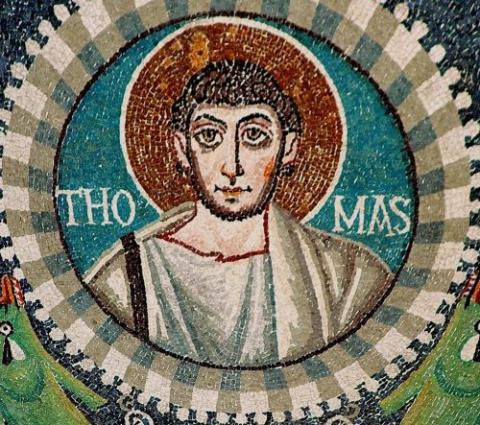
A mosaic depicts St. Thomas at the Basilica of San Vitale (526-467) in Ravenna, Italy. Thomas the apostle, according to tradition, evangelized the western Indian coast in 52 AD. (Wikimedia Commons)
"We owe her an immense debt of gratitude for stepping into a centuries-old void and single-handedly helping to keep the linguistic and liturgical heartbeat of the church of the East alive in India," Thekkeparambil said.
Othottil said that preserving the Eastern Syriac rite "is the only way to safeguard" the 50,000-strong church's "unique theological identity" amid Kerala's some 6 million Christian communities that use the local language for the liturgy.
Although almost 1 in 5 people in Kerala's 34 million is a Christian, "Syrian presence isn't that large here. The unique feature of our church is that its liturgical prayers are still in Syriac. Being able to pray in that language itself means going back to our roots," Othottil said.
The Assyrian Convent was purposefully constructed directly adjacent to the Mar Timotheus Orphanage, where the three nuns balance their daily contemplative prayer, according to the strict liturgical rites of the Assyrian Church of the East.
Advertisement
As part of their social commitment, the nuns provide continuous care, guidance and maternal support to the children at the orphanage, Othottil said.
How do she and other nuns reconcile the demands of ancient theology with the practical realities of wiping children's noses and helping with homework?
"Simple. True scholarship fosters deep compassion," Othottil said.
"Women are naturally multitalented. Often, we have to discuss high theological concepts in classrooms, explain them to our research students, or speak at research conferences. But when we are with our children, we must become ordinary human beings."
Whether the church will have more nuns in the future is a question weighed against the church's close-knit demographics and the socioeconomic realities of modern Kerala.
Christian families are increasingly becoming smaller with single or two children, and educated youth are migrating to Western countries or the Persian Gulf in search of better career opportunities.
"A monastic system isn't very applicable in a place like this. Therefore, fostering vocations here is quite tough. And ultimately, only those who are called will be able to come. All we can do is pray for the grace to hear that call," Othottil said.
"Whether we are at a micro level or a nano level, it doesn't matter. The greatest realization is that all human beings are an essence of God and that everyone is a child of God."