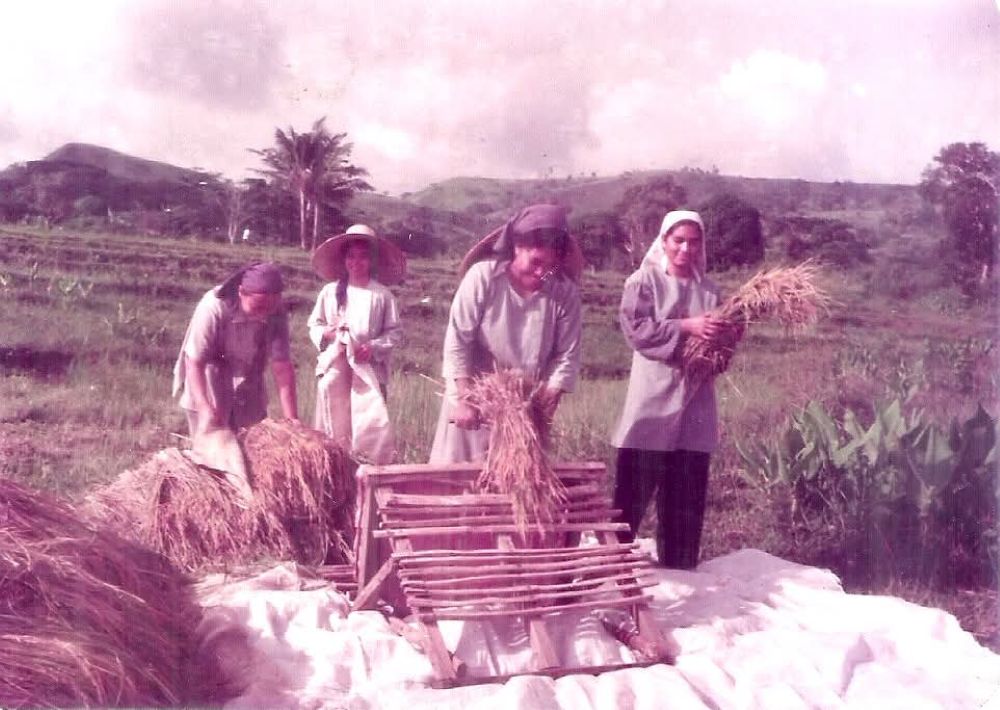
Sisters of the Little Sisters of Jesus thresh rice in Boso-Boso, Antipolo, Philippines, in the 1980s. They are beating harvested stalks against a wooden frame to separate the grain. (Courtesy of Little Sisters of Jesus)

by Oliver Samson
A nun in a blue veil sweeps fallen leaves at Quezon Memorial Circle. Around her, couples linger on benches. It's not the kind of place where one would expect to find a religious sister at work.
One day, a nun from another congregation saw her and began to cry.
"Why are you working here? There's so much temptation."
The sister sweeping that day was Sr. Cecilia Grace de Jesus of the Little Sisters of Jesus of the Philippines.
For the congregation, that tension — between contemplation and immersion — is something to embrace, not avoid.
"If you work in a factory, you run after the vehicle just to get there on time," Sister Cecilia Grace said. "There is noise. There is pressure. You hear everything — how people talk, how they struggle."
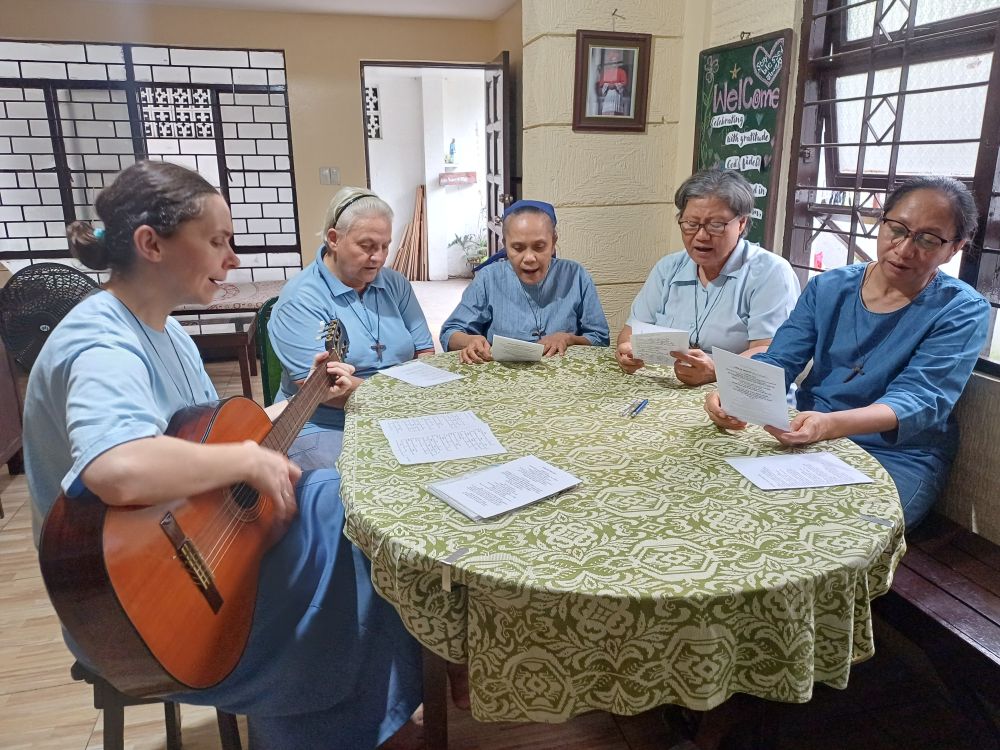
Sister Gosia plays the guitar as Sisters Annarita, Maria Elizabeth, Cecilia Grace and France Grace sing, marking 50 years of the Little Sisters of Jesus ministering in the Philippines. (Oliver Samson)
For the past 50 years, they have worked in bakeries or taken factory shifts, and, when the season came, bent under the sun to harvest rice. At times, they stepped in as a family's househelp when the regular help was away. When factory work was scarce, they took in laundry. At a glance, they were indistinguishable from the women around them — except for the veils.
This was by choice. Rather than live apart in convents, the sisters chose to settle in poor communities — slum areas in Manila and rural villages in the provinces — making their homes among workers and their families so they could share in the realities of daily life. The spirituality of Charles de Foucauld — whose hidden life among the poor inspired the congregation — shapes this approach. Presence, they believe, is not measured by visible results but by a quiet, faithful closeness to others.
"In the convent, everything is provided," added Sr. Maria Elizabeth de Jesus. "Here, you move with the flow of the world. You feel the tiredness of workers. Sometimes you fall asleep in the chapel because you are so tired."
That fatigue is formative. It sharpens their awareness of injustice — low wages, inequality and the fragility of everyday life.
Their presence, even when quiet, can shift a workplace.
"Sometimes, just seeing a sister in the workplace, people start to reflect," Sister Cecilia Grace said.
'Journeying with others doesn't produce results you can measure. The fruits belong to the mystery of God.'
—Sr. Annarita de Jesus
Working alongside laborers also changed how they understood the Gospel.
"It helped me to go deeper — not with my head, but with the heart," said Sr. Annarita de Jesus, an Italian sister. "Jesus spent many years in Nazareth. He learned to speak a language ordinary people could understand."
That same insight emerged in the fields. In rice paddies, young shoots were almost indistinguishable from weeds.
"You might pull out the rice by mistake," Sister Cecilia Grace said. "The parable of the weeds among the wheat ceased to be abstract. You understand why you cannot remove them too early. The Gospel becomes real because it comes from ordinary life."
The same was true in the lives around them. Stories of broken families and reconciliation gave new depth to the prodigal son.
"You see forgiveness, acceptance," Sister Maria Elizabeth said. "If I did not experience this, I would not understand the Gospel deeply."
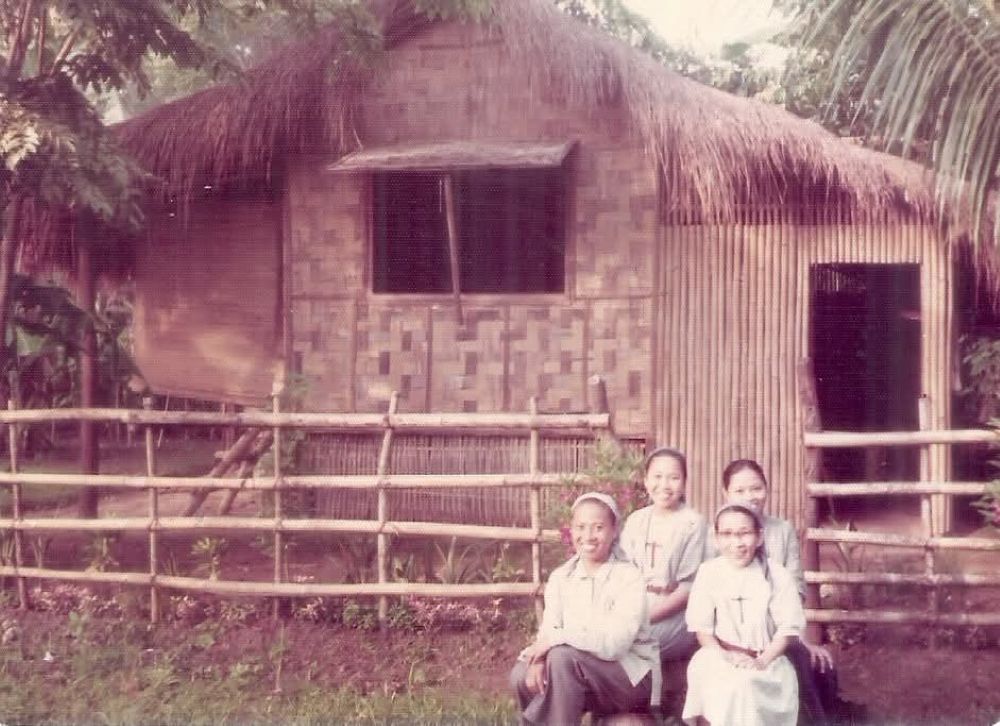
Sisters of the Little Sisters of Jesus pose outside their bamboo and nipa home, where they lived simply among workers and the poor in the 1980s. (Courtesy of Little Sisters of Jesus)
Living as workers has also brought moral tension.
In one factory, workers were tasked with replacing labels on cheap clothing to pass them off as branded. Sister Maria Elizabeth refused. "It was a deception," she said.
In another job, she encountered work that conflicted with her beliefs and chose to leave. "There are things you cannot compromise," she said.
Even dignity itself had to be relearned. Sister Cecilia Grace recalls being recognized by a former classmate while working as a sweeper. "She asked me, 'Is that really you?' I felt ashamed."
The moment forced her to confront her assumptions.
"Dignity is not based on work," she said. "Every person has dignity."
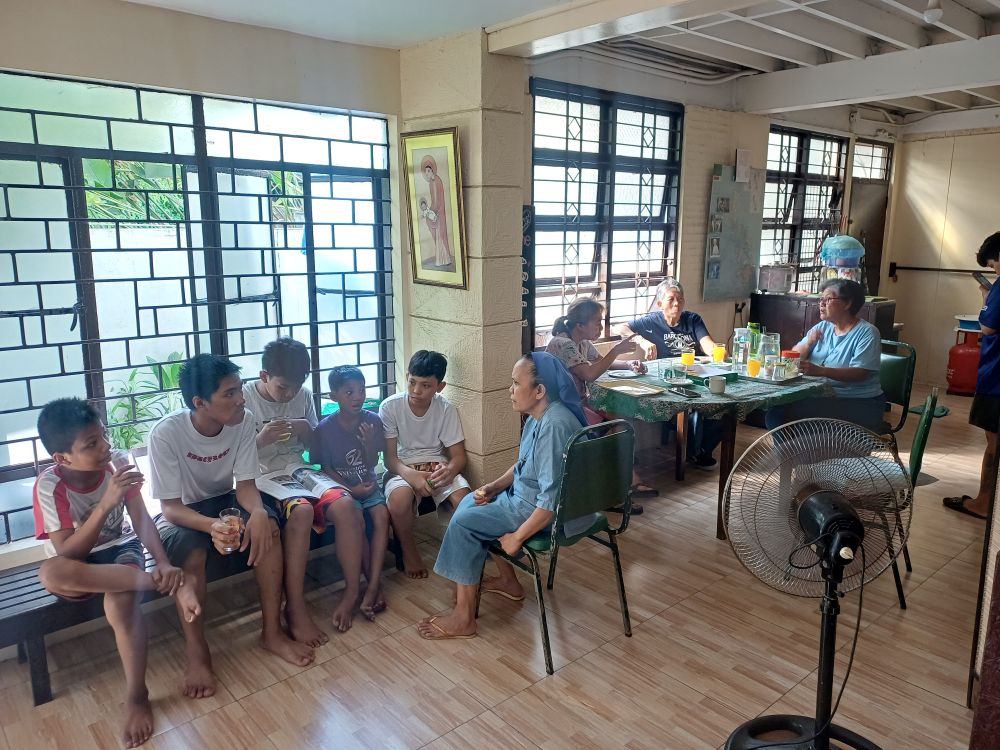
Srs. Maria Elizabeth de Jesus (left) and Cecilia Grace de Jesus, both in blue, sit with neighbors and children inside their modest house in Mandaluyong, Philippines, where the Little Sisters of Jesus live among the communities they accompany. (Oliver Samson)
For Sister Annarita, poverty and dignity are not opposites.
"Work, even hard work, becomes a source of dignity," she said. "And the poor have a deep trust that God will not abandon them. That always challenges my own faith."
Their presence in communities sometimes drew suspicion as much as trust.
While living among farmers in Antipolo in rural Philippines, the sisters came under surveillance. Their house was searched for weapons, and they were suspected of being members of the New People's Army. At the same time, some neighbors assumed the opposite — that the sisters shared their cause.
"One of them told us, 'Sister, we have many companions there in the mountain,' " Sister Cecilia recalled. "'If anyone harms you, we will help you.'"
The sisters also found themselves drawn into a fight to protect the community's water supply. Treasure hunters had been cutting trees across the area, and one large tree — vital to the water source of nearby residents — was next. The sisters opposed its removal.
Armed men, their faces covered, confronted them late at night.
"They pointed a gun at us," Sister Elizabeth recalled.
The sisters stood their ground, pleading with them not to resort to violence.
Yet beyond these moments of resolve lay a more difficult reality.
Not every effort led to visible change. Attempts to support workers seeking better wages were sometimes met with indifference. But for the sisters, accompaniment is not measured by results.
"Journeying with others doesn't produce results you can measure," Sister Annarita said. "The fruits belong to the mystery of God."
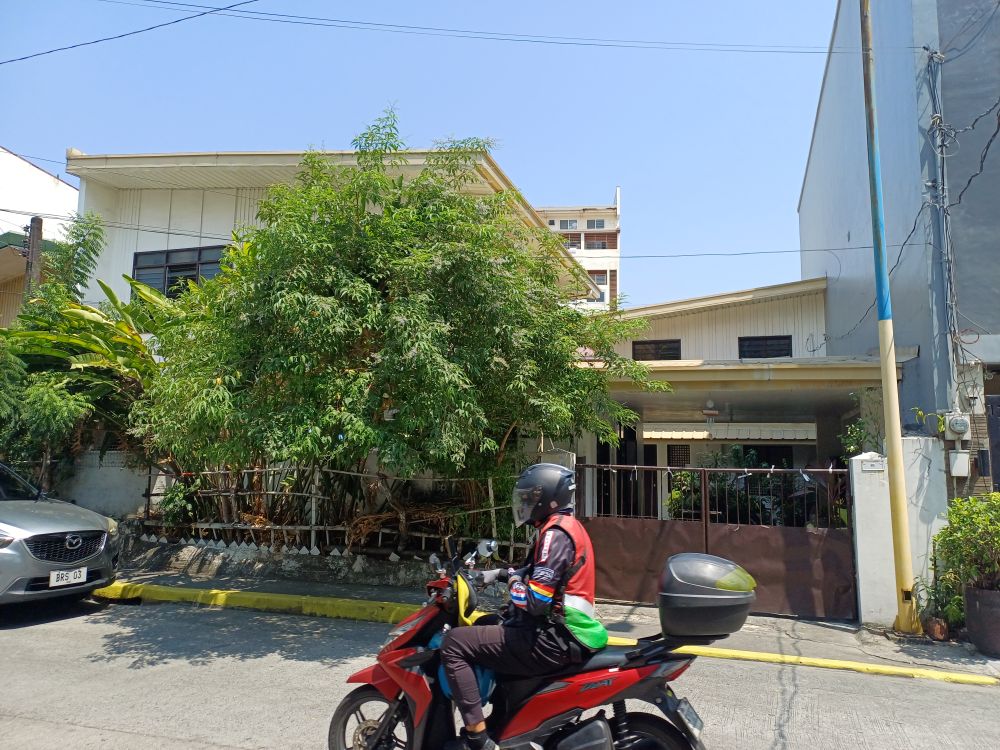
The Little Sisters of Jesus live in this house in Mandaluyong, Philippines, where they live among their neighbors. The low gate allows friends to reach in and open it from outside. (Oliver Samson)
Over decades, their mission has evolved. Age has drawn them away from manual labor and into quieter forms of presence — listening, accompanying the sick, connecting people in need.
Today in Mandaluyong, that presence extends even to those with material comfort.
"Even those who have much in life carry their own poverty," Sister Cecilia said. But the core remains: to be with people where they are.
From the communities they lived among, the sisters say they received more than they gave.
"What I learned from the people is perseverance," Sister Cecilia said. "When you wait in long lines, they will tell you, 'Tyaga lang, sister.' "
"Just be patient, sister."
It is a simple phrase, repeated across the years. For the congregation, it has come to express a faith lived not apart from the world, but within it — amid its struggles and its quiet, enduring hope.
Advertisement
When people ask where their convent is, they answer simply: They do not have one. They have a house.
The sisters have shaped even the smallest details of their home around this openness. They do not keep dogs so that visitors would not be met with fear but with welcome.
It is there, in ordinary neighborhoods, that they have chosen to live — working, listening and accompanying — following a path shaped less by separation than by closeness.