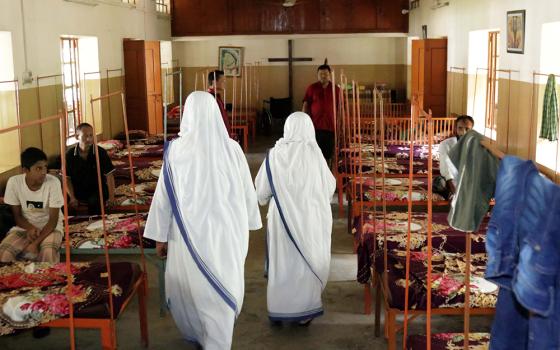
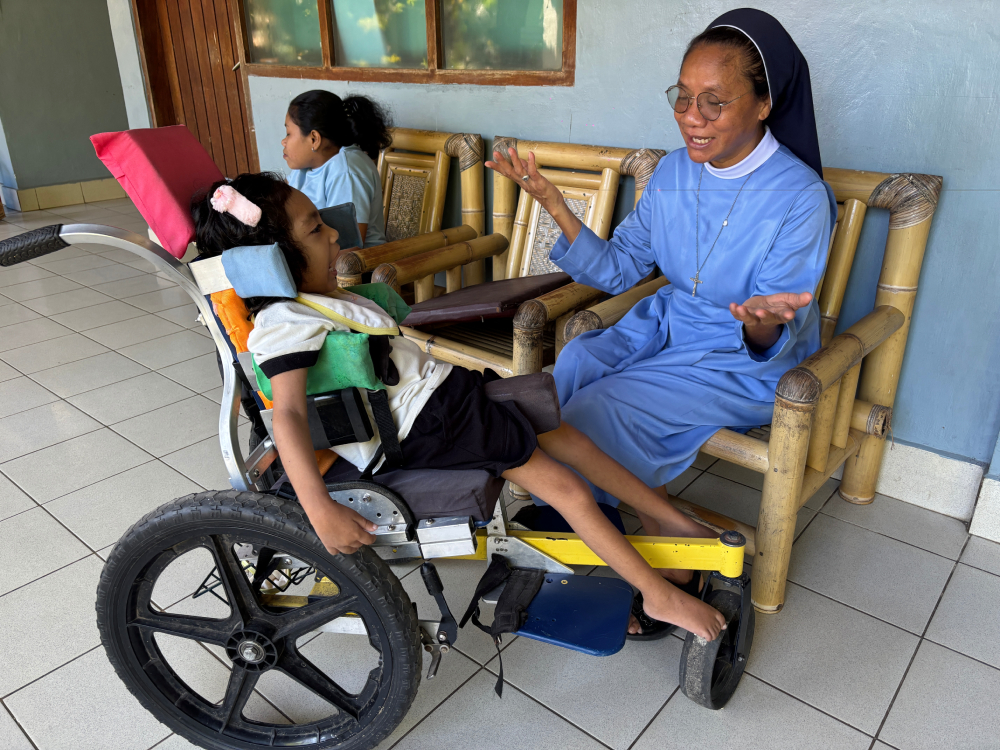
Sr. Lidwina Mamung, 60, comforts a 6-year-old child with a physical disability at the St. Damian Rehabilitation Center for Leprosy and Disability, Binongko, in Labuan Bajo, Flores. (Ryan Dagur)
by Ryan Dagur
From the time he was old enough to walk to school through the rolling highlands of Flores in Indonesia's East Nusa Tenggara province, Agustinus Suryanto knew what it meant to be stared at.
Born with a physical disability, he said he quickly learned a lesson from life: "If you aren't mentally strong, you should never leave the house again," Suryanto told Global Sisters Report in Labuan Bajo, a tourist town on the western tip of Flores.
The 37-year-old is the fourth of nine siblings, five of them born with physical disabilities. No doctor has found an explanation for this.
Three of them eventually found their way to the St. Damian Rehabilitation Center for Leprosy and Disability in Cancar, founded by German Holy Spirit Sr. Virgula Schmitt, who arrived in Indonesia six decades ago.
After Suryanto arrived at the center in 2000, it helped him rebuild his life. He now runs a travel business, has bought land and built a house with his own earnings, and welcomed his first child in mid-June.
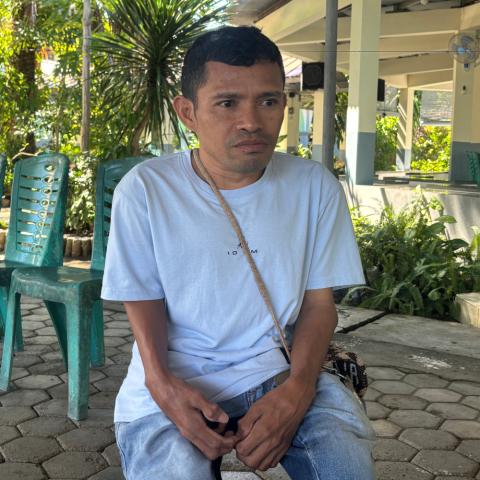
Agustinus Suryanto, an alumnus of the St. Damian Rehabilitation Center for Leprosy and Disability in Cancar, now runs a travel business serving tourists in Labuan Bajo. (Ryan Dagur)
Suryanto's life reflects what Schmitt believed: People with disabilities and those marked by disease do not need pity. They need tools.
A calling like no other
The nun, a trained nurse who arrived on the Catholic-majority island in 1966, quickly realized that leprosy affected people and that disabled children were the most stigmatized. She chose to work with them.
As in most other parts of the world, leprosy patients are often cast out by their families and communities and treated as untouchable. Their situation was particularly difficult in remote Flores.
"Most of the sisters at the time were from Europe, and they didn't always understand the nature of Sr. Virgula's calling," said Indonesian Holy Spirit Sr. Lidwina Mamung, 60. She leads the Binongko center in Labuan Bajo, a sister facility of the Cancar center.
Schmitt deliberately named her institution not an orphanage nor a shelter, but a rehabilitation center. And the patron was St. Damien of Molokai, the Catholic saint who died working with people with leprosy.
Mamung remembers the founder saying, "I am not raising other people's children; I am empowering them."
Schmitt accepted people to the center without the formalities of referral letters or other documents. "She focused on what people needed, not on paperwork," Suryanto said.
When a child arrived at the center with both hands crippled, Schmitt would tell them they still had feet — feet with which they could walk, write and build a life.
"She always said: If you believe you can, you will. Behind every condition, there is always something that can sustain your life," Suryanto said.
He paused. "I had no idea what my potential was. The world felt completely dark."
She opened opportunities for the residents to learn to weave rattan chairs, embroider fabric, carve wood and sew clothing. They were trained to lead prayers at Mass and to speak in front of others — small acts that built up their confidence.
Holy Spirit Sr. Beatrix Sero, 50, who began leading the center in Cancar 10 months ago, says the work helps her "learn from these children."
"Living alongside them makes me stronger. They accept themselves as they are in ways that are often hard for the rest of us. That is extraordinary."
One young man living at the center is completing his university degree in information technology on a full scholarship. Born without hands, he has taught himself to work on his laptop entirely with his feet.
Two centers, one mission
The Cancar Center — now in its 60th year — houses 78 children and young adults, from age eight to mid-20s, coming from across the region.
In 2022, the center started its own school for residents with special needs, so that learning and therapy can happen under one roof.
An Australian medical team makes regular visits, bringing orthopedic surgeons, cleft palate specialists and dermatologists as part of a partnership that Schmitt built.
The Binongko Center, now open for 30 years, was established specifically for seawater hydrotherapy, a recovery method important for patients who have undergone surgery at Cancar.
Schmitt purchased beachfront land from a Catholic family in the area because she believed that for local people, the sea was part of the healing.
The attention and care that 33-year-old Vitalia Jemina receives shows how the nuns work to help the helpless.
She has been suffering since she was 8 years old with knee swelling and pain. Her family treated her with home remedies and traditional medicine. She also visited a local clinic later, which gave her temporary relief.
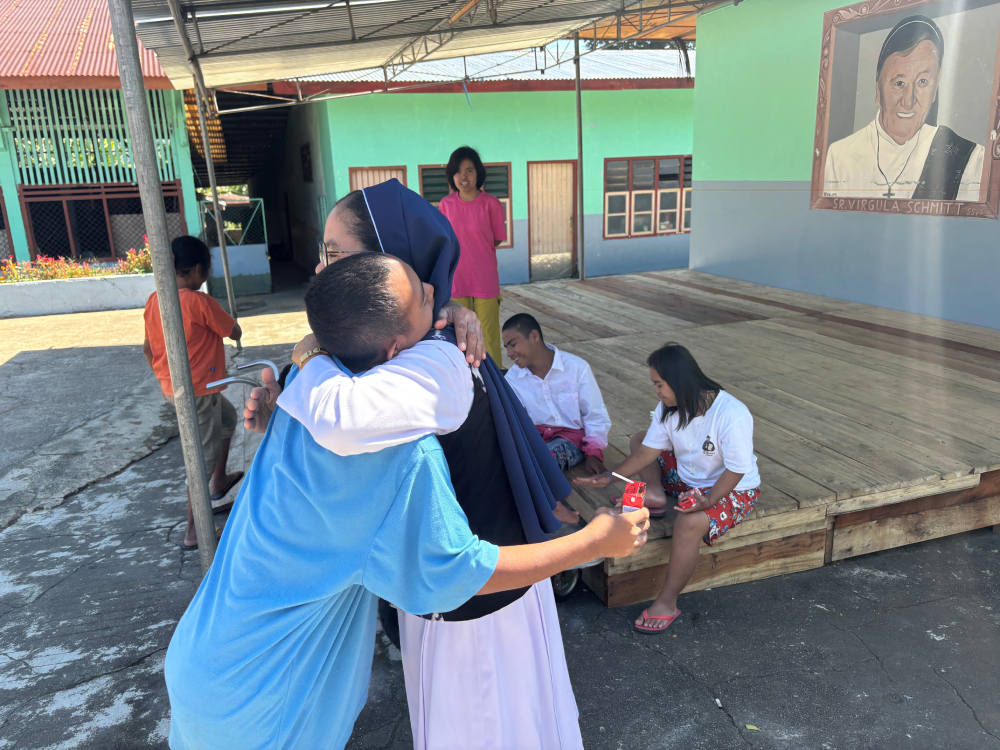
Sr. Beatrix Sero embracing one of the St. Damian Rehabilitation Center's residents. (Ryan Dagur)
But her condition worsened, and a Holy Spirit nun, suspecting leprosy, brought Jemina to Cancar in 2022, where medical tests showed that she had an advanced disorder of the skin and bone, but not leprosy.
After three months of care at Cancar, the single mother of a 12-year-old daughter was transferred to Binongko for easier access to specialists after surgeries in late 2022 and 2023.
When Jemina's daughter came to spend the school holiday with her mother in 2024, the sisters offered her a place to stay to continue her studies at a nearby school.
"I am so grateful my daughter can be close to me. That way I can give her my direct attention as a mother," Jemina said. "And the center gives enormous support for her education."
Over two years, she has watched her daughter adapt and grow. Grades that were modest at first — the adjustment to a new school, a new city — have improved steadily.
Jemina's "only hope is to remain healthy and strong enough" to accompany her daughter as she grows and finishes school. "That alone would be the greatest happiness for me."
The center has some 3,000 alumni, and more than 100 have settled in the Labuan Bajo with families, working as tour guides, hotel staff, airport employees, mechanics, health workers and government officials.
In 2009, alumni founded the Damian Cooperative, which offers low-interest loans to protect members from predatory moneylenders. It now has more than 200 members.
Suryanto's travel business grew from this network. While attending disability community events in Jakarta and Yogyakarta, he kept hearing people ask about the center.
He says his business follows what Damian taught him: honesty and transparency above everything else.
The principle helped him survive in the city — which is gaining attention as the gateway to Komodo National Park, home to the world's largest living lizard — where competition is fierce.
But his clients become his advertisements. "Once, around 20 doctors from Jakarta booked a tour based solely on a previous guest's recommendation," he said.
One of his brothers, who uses a wheelchair, now teaches at a school for students with special needs. Another works at a women and children's protection center. All of them passed through the Cancar center.
What remains unresolved
Mamung speaks plainly about the new cases that continue to emerge from remote villages. Neither center currently has a dedicated leprosy nurse.
"If caught early, leprosy can be cured fully and [people can] return. But without a specialist, we cannot always help people from outside our immediate area."
Advertisement
Schmitt had allocated around 50 plots of land in Labuan Bajo to cure leprosy patients, funded by overseas donors — a way of giving people a permanent foothold after leaving the center.
But over time, some recipients sold their plots. Others fell into debt through online gambling.
"We now focus on education and empowerment," Mamung said. "Giving too much can create dependency."
The center faces other pressures as well. Families sometimes abruptly withdraw residents to qualify for government social assistance programs that require recipients to live at home.
"Many of them end up just sitting inside without any mobility," Mamung said. "Here they have wheelchairs, clean water, friends, and a purpose in life."
Both centers operate almost entirely on donations, according to Sero.
Most caregivers receive no salary. Many are former residents who chose to stay. Neither center has a full-time nurse, even though residents need consistent medical attention. Government support has dwindled in recent years.
Stigma, Suryanto noted, persists as well. "It's not always intentional," he said. "But it still hurts. At Damian, we were taught that self-confidence is the most essential foundation. Everything else is built on that."
Schmitt returned to Europe in 2011 in declining health and died on June 27, 2022, aged 93. That date is now celebrated annually in the Damian alumni community, not in mourning but in gratitude.
Before she left, she ensured the ministry had a solid legal and institutional foundation. She established three separate foundations to advance the social, educational and medical dimensions of the work.
Leadership passed to Indonesian sisters who had served with her for years.
The shift from foreign missionary leadership to local leadership — so often spoken of as an aspiration in religious communities — happened here quietly and without disruption because the values were never held by any one person. They had been built into the daily life of the place.
"We honor her as our founder," Mamung said. "Her spirit is the foundation of all we do. We are God's instruments as long as people need us."