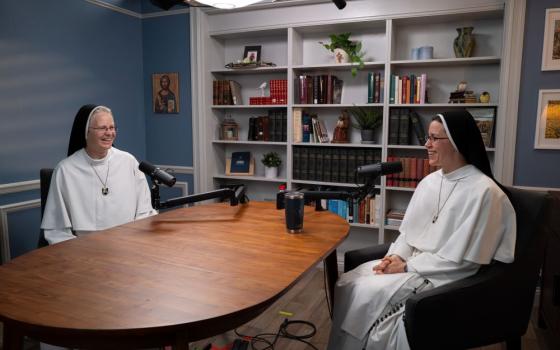
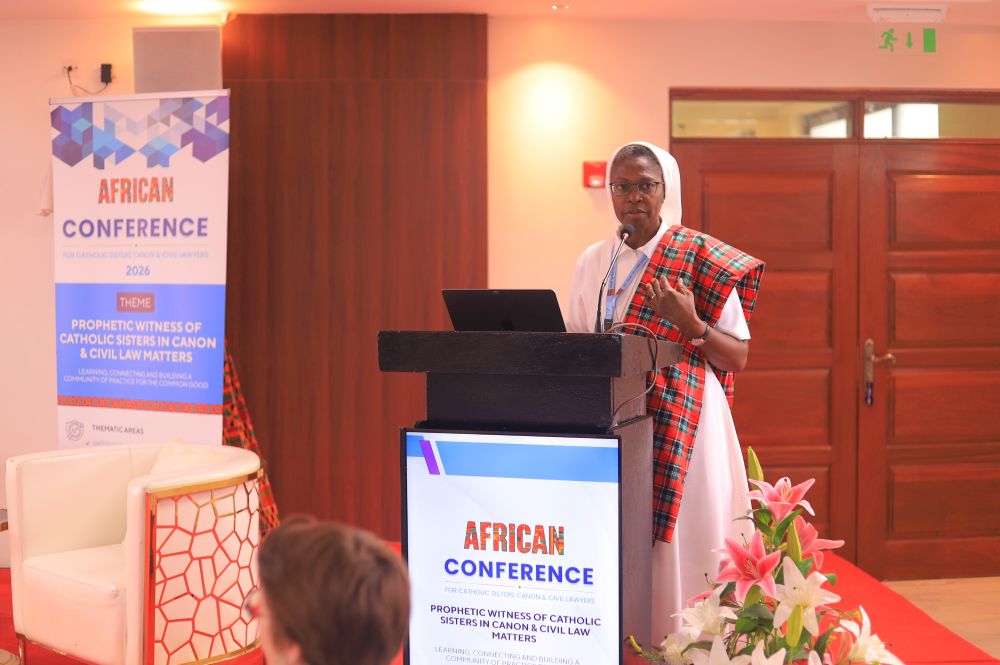
Sr. Dr. Mary Lembo, a psychotherapist from Togo, delivers her presentation on safeguarding in contemporary institutes of consecrated life during the inaugural African Conference for Catholic Sisters in Canon and Civil Law in Nairobi, Kenya. (Wycliff Peter Oundo)

by Mourine Achieng
Before the first session began, the conference hall buzzed with conversations in English, French and Swahili as Catholic sisters greeted one another with warm embraces, exchanged business cards and shared stories about the legal challenges facing their congregations.
For many, it was the first time meeting another sister serving in canon or civil law.
That moment captured the significance of the inaugural African Conference for Catholic Sisters in Canon and Civil Law, held July 30-31 in Nairobi. The conference brought together more than 200 sisters from 13 African countries. It marked the emergence of a growing movement seeking to strengthen justice, safeguarding and accountability within religious life through legal collaboration.
The conference was born from the Catholic Sisters in the Legal Profession's objective to raise the visibility of religious women serving in legal fields. In addition to running schools, hospitals, development projects and social ministries, many religious institutes across Africa are navigating heightened safeguarding expectations and increasingly complex legal responsibilities.
Sr. Eutropia Chao Mwakamba, director of Catholic Sisters in the Legal Profession, told Global Sisters Report that many sisters trained in canon or civil law often serve in ministries unrelated to their legal expertise. Even those working in the legal profession frequently do so in isolation, with little opportunity to connect or collaborate with peers — even as the legal demands facing religious institutes continued to grow.
"We convened the African conference hoping to have 100 participants, but we surpassed our target," said Chao*, a Missionary Sister of the Precious Blood. "We hosted more than 200 sisters" — as well as representatives from key Vatican offices, including the Pontifical Commission for the Protection of Minors and the Dicastery for Evangelization, and other organizations involved in safeguarding and consecrated life.
WhatsApp group turned movement
"It all started when Sr. Joyce Meyer of the Sisters of the Presentation of the Virgin Mary in the United States shared the idea of starting a community for civil and canon lawyers with me," Chao said. "We started one." (Meyer is the international sister liaison for GSR.)
What followed surprised even its founders: The WhatsApp group evolved into a Kenyan consortium and later into a registered legal organization promoting legal services, mediation and alternative dispute resolution for religious institutes.
Sr. Jane Wakahiu, associate vice president of the Catholic Sisters Initiative at the Conrad N. Hilton Foundation (a major funder of GSR), told GSR that rapidly changing ministry — including AI, social media and other emerging challenges — prompted organizers to bring sisters together.
Together, these challenges highlighted the need for strong governance, clear policies, and supportive leadership within congregations and ministries, as well as accompaniment for those experiencing disadvantage.
"We gather in the spirit of synodality united in mission to engage in honest dialogue about religious life, our prophetic roles, challenges we face in ministry, our care for those we serve and practices that must be transformed to foster a culture of protection and wellbeing for all those entrusted to us," Wakahiu said.
That vision shaped discussions throughout the conference, where participants argued that legal knowledge is no longer confined to tribunals or diocesan offices. Increasingly, they said, it has become an essential ministry that helps religious institutes protect vulnerable people, steward resources responsibly and strengthen trust in the communities they serve.
Safeguarding emerged as one of the clearest examples.
Rather than asking whether congregations have safeguarding policies, presenters challenged participants to examine whether they have created lasting cultures of protection rooted in formation, accountability and leadership.
"The instrument to make safeguarding a culture in religious life is formation," said Sr. Dr. Mary Lembo, one of the conference presenters with extensive experience in religious formation. "That's why the guidelines, the policies and the code of conduct must start with the candidate and continue throughout their religious life."
Among the issues discussed were the canonical separation of members from religious institutes, church property administration, corporate governance and data protection. Rather than treating them as technical legal matters, participants viewed them as practical challenges affecting the daily life and mission of religious congregations across Africa.
Yet even as the conference explored complex legal questions, its central message remained simple: Sisters trained in law should no longer work alone.
For many participants, the gathering was the first opportunity to meet women religious facing similar responsibilities. Throughout the two days, conversations continued long after formal sessions ended as sisters exchanged contacts, compared experiences and discussed how they could support one another long after returning home.
Advertisement
Sr. Luciana Wanyahoro, chair of the Catholic Sisters in Legal Profession advisory board, said she hoped the gathering would strengthen both professional competence and collaboration.
"This conference will inspire meaningful dialogue, strengthen our professionalism and collaboration," said Wanyahoro, of the Visitation Daughters of Mary. "Together, we can make it. This conference will equip us to serve the Church and our congregations better."
Organizers say that spirit of collaboration is what they hope to replicate across the continent.
Chao said the Kenyan initiative is intended to serve as a model for sisters in other African countries, encouraging them to establish their own legal consortiums while creating a continental network of canon and civil lawyers who can share expertise, accompany one another and strengthen religious institutes.
"We want the impact of this conference to be felt across Africa by increasing the visibility of Catholic sisters in the legal profession," Chao said. "We also hope the documentation from this conference will strengthen the work of canon and civil lawyers across the continent."
Wakahiu said the participants left Nairobi with a shared commitment to continue learning from one another.
"The sisters expressed joy, hope and a commitment to working together in a spirit of synodality to support religious in their countries," she said. "They also pledged to foster networks for learning, collaboration and mutual support."
Looking around at the hundreds of sisters gathered in Nairobi, Meyer reflected on how far the initiative had come from its modest beginnings.
"Isn't this amazing!" Meyer said. "We simply opened the door through a WhatsApp community, and all these canon and civil lawyers came through."
*This story has been updated to use Chao instead of Mwakamba as a surname, per the source's request.