
Sr. Debra Sciano throws out the ceremonial first pitch at a Milwaukee Brewers game June 17. Sciano, who will become president of the Leadership Conference of Women Religious Aug. 1, is such a big baseball fan she keeps score during games on a paper scorecard. (Courtesy of Kathy Sciano Lamb)

Sr. Debra Sciano is the kind of baseball fan who fills out a scorecard as she watches the games, using a pencil and paper to record outs, hits and errors.
That is also how Sciano, provincial leader of the School Sisters of Notre Dame's Central Pacific Province, lives her life: with a different view of the world, and on a different level.
Whether representing abused children as a prosecutor, navigating years of tension between U.S. Catholic sisters and the Vatican, or helping lead one of the country's largest communities of Catholic sisters, colleagues say Sciano, 68, approaches every challenge with the same attentiveness, empathy and instinct to listen.
On Aug. 14, Sciano will become president of the Leadership Conference of Women Religious, the organization representing about two-thirds of the nearly 35,000 Catholic sisters in the United States. After serving as an LCWR region chair, national board member and president-elect, she succeeds Presentation Sr. Vicky Larson as the conference continues emphasizing collaboration among congregations, lay partners and the global church.
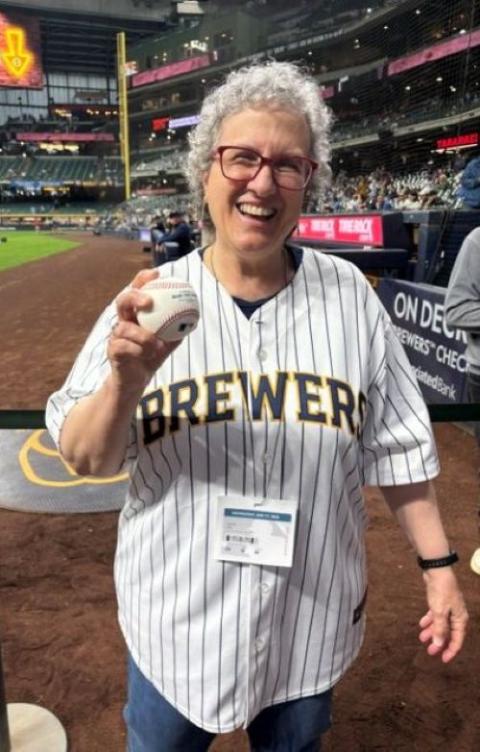
Sr. Debra Sciano poses at a Milwaukee Brewers baseball game June 17, where she threw out the ceremonial first pitch. (Courtesy of Kathy Sciano Lamb)
Milwaukee attorney Mark Cameli, who has known Sciano nearly 20 years, said filling out a paper scorecard during a baseball game is an example of how she does things differently. A scorecard is an anachronism in an age of instant communications and digital access to every imaginable statistic. But there's also something special about a tradition almost as old as the game itself.
"I think it draws you into the game in a different way," Cameli said. "With baseball, there's the social interaction, the food and the beer — people [that keep score by hand] are not going for that purpose at all. They're having a different kind of experience. They're watching at a granular, more nuanced level."
And you can see that in Sciano's life as a woman religious, he said.
"She has real empathic powers to understand people in their place and their experiences," Cameli said. "She has these amazing empathic powers to make others around her better, and that's really the essence of a good leader."
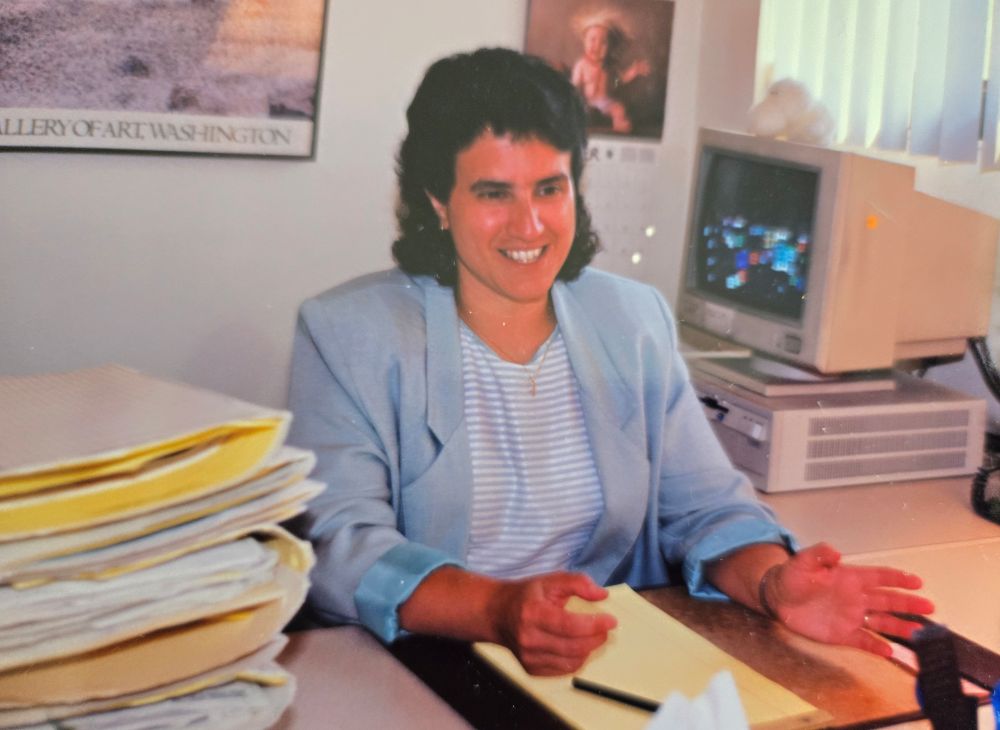
Sr. Debra Sciano sits at her desk in the Children's Court Center in Milwaukee in 1990 or 1991, where she served as an assistant district attorney for the state of Wisconsin. (Courtesy of Debra Sciano)
The day Sciano assumes the presidency, the last day of LCWR's annual assembly, current president Presentation Sr. Vicky Larson will become past president; and current past president St. Joseph Sr. Kathy Brazda will end her term in the organization's triumvirate presidency. Sinsinawa Dominican Sr. Betsy Pawlicki will become president-elect. (The assembly runs Aug. 11-14 in Orlando, Florida.)
Because LCWR has a three-person presidency, Sciano said, the practical changes in her duties will be modest, though she expects more speaking engagements and travel. Her year as president-elect included meetings with bishops and leaders of religious conferences, as well as a March trip to Rome to meet officials from every Vatican dicastery and Pope Leo XIV.
"It was amazing. I've been to Rome many times because our congregation is international … but this time was totally unique," she told Global Sisters Report. "The ultimate blessing was the meeting with Pope Leo."
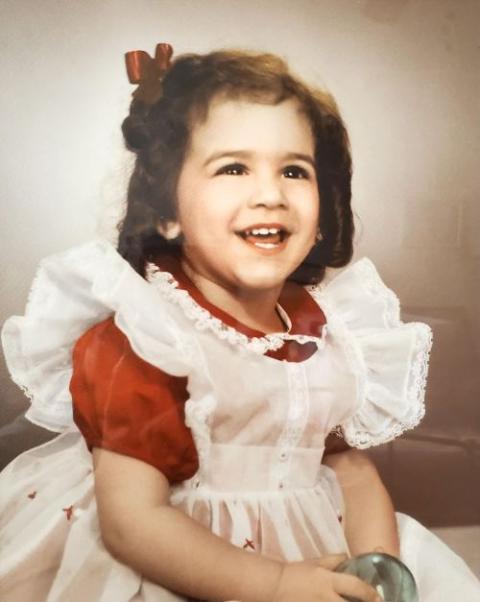
Sr. Debra Sciano, pictured at age 2, grew up in an Italian neighborhood on Milwaukee's east side. (Courtesy of Debra Sciano)
The trip also changed her perspective on the Vatican, which had been shaped by the stress and sorrow of the apostolic visitation of sisters in the United States and the doctrinal investigation of LCWR, which ended in 2014 and 2015, respectively. At the time, Sciano was helping her congregation merge four provinces into one.
"As hard as it was to merge four provinces, the sisters were saying, 'We're not worried about combining four provinces, we're worried about this visitation,' " she said. "There was a lot of pain, a lot of hardship."
But that atmosphere of conflict was gone when she traveled with other LCWR leaders to Rome this year.
"For me, there was a lot of transformation that happened within myself. It was a mind-opening and heart-opening opportunity for me," Sciano said. "I felt a real openness, a real willingness to get to know each other. There was respect and a welcoming spirit in every office."
The trip also reinforced for her that the concerns facing women religious in the United States are only one part of a much larger global church.
"When I think about what they have to deal with …" Sciano said. "We all are struggling. We talked about things happening in the states that we're concerned about, but we always also have to talk about the global reality."
'Hard to go home at night'
Sciano grew up in an Italian neighborhood on Milwaukee's east side, attending an Italian parish and living among a large extended family. All four grandparents had immigrated from Sicily.
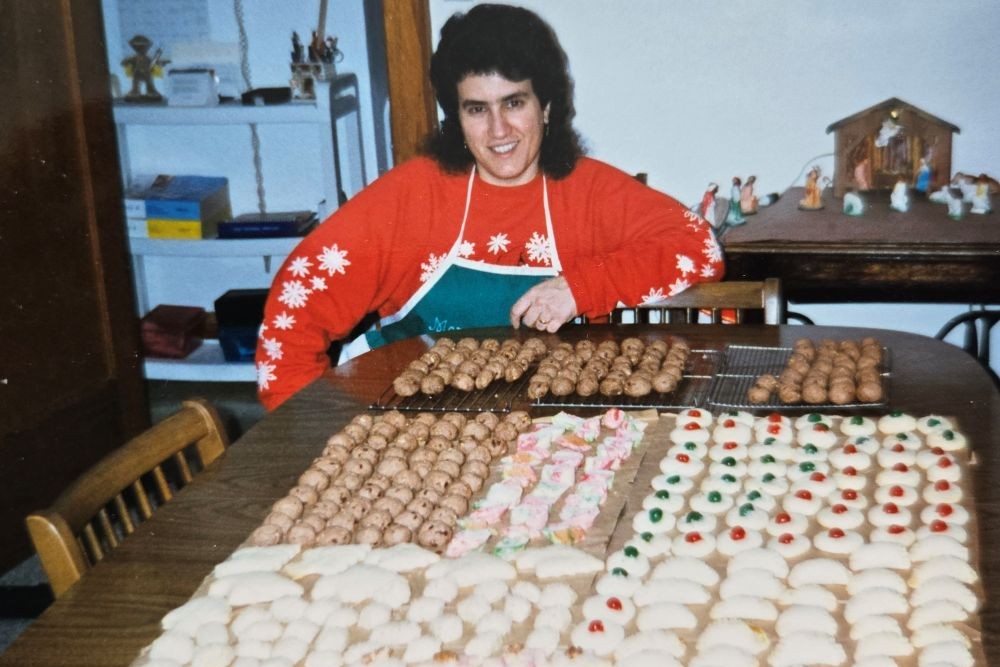
Sr. Debra Sciano poses in 1994 with the dozens of Italian cookies she loves to bake. (Courtesy of Debra Sciano)
She still loves to cook, especially Sicilian dishes such as sugu, chicken parmesan, stuffed shells, lasagna and, "Of course you gotta make meatballs." She was once known for making Sicilian-style pizza for congregational fundraisers, using 100 pounds of flour for the hand-kneaded dough. "The sauce tends to be a little sweeter — it's a secret family recipe," she said.
A lifelong Milwaukee Brewers fan, Sciano grew up playing baseball with her older sister, Kathy Sciano Lamb, who pitched while Deb played catcher. "She is a fanatic," Lamb said. "She's got dirt from the Brewers' field in her house. She keeps score — we go to a game and I don't even know what she's doing."
In June, Sciano threw out the ceremonial first pitch at a Brewers game.
"That was probably one of the highlights of her life, aside from meeting the pope," Lamb said.
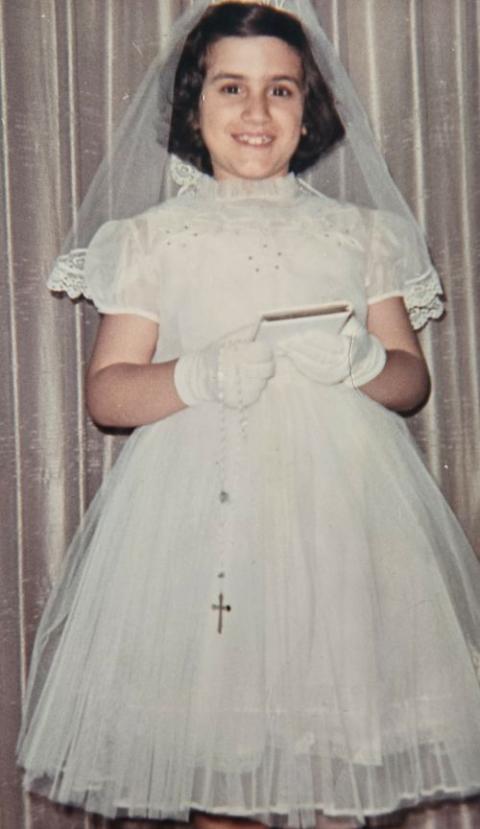
Debra Sciano celebrates her first Communion in 1966. (Courtesy of Debra Sciano)
Sciano was the youngest of three girls and never imagined religious life, even after attending a Catholic high school taught by the Sinsinawa Dominican sisters. Instead, she wanted to become a lawyer.
Then, a friend interested in religious life invited her to a vocation retreat with the School Sisters of Notre Dame. There, she met a boy she began dating — but she also met three sisters who made such an impression that the idea of religious life entered her mind and never left. She entered the congregation in 1977 at age 19.
"Of course, I tried to talk her out of it," Lamb said. "But once she decided, I was very supportive of her."
Lamb said their maternal grandmother should get some of the credit.
"We lived in a duplex with all our grandparents, and when she was 5 or so, she got moved to Nana's room," Lamb said. "Nana was very spiritual. She basically sat in her room and prayed the rosary, so Nana would be sitting there praying over her. I always thought that had an influence."
After entering religious life, Sciano earned a bachelor's degree in criminal justice from the University of Wisconsin-Milwaukee and a law degree from St. Thomas University in Miami. She spent nearly 13 years as a Wisconsin assistant district attorney representing children in need of protection and services, work that exposed her daily to abuse and neglect.
"To this day I vividly remember some of the things she told me," Lamb said. "I think it was just her spirituality that she had that got her through, and the support network in the district attorney's office. That and she was making progress, she was winning cases. You know you're making a difference; on the other hand, you know you're going down a deep hole that can never be filled."
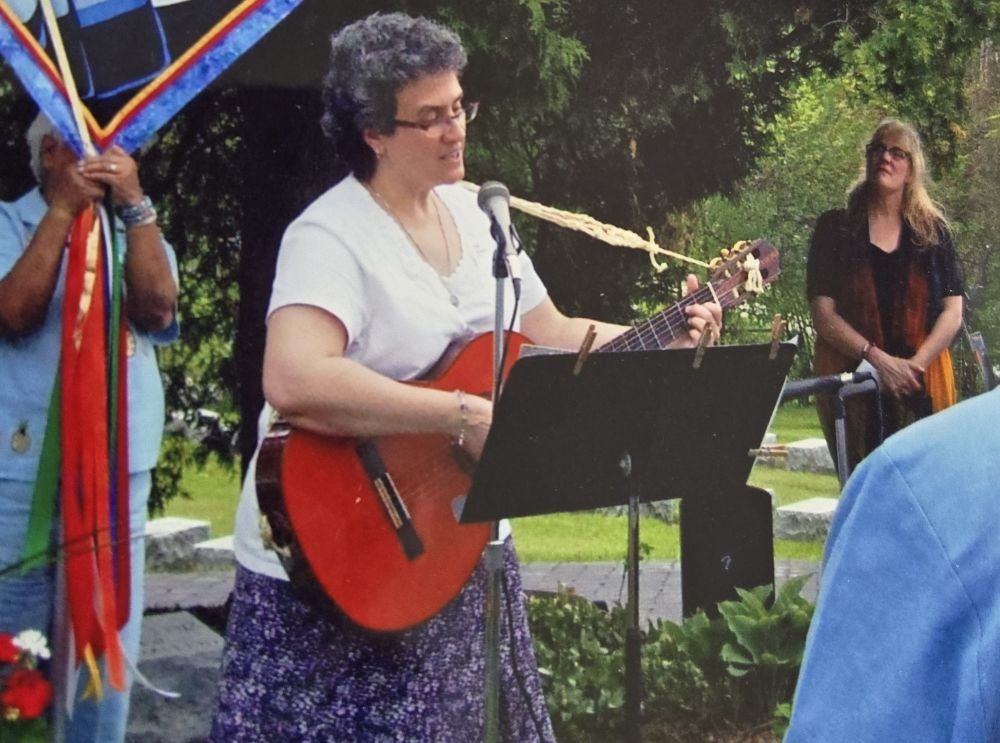
Sr. Debra Sciano leads a group in song in 2011 as the School Sisters of Notre Dame closed the Milwaukee Province and merged it with three others. (Courtesy of Debra Sciano)
Sciano said several factors sustained her in the role.
"The lawyers, the social workers, teachers, hospital personnel — we were all there for the same reason: We cared about the children we were working with. But with the worst of the worst cases, it was hard to go home at night," she told Global Sisters Report in October. "Community and prayer are so essential. Learning to take that time to be centered, having a spiritual director, getting exercise. I was probably more balanced then than I am now with being in leadership."
In 1998, Sciano successfully argued a case before the Wisconsin Supreme Court — an accomplishment she never mentioned during multiple interviews.
"As a lawyer, I should know that. But I don't think I know that," Cameli said, despite writing a bio of her when she was named Italian of the Year by the Wisconsin chapter of the Italian American Bar Association.
The case, Sallie T. vs. Milwaukee County Department of Health & Human Services, addressed the complex question over the presumption that it is in the best interest of a removed child to be returned to their biological family, if possible; the rights of foster parents to intervene; and what a court can and cannot consider in those cases.
"She did amazing things as a young person," Cameli said.
'It just doesn't leave you'
Sciano always saw herself as an attorney, but never imagined herself as a leader. The congregation repeatedly encouraged her to consider leadership, and she finally agreed in 2001 as she began feeling burned out by her work with abused children.
"It's one of those things that never quite leaves a person," Sciano said. "To this day I remember those children. It just doesn't leave you."
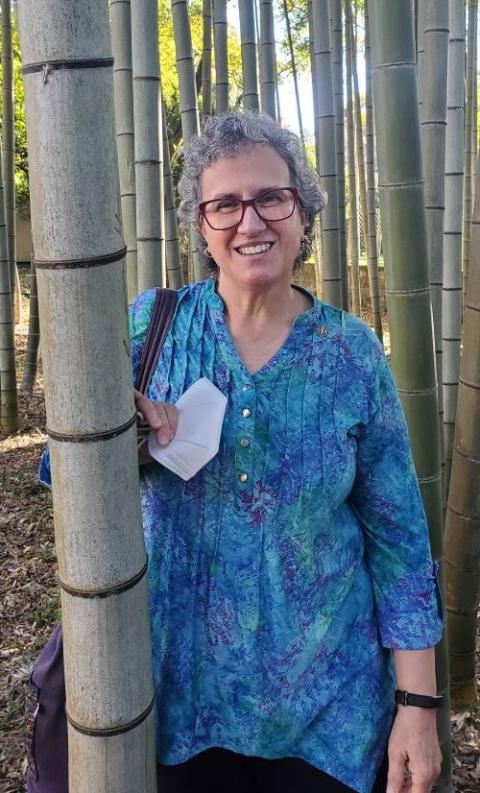
Sr. Debra Sciano poses with bamboo trees on a trip to Japan in 2022. (Courtesy of Debra Sciano)
Neither did the things she learned in the position.
Early in her legal career, she lived in a convent next door to then-Milwaukee Auxiliary Bishop Richard Sklba, and they often gardened together.
"He asked how I was doing, and I said I can represent and advocate for the children, but working with the parents is really difficult," Sciano said. "He said to me, 'Remember, those are the ones you're being called to.' It helped me understand every person comes from their own heartbreak and their own circumstances. … Everything we do in life, you build on it and learn, to help you with the next thing."
Cameli said those years made Sciano the leader she is today: She served in Volunteers In Service to America (now part of AmeriCorps), was a community organizer, and while in law school served as a child advocate and worked for the Legal Aid Society.
"This was all instilled in her, but some of this I also think is just hardwired," he said. "She's an amazing leader because of it."
Sr. Helen Jane Jaeb, who has served in leadership with Sciano since 2009, said her leadership is defined by listening and inclusion.
"She doesn't do it alone. She is a person who really tries to include all who need to be," Jaeb said.
Despite her accomplishments, Jaeb added, Sciano never places herself above others. "When there were legal issues she was working on for us, even with her background as a lawyer she depended on others to help. She didn't just make the decision, she asked for help from others with the right background to help us through things."
"She's one of us. It's not, 'I'm the provincial.' ... She's just very inclusive. She's really a great listener."
Advertisement
She may be a natural leader, but she is not always comfortable in the spotlight.
Tom Koester, director of liturgy and music at Sts. Peter and Paul Parish in Milwaukee, said Sciano would rather lead a congregation in song than deliver a speech.
"She's a great leader and a great presence when she's up there," Koester said. "She says the choir has been a kind of respite and home for her."
'A really rich experience'
Sciano said she expects LCWR to continue emphasizing collaboration among congregations, church organizations and lay partners, noting that justice promoters and communicators have again been invited to the annual assembly.
"That's just part and parcel, every day," she said. "It's been a really rich experience for us."
She said Pope Francis' emphasis on synodality — walking together — has helped shape that approach.
"We've grown into what [synodality] means," Sciano said. "It's really important we get beyond what we've always done."
And the future of religious life is bright, she said, regardless that the number of women religious in the U.S. continues to fall.
"We've connected and shared our charisms and values and ministries for decades. And that lives on," she said. "There's something about what we have to offer, and I think people are attracted to that."