
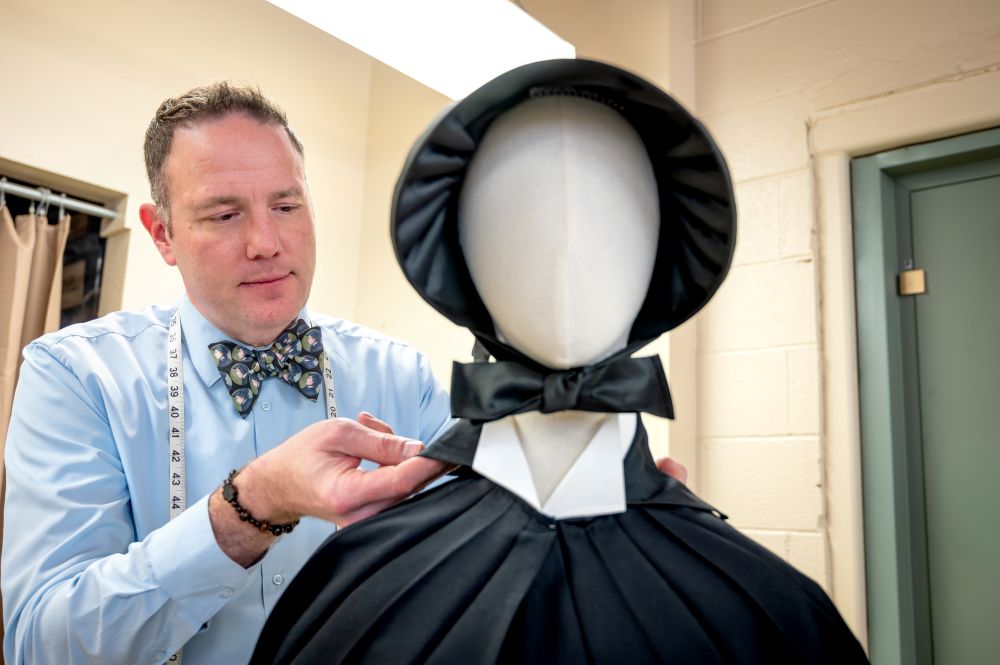
Darrin Pufall Purdy, theater professor at Boise State University, fixes a replica of a habit the Sisters of Charity of New York wore in the 1950s in an undated photo. Pufall Purdy's research on the habits of women religious led him to advise and design costumes for Broadway. (Courtesy of Darrin Pufall Purdy/Priscilla Grover)

by Rhina Guidos
In the pleats, cuffs and hems of the habits of the Sisters of Charity of New York, theater professor Darrin Pufall Purdy found a type of calling of his own.
While attempting to reconstruct habits worn by nuns for the theater production of the play "Doubt: A Parable," which prominently features the Sisters of Charity of New York in the 1950s, he found elegance and mystery looking at photos of the long black garments, derived from widow's clothing worn by congregation founder Elizabeth Ann Seton.
The sisters had modified the habit in the 1960s, after the Second Vatican Council allowed congregations to modernize the clothing. They gradually stopped wearing habits in the 1970s and only parts of original ones remain.
Though photos were abundant, there wasn't much information about the garments, not even a pattern. That presented a challenge for the professor as he looked to accurately represent the sisters' clothing.
"I kept asking myself: 'What exactly am I looking at?' " Pufall Purdy, director of university theater and costume design at Boise State University, recalled during a May 12 presentation at Philadelphia's American Catholic Historical Society.
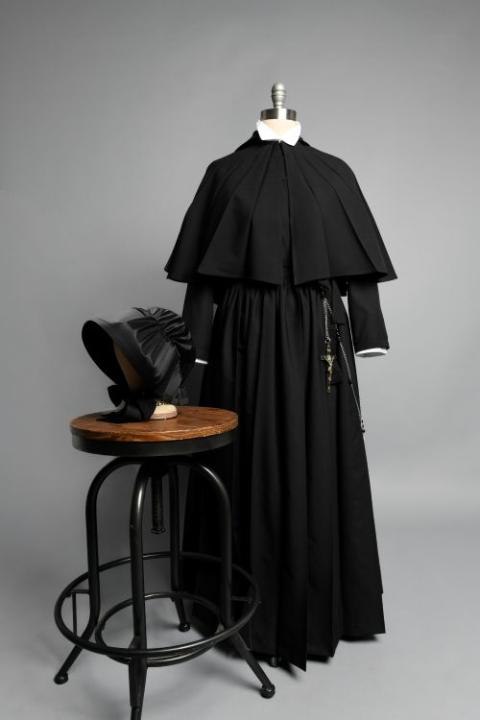
This undated photo shows a replica of a habit the Sisters of Charity of New York wore in the 1950s as recreated by Darrin Pufall Purdy, theater professor at Boise State University in Idaho. (Courtesy of Darrin Pufall Purdy/Jonathan Collins Photography)
His curiosity led him down a path of putting together a researched version of the clothing for the play. The historic pattern he later gave to the Sisters of Charity, something he is now doing with other congregations of women religious in the United States trying to regain that part of their history, including the Servants of the Immaculate Heart of Mary, in Scranton, Pennsylvania, and the Oblate Sisters of Providence in Baltimore. But it all began with the Sisters of Charity of New York.
In rehearsal rooms and costume shops, he had looked for details, trying to reconstruct garments that audiences barely noticed but carried the emotional weight of "Doubt," about the clash between a priest and sister, who suspects him of abuse. The play by John Patrick Shanley premiered on Broadway in 2005.
An important connection surfaced during the COVID-19 pandemic that elevated Pufall Purdy's research. Mindy Gordon, director of archives at the Sisters of Charity of New York, told him about random pieces of clothing in the congregation's archive, including a chemise, a type of smock, a pair of wool stockings, capes, an apron and about a dozen caps, "but not one full habit," he said. The most important resource the community had, however, were two sisters who had worn the garment, including one, nearing 90, who remembered it "down to the quarter inch," the professor said in his presentation.
She filled him in about some of its mysteries including a "death tuck." After a sister's death, her shoes were removed and a 6-inch piece of folded fabric at the bottom of the habit was stretched out to cover her feet as the body was placed inside a coffin.
Why not bury her with the shoes?
"They were expensive," and another sister could use them, she told him.
Sisters also wore an apron, tied at the waist and invisible in many photographs. But they weren't buried wearing it because, as another nun explained to him, the sister's work on earth was done, no need for the apron. The cap was made from silk and cardboard, shaped by an internal cord drawn tight enough to leave marks on the wearer's ears after decades of use. At night, sisters preserved the sharp pleats in the aprons and capes by placing them between pieces of cardboard beneath their mattresses.
'It's not just about a static garment. It's about the people who wore it.'
—Darrin Pufall Purdy
Using his iPad, Pufall Purdy began filming interviews about the clothing with sisters, who demonstrated how garments were folded, pinned and worn. What started as a costume research project evolved into an act of historical preservation for a disappearing generation as the Sisters of Charity of New York announced in 2023 that they will no longer take new members.
"They use the term 'coming to completion,' " Pufall Purdy explained about the term religious orders in the U.S. use to signal closure, or what they see as the end of the congregation's historical life cycle. "I think, as laypeople, we think, 'Oh, it's so sad.' But they [sisters] believe the Holy Spirit has told them that they have come to do what they were meant to do, and now it's time for others. And I think it really changed my view of a community coming to an end."
And thanks to the professor, who has collected details, the regained history of the clothing will remain.
"It's not just about a static garment," he said. "It's about the people who wore it."
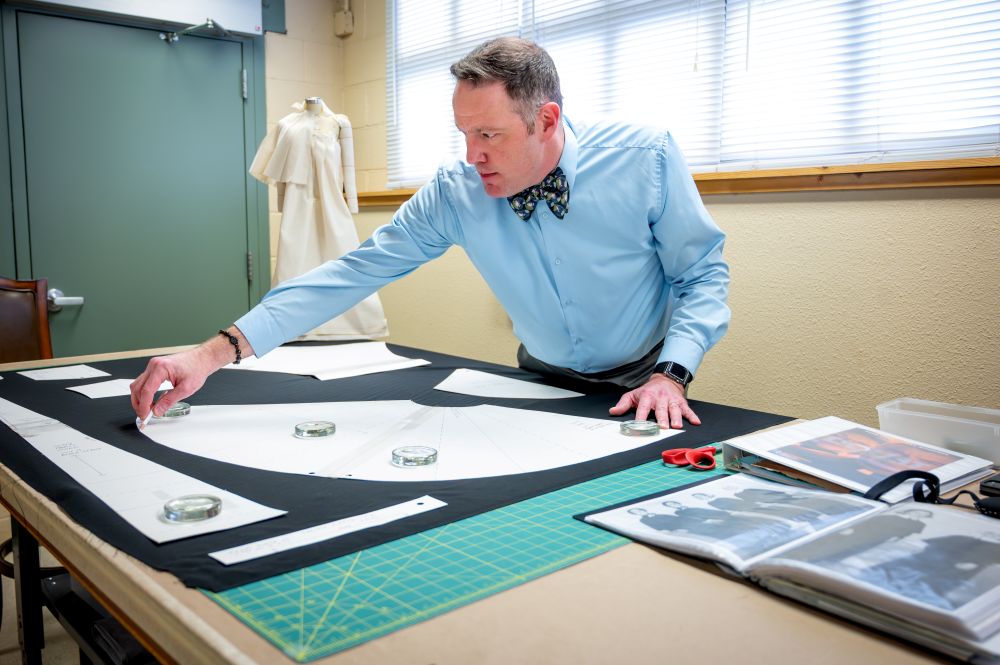
Darrin Pufall Purdy, theater professor at Boise State University, works on a replica of a habit the Sisters of Charity of New York wore in the 1950s. His research led him to advise and design costumes for the Broadway revival of "Doubt: A Parable." (Courtesy of Darrin Pufall Purdy/Priscilla Grover)
After completing a replica of Sisters of Charity habit, from undergarments to outer cape, the process revealed embedded frugality. Petticoats contained a 12-inch strip of expensive black fabric only where the hem might show beneath the tunic. The rest was constructed from muslin, one of the cheapest types of fabric available. The sisters didn't use a full white shirt but gave that impression with the use of detached white collars and cuffs for laundering and, in some cases, they used plastic bleach bottles or the white part of cereal boxes as cuffs.
Pufall Purdy's devotion took a turn he didn't expect when archivist Gordon called to tell him a 2024 Broadway revival of "Doubt" was in the works.
"You should work on that," she told him.
Purdy thought that would be a long shot, but then he received an urgent email from someone working on the production who had talked to the sisters. Officials asked him to put together an authentic habit for a publicity shoot. Impressed with his work, the professor was then commissioned to create habits for the production.
Advertisement
The work is not about costumes, he told the audience at the historical society presentation.
"It's about fashion history. It's about women's history, and about Catholic heritage," he said. "It's been the surprise of my career and the delight of my life to be able to work not only with the Sisters of Charity of New York, on this specific part of the project, but it has opened up a wide field of opportunity for me to collaborate with other communities. So, I am so delighted to be the voice for some of these communities to help unfold the mystery of this beautiful ritual of clothing that they have brought to our history."