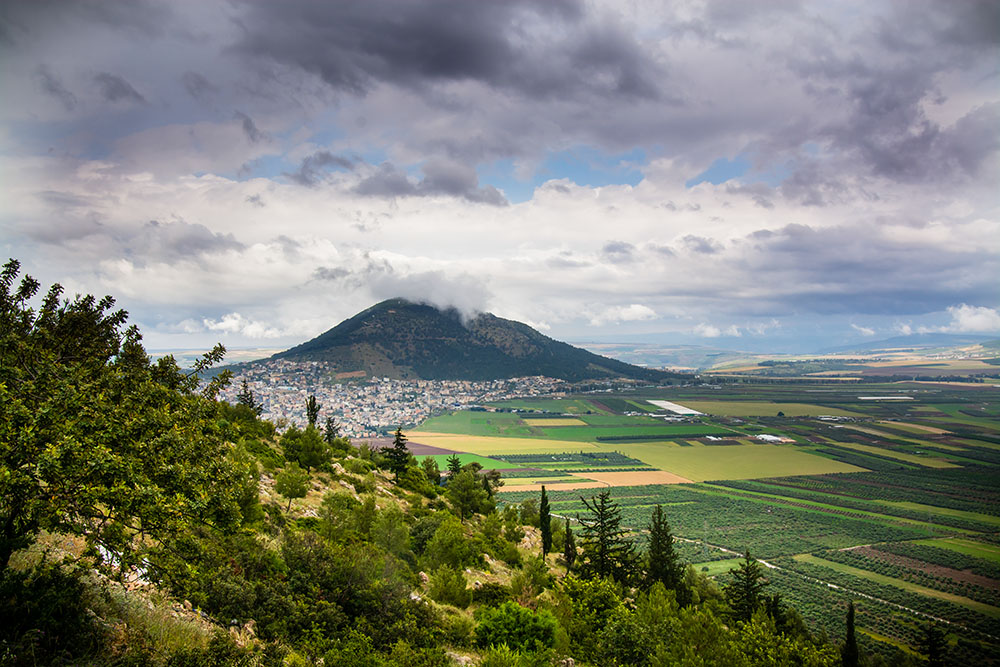
Clouds pass over Mount Tabor in the distance in Galilee, Israel. The mount is traditionally known as the site of Jesus' transfiguration. (Wikimedia Commons/Reutmaor)

by Sr. Mary Nzilani Wambua
Editor's note: Welcome to Theologians' Corner, where each week a different woman theologian from around the world offers a fresh reflection on the Sunday readings.

Second Sunday of Lent
March 1, 2026
The second Sunday of Lent places us at a turning point in the Lenten journey. This Sunday presents the Transfiguration as a counterbalance to the Temptation narrative of the first Sunday, where we began in the desert with Jesus, confronting temptation and learning reliance on God.
Today, we are led up the mountain, where God reveals not a demand, but a promise that transformation is possible when we trust and listen. Liturgically, this Sunday serves to strengthen the faithful for the penitential journey ahead by offering a foretaste of Easter glory.
The first reading from the book of Genesis reminds us of the call to leave everything and follow Christ. It tells us that God's call to Abram is radical. Abram is asked to leave everything that defines security and identity — his land, his family, his past. He was told to do so without knowing exactly where he was going. What God offers is not a detailed plan, but a relationship and a promise: "I will make of you a great nation."
This reading reminds us that Lent is a season of leaving behind: habits that enslave us, attitudes that harden our hearts, comforts that keep us from growing. Like Abram, we may hesitate because we want certainty before obedience. But Abram teaches us that faith is not about understanding every step, it is about trusting the one who calls. Abram's greatness does not come from achievement, but from obedience. His journey begins not with confidence, but with trust.
Lent asks us the same question: What familiar place is God asking me to step away from?
The responsorial psalm echoes this trust: "Lord, let your mercy be on us, as we place our trust in you." Trust here is at the heart of the spiritual life, an active choice to rely on God rather than on our own strength or understanding. Lent gently strips away the illusion that we can save ourselves. Through fasting, prayer and sacrifice, we are reminded that our hope rests in God alone.
This psalm teaches us to wait, to trust even when God's action is not immediate or visible. Waiting on the Lord is not weakness; it is quiet strength formed through faith.
Advertisement
In the second reading, Paul speaks honestly about the cost of discipleship. He is reminding us that following Christ involves sacrifice and, at times, suffering. Paul does not deny this reality, but he reframes it. Suffering for the Gospel is never pointless because our hope is rooted in God's saving power, revealed fully in Jesus Christ. Lent is not about proving ourselves worthy. It is about allowing God's grace to work in us, even through difficulty.
The Gospel of the Transfiguration is the heart of today's celebration. Jesus takes Peter, James and John up a high mountain, where he is revealed in glory. Moses and Elijah represent the law and the prophets, indicating that Jesus is the fulfillment of Israel's sacred history. The Father's voice declares: "This is my beloved Son ... listen to him." The divine voice here emphasizes obedience and faith over understanding.
This moment is not meant to remove suffering from Jesus' path. In fact, it comes immediately after Jesus predicts his passion. The Transfiguration is given so that the disciples will remember who Jesus truly is when they later see him rejected, beaten and crucified.
Peter wants to remain on the mountain. Like him, we often want faith to stay comfortable, uplifted and free from challenge. But discipleship does not stop at the mountaintop. Jesus leads the disciples back down, toward Jerusalem, toward the cross.
Lent reminds us that God's light often shines brightest not by removing darkness, but by transforming us within it. What we need to remember is that God does not call us to remain where we are, but to follow, to listen and to trust, even when the path includes uncertainty and sacrifice.
As we continue with our Lenten journey, these readings ask us important questions: What is God asking me to leave behind? Where am I being called to trust more deeply? Am I willing to listen to Christ, even when his path leads through difficulty?
Like Abram and the disciples, we are invited to walk forward in faith. And, like them, we are assured that God is faithful. The glory revealed in Christ reminds us that transformation is possible and that beyond every cross, God is already preparing resurrection.