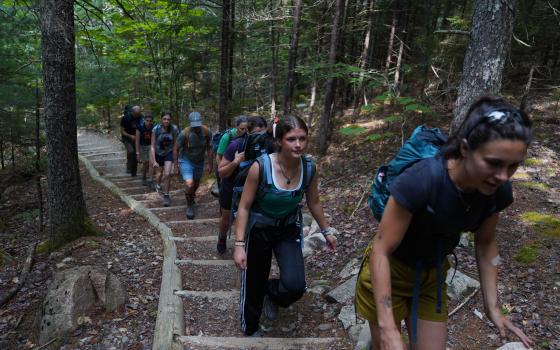
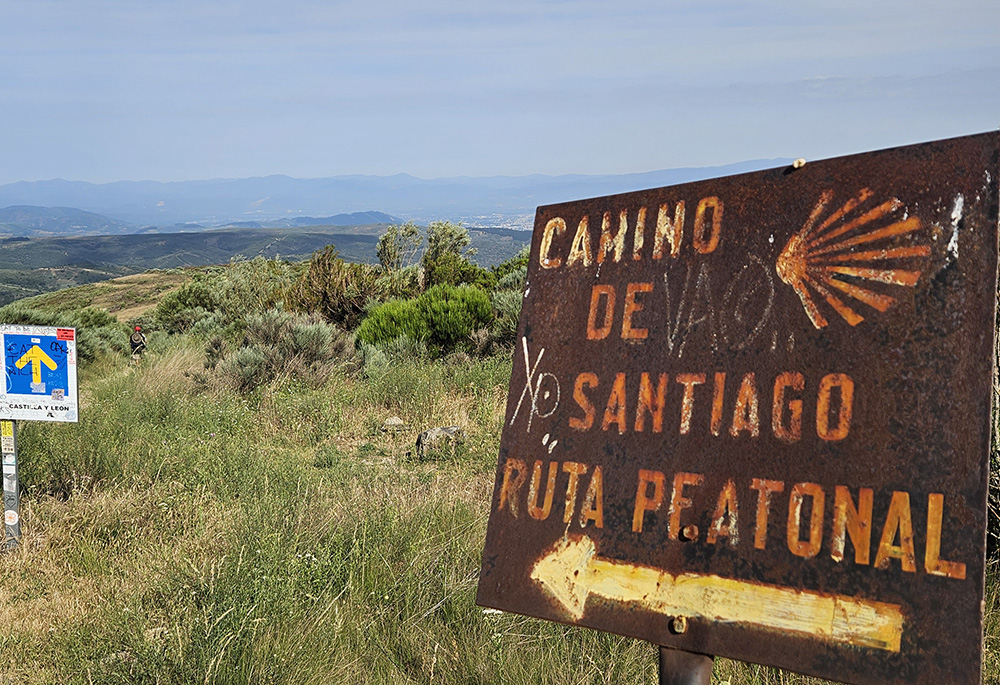
High above the Spanish countryside, the Camino de Santiago takes pilgrims up from the desert to the heights of majestic mountains time and again. (Courtesy of Colleen Gibson)

by Sr. Colleen Gibson
Columnist
"You walked how far?"
This question has become a kind of refrain in the wake of my return from the Camino de Santiago earlier this summer. There, with 24 young women going into their senior year of high school and a cohort of dedicated chaperones, we trekked over 200 miles across Spain.
Any length of the Camino, be it the minimum 100 km, the over 300 km my group traversed, or the nearly 800 km from the French border (or more if you, like some we met, came from far beyond), is an accomplishment. No distance, it seems, is requisite to capture the wisdom and grace of such a pilgrimage. As we came to learn, each Camino is as unique as the one who makes the pilgrimage.
The journey of the pilgrim isn't always known from the start. In fact, as the lure of the Camino goes, for some (if not all) the real Camino does not start until you leave Santiago. That is to say, that with sore feet and a humbled heart, the pilgrim discovers that the Way is made by walking — forward further into the life we are blessed to live.
Reflecting only a few weeks after my return from Spain, I know that there is much that I do not know or yet understand from this journey. However, as the soreness still shakes free from my bones, I am amazed by the wisdom of a heart stretched and sustained all along the way. I marvel too at the way that this wisdom is not only for the one who walks. It is for us all.
On Day 3 of our journey, I got an email from a member of the parish where I minister full time. No stranger to the Camino (having done it multiple times), she wrote with words of encouragement as she followed along with a daily missive I sent to the parish community to account for my time away. Having read all the practical advice she offered, I smiled at her closing salutation: "Buen camino! Ultreia!"
Advertisement
In our first days of walking, the greeting "¡Buen camino!" (literally "good journey") had become everyday parlance. From shopkeepers to fellow pilgrims, every interaction is punctuated with this wish of goodwill and happy trails.
The second of my friend's salutations, however, was less familiar. In fact, it was not until the end of our first week that I noticed "ultreia" scribbled on guide posts and coupled with its partner, "suseia."
Ultreia et suseia, Deus adjuva nos. Onward and upward, God help us.
This phrase was far older than the tourism-board-crafted "Buen Camino." Its origins lie in the Codex Calixtinus, the 12th-century manuscript that is considered the first codified guide to the Way of St. James. From this original guidebook to the Camino, the Latin greeting of "Ultreia et suseia" became a rallying cry for pilgrims. Offered as a call and response, one pilgrim would say "Ultreia!" with another responding "Suseia!"
Reading my friend's greeting from thousands of miles away, I felt companioned and supported in a special way. That's because this greeting of "onward and upward" is more than just a pep talk or rallying cry, it is a prayer of a pilgrim people offered in communion.
Ultreia: More than forward movement
At the root of the word ultreia is the encouragement to go forward. Yet, it is about more than forward motion, it is a call to go further … to move beyond whatever you might find in your way. This means moving beyond our limits, continuing through the current moment, through our fears and our longings to discover what God has in store for us on the other side of these things.
To move onward in this way, we take every step with intention, knowing that the very act of stepping forward has lessons to teach us. We come to learn that every step leads us onward — to what is to be, to our own becoming, and to God's hopes and dreams that await us.
Suseia: A reply of hope
In response to the call to go further (ultreia), we must declare our intention and desire to "go higher." This is the meaning at the root of the word suseia. Literally meaning "to move from below to above," suseia is the impassioned response of a fellow traveler who assures us (just as surely as they assure themselves by saying it) that we are doing more than we think. We are rising up and the very act of rising and sustaining ourselves in moving forward is a feat unto itself.
Pressed to move upward, we witness to hope. This is the work of resiliency. The push to persevere in the face of fatalism and despair is what it means to aim higher and press on. To the pleas of our body (and of the world) that we must be done — we must be struck down or destroyed — the reply of "Suseia!" is a bold and emphatic "No!"
Suseia declares "upward we must go!" Like rising tides or well-fed yeast, we grow and rise higher and higher … we do what is natural, we come into our own, we embrace God's call and companionship. And thus, we draw toward God and embrace the fullness of who we are and who we are called to be: a people propelled by hope and sustained by faith and love.
Deus adjuva nos: So help us God
The wisdom of the path tells us that we do not know what lies ahead. No matter the projections or the planning, we wait to find the realities we will encounter. When we do encounter these realities, we don't do so alone. We have one another … and we have God.
Together, then, in prayer and with the assurances of faith, we can proceed. Onward and upward, Ultreia et suseia! Deus adjuva nos, God help us.
With God's help we make the way. We embrace the blessing of our bodies and we seek to be better members of the body of Christ.
When we are tempted — by the struggles and challenges of the path we follow — to ask: Why me? Why now? Why this?
God responds to our cry with the truest "why" that we might explore: Why have you been called to be here at this moment?
Answering this question sets a course for us. It invites us to ask: Where may God's call be beckoning my response? and What does faithfulness to God's call look like for me today … right now … in this moment?
However we respond, the cry and the wisdom of ultreia et suseia tells us that we cannot respond on our own. We travel together with companions — physical and spiritual — and we make our way with the One who is the Way, the Truth, and the Life. This is the God who promises to help us no matter what. The One who hears our cries for help and responds even before we know it.
Each step is made in faith — onward and upward — with our eyes fixed on Jesus (Hebrews 12:2). Putting one foot in front of the other, we make our way by walking. Steadied by the Spirit, we find our stride. Accompanied by God and by our fellow travelers, we persevere. And grounded by the very path we walk, we discover that, wherever we are in our journey, everything we need is right here with us.