(Unsplash/Jonathan Meyer)
When Pope Francis invited us to walk together in the synod — to listen, to speak honestly, and to discern what God asks of the church — I felt both inspired and challenged. Listening sounds easy, but speaking the truth, especially God's truth, often hurts. Yet as I've learned through prayer and experience, love always prevails.
The story of the prophet Jeremiah has always touched me deeply. God told him, "Before I formed you in the womb I knew you, before you were born I dedicated you, a prophet to the nations I appointed you." (Jeremiah 1:5). I imagine how Jeremiah must have felt — chosen before birth, yet called to a mission that would bring him rejection and pain. I, too, have known moments in ministry when speaking honestly about what I saw or believed was often uncomfortable. Like Jeremiah, I sometimes wished I could stay silent rather than risk misunderstanding or criticism.
One experience in ministry has stayed with me. A former student often came to me in tears, hoping I would take her side in the struggles of her marriage. After prayer and careful reflection, however, I also saw the quiet goodness of a husband devoted to his children. Gently, I shared what I had observed. Although my words were difficult for her to accept at first, she gradually began to recognize those qualities herself. That experience taught me that truth spoken with love can become the beginning of reconciliation rather than division.
Jeremiah's cry, "I wish I had never been born!" (Jeremiah 15:10), echoes the feelings of anyone who has tried to stand for truth and been rejected. His tears remind me that prophets are not heroes without fear; they are ordinary people who struggle deeply but choose to trust God anyway. When I face resistance or misunderstanding, I recall Jeremiah's perseverance. His love for God's people was stronger than his fear.
Jesus, like the prophets before him, also faced rejection throughout the Gospels. When he returned to his hometown, people first welcomed him warmly, but the moment he spoke truths they did not want to hear, their admiration turned to anger. They drove him out, ready to throw him off a cliff (Luke 4:29). I have often reflected on that scene and thought of times when telling the truth cost relationships or comfort.
For example, I remember a teacher's meeting where a teacher broke down in tears because her class had fewer students than another class. The larger class had two teachers: one dismissed the children while the other tutored struggling students. As parents began requesting transfers to that class, I suggested that the tutoring continue, but be scheduled at another time to avoid unnecessary comparisons. Many agreed, but my colleague felt hurt by this, and our relationship became strained. That experience reminded me that even well-intentioned honesty can sometimes come at the cost of a relationship.
Jesus shows me that faithfulness sometimes means walking through misunderstanding with love, not bitterness.
Advertisement
There are moments when I, too, want to say with Jesus in Gethsemane, "Father, if you are willing, take this cup away from me" (Luke 22:42). Yet his example reminds me that love is stronger than fear. Love gives us the courage to keep speaking the truth gently, even when it hurts.
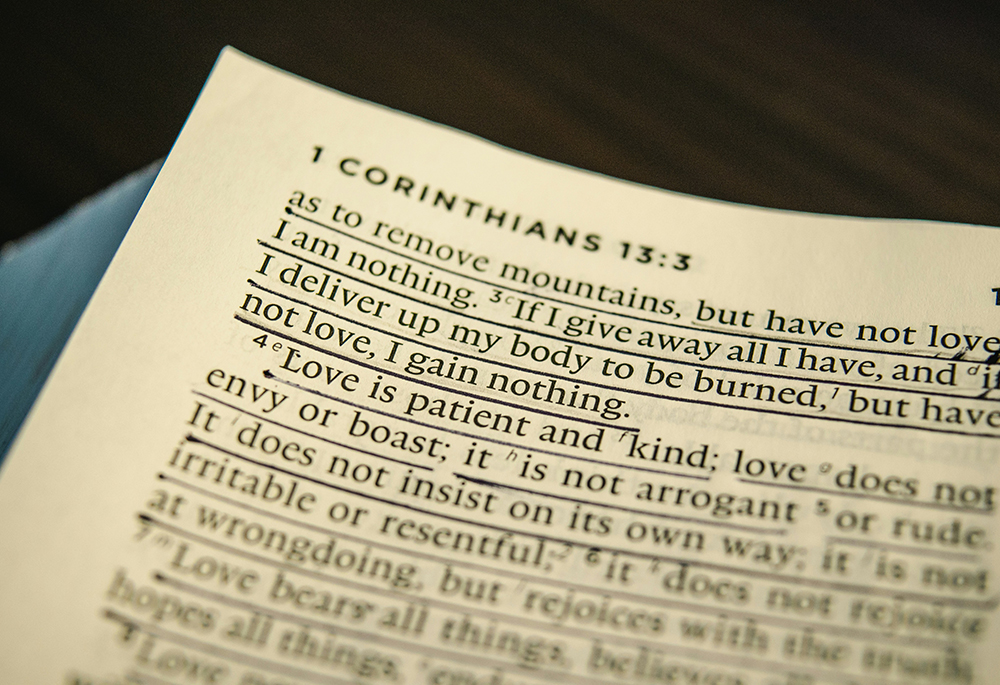
St. Paul reminds us, "Love is patient, love is kind. … It bears all things, believes all things, hopes all things, endures all things" (1 Corinthians 13:4-7). These words speak deeply to my vocation as a religious sister. I realize that to preach is not only to speak with my voice but to live the message through actions, patience and compassion. When I share God's word, I try to remember that love, not eloquence, gives meaning to every word.
Over the years, I have come to see that speaking the truth in love often happens in the small, hidden corners of life. It may be a sister gently reminding another of our mission, a teacher helping a struggling student find hope again, or a nurse quietly advocating for a patient no one seems to hear. Prophetic love does not always appear in grand gestures; it often whispers through patience, integrity and tenderness.
In my own life and mission, I have learned that truth and love must walk together. Truth without love can wound, but love without truth loses its strength. The balance is fragile — but it is where grace dwells.
I once had a student who was capable but unwilling to study. Rather than ignoring the problem or criticizing harshly, I chose to speak honestly while encouraging the student to use their God-given gifts. Over time, the student became more diligent and confident. That experience reminded me that truth bears fruit only when it is spoken with patience, encouragement and love.
Witnessing the truth is not limited to biblical figures. Even in our own time, God continues to raise up people whose courage reminds us that truth often comes at a cost.
Just before the pandemic, Dr. Li Wenliang, the Chinese doctor who tried to warn others about the danger of COVID-19, suffered for telling the truth. Li became known as a whistleblower who alerted the public about a mysterious illness in December 2019 before being silenced. His story reminds me that truth and compassion often walk hand in hand, even when the cost is high.
When I think about people like Li, I am reminded again that the call to be prophetic is not limited to priests, sisters or preachers. Every person of goodwill is invited to bear witness to truth in their own place and time. Some do it through words; others through quiet integrity. I have met laypeople, parents and even young students who carry out their prophetic mission simply by choosing honesty and kindness in a culture that often rewards self-interest. Their courage encourages me to keep going, even when I feel small or unseen.
Whenever I choose to speak or act with integrity and compassion, I feel a quiet strength rising within me — the same strength that sustained Jesus, Jeremiah, St. Paul, Li and so many prophets of love. Their stories remind me, and perhaps remind us all, that love never fails.