
(GSR graphic/Olivia Bardo)

by Mourine Achieng
Tasked with the responsibility of "strengthening compassionate, sustainable care for aging sisters and the people of God in Kenya," the Care for Aging Sisters Association Kenya at its inception in 2023 had a modest 22 congregations, a number that has since grown to 54.
Initiated by the Association of Sisterhoods of Kenya and funded by the Conrad N. Hilton Foundation, the association was established to address the disturbing results from research conducted by the Centre for Research in Religious Life and Apostolate that revealed disparity in age distribution within religious congregations. The research also highlighted a lack of preparedness for old age and inadequate sustainable caregiving measures. (The Hilton Foundation is a major funder of Global Sisters Report)
"There was a gap after sisters retire from active ministries. Most congregations didn't know how to deal with it." Sr. Agnes Wamuyu, the executive director for the Care for Aging Sisters Association, told Global Sisters Report.
The association took its mandate in stride, starting with an assessment that remarkably coincided with the Centre for Research in Religious Life and Apostolate findings. In the three years of its existence, the association has taken a multifaceted approach in promoting healthy aging, caring for the old and improving quality of life to shift mindsets on how sisters perceive aging and care for the older religious. Wamuyu noted that the association is looking at a full cycle, from the entry of a sister in a congregation to her exit.
Wamuyu, of the Franciscan Elizabethan Sisters, and her team found a higher number of older sisters than younger ones, yet structural designs in congregations' houses barely factored in the elderly religious, and younger sisters didn't have skills to care for the older ones.
"If today 20 sisters in a congregation are above 75, in 10 years they will be approaching 90 years. How prepared are their congregations and more importantly how prepared are the sisters themselves?" Wamuyu said.
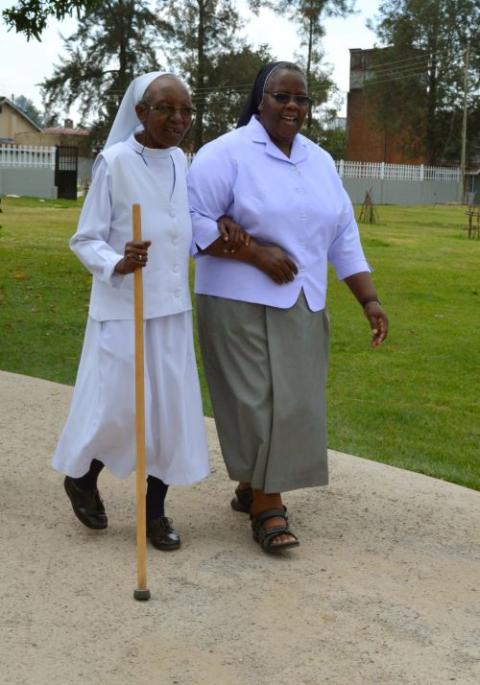
Sr. Agnes Wamuyu, the executive director of the Care for Aging Sisters Association Kenya, takes a walk with Sr. Seraphine Chebet of the Sisters of Mary of Kakamega during the Conrad N. Hilton Foundation's senior staff site visit in June 2026. (Courtesy of Sr. Agnes Wamuyu)
Since the association had funds, Wamuyu said, after the assessment they immediately intervened in the neediest cases.
Some of the interventions involved changing a mattress or a bed to alleviate back pain. In other instances, the association purchased an adjustable bed for the comfort of a bedridden sister and convenience of the caregiver.
Where necessary, the association installed solar panels, adjusted room sizes, built extra bathrooms, modified spaces to remove stairs and built extra rooms.
On some occasions, the changes were as simple as adjusting the elderly sisters' waking time, encouraging relatives to visit and promoting an active lifestyle.
Notably, at the recommendation of the association, the Assumption Sisters of Mary, Nairobi, relocated their older sisters' home from Thika to Nairobi, 44 kilometers (27 miles) away. This eliminated the distance for people checking in on the sick elderly sisters.
While the immediate responses were crucial, the Care for Aging Sisters Association discovered that for sustainability, creating awareness, training, health insurance policy coverage, pension plans and collaboration with education institutions would be the backbone to transform care for the aging.
Capacity building through training
The association trained three sisters as geriatric nurses, and two work as full-time employees of the association. The training was essential as visits to the congregations required specialists in eldercare since aging often comes with health issues.
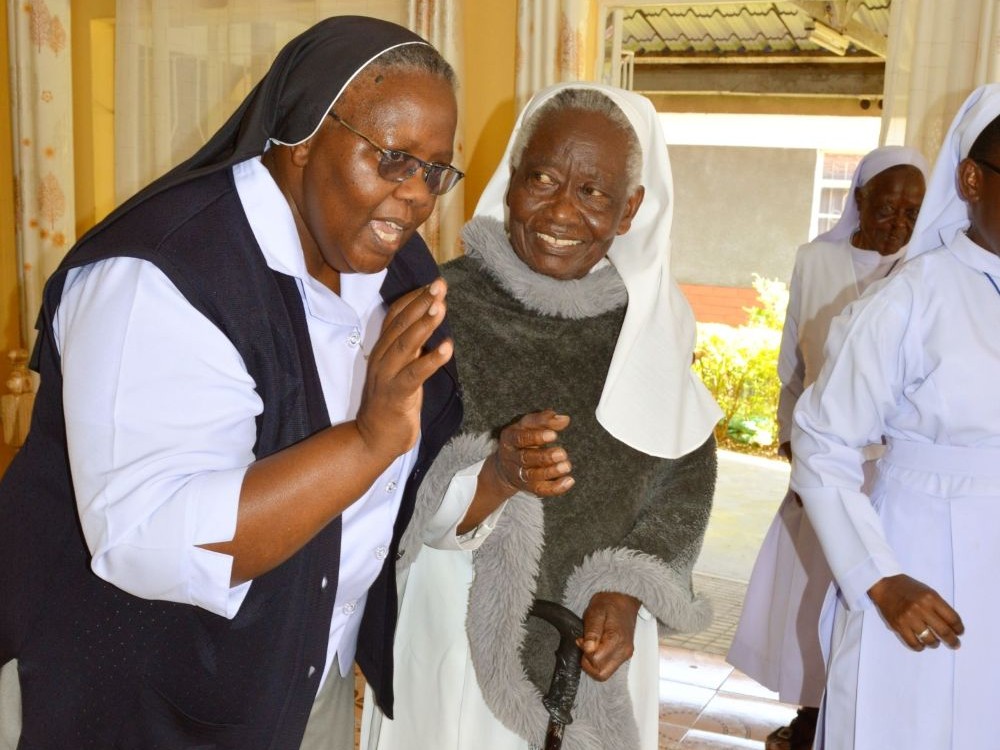
Sr. Agnes Wamuyu, the executive director of the Care for Aging Sisters Association Kenya, shares a moment with Sr. Albina Mwangale of the Sisters of Mary of Kakamega during the Conrad N. Hilton Foundation's senior staff site visit in June 2026. (Courtesy of Sr. Agnes Wamuyu)
In the initial 22 congregations, the Care for Aging Sisters Association started capacity building on compassionate, supportive and person-centered care that promotes overall well-being of older people.
They targeted superiors, then proceeded to professed members, formation houses and schools run by the religious.
In partnership with Chemichemi ya Uzima College, the association further trained 22 sisters as caregivers and continues to train more to better equip congregations with knowledge and practical skills in caring for older sisters. They have since trained lay people in caregiving, graduating over 150 caregivers.
"I was overjoyed when my congregation recommended this course. Now, I have the knowledge to cater for the needs of the elderly and the sick as well as support them emotionally," said Sr. Mary Rhoda, a member of the Congregation of the Sisters of St. Felix of Cantalice and the caregiver in charge of patient care at Mother Angela Huruma Hospital in Nanyuki.
Increasingly, the association is taking a proactive approach.
Beyond training in caring for older sisters, Wamuyu said, they also proactively train sisters on how to care for their health so that "they don't grow old with health problems." This year, the association has presented webinars focusing on chronic diseases — causes, risk factors, symptoms, healthy lifestyle practices, treatment and effective management strategies.
The Care for Aging Sisters Association is also actively working to bridge the gap between the younger and older generations. "Right now, we're training younger sisters to relate with the older sisters," said Wamuyu. "The younger sisters perceive older ones as a burden while the older sisters feel misunderstood by the younger ones."
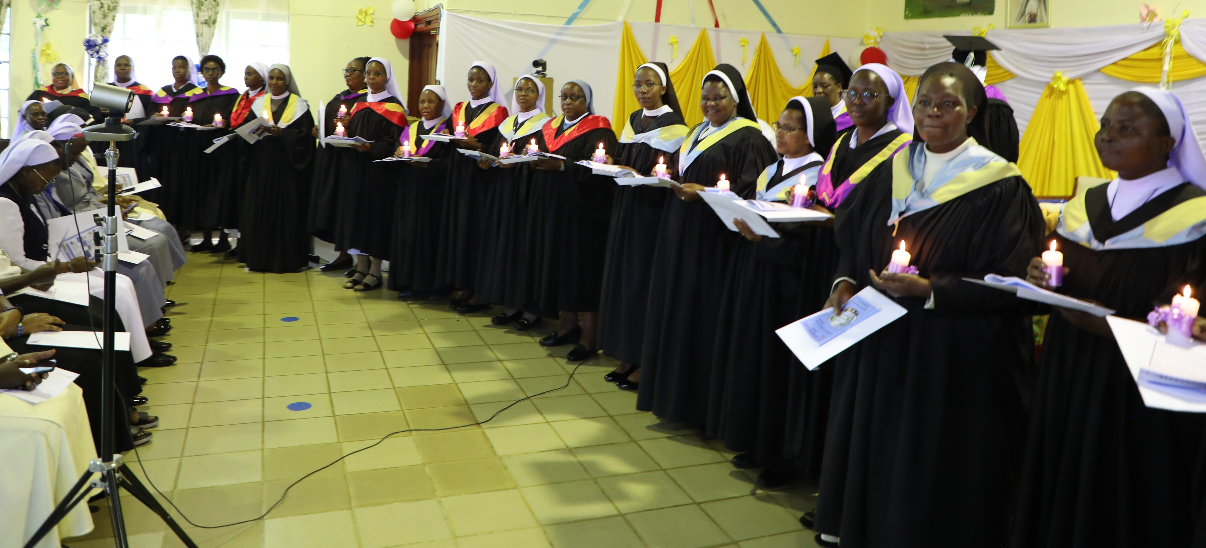
Graduates participate in the June 2026 Certificate in Geriatric Care Management course offered by the Care for Aging Sisters Association Kenya. (Courtesy of Sr. Agnes Wamuyu)
The association has stretched its wings to stakeholder engagement with the Curriculum Development, Assessment and Certification Council to negotiate the possibility of developing its geriatric certificate course into a degree.
With the Nursing Council of Kenya, the association is negotiating for the integration of geriatric care into nursing curricula when the council updates nursing course content.
It's also seeking partnership with Kenya Medical Training College, the Aga Khan University, University of Nairobi, Chiromo Campus and other health institutions and universities to increase public access to geriatric care management courses.
The days to come
Most congregations treat their sisters in their dispensaries. Wamuyu explained that while this is a noble practice, sometimes a sick sister may need level 3 or 4 hospital treatment, and the congregation ends up using a lot of money.
While the association encourages congregations to upgrade their level 2 hospitals, it also educates congregations on the advantages of health insurance cover.
"A facility upgrade helps congregations treat a wide range of ailments," Wamuyu said. "However, if there's a need for specialized treatment that the government insurance can't cater for, an insurance policy would help a sister get the needed treatment without stretching the congregation's finances. We're calling insurances, trying to bargain for a uniform rate for congregations."
Advertisement
The association is encouraging congregations with equipped infirmaries and personnel to accommodate elderly sisters from other congregations, Wamuyu said. She said that such a partnership would be more effective than a congregation caring for one or two sisters.
She further added that the association is contemplating a long-term solution — building a common infirmary that can be a bridge between the hospital and a community. When a sister leaves the hospital and needs palliative care, the infirmary can be an intermediary before the sister goes back to her community.
The Care for Aging Sisters Association is also focusing on pensions for elderly sisters. It has initiated talks with the National Social Security Fund on behalf of sisters who worked for the government and have never received their retirement funds.
The association is also determining the number of sisters eligible for pension based on the ministries they served in their congregations, parishes or dioceses.
"Sisters give their own life blood for service," Wamuyu said. "They are often not left with anything for later years. Now, we're teaching sisters to consider old age. We're sensitizing them on balancing between investing in their ministries and the lean days to come."