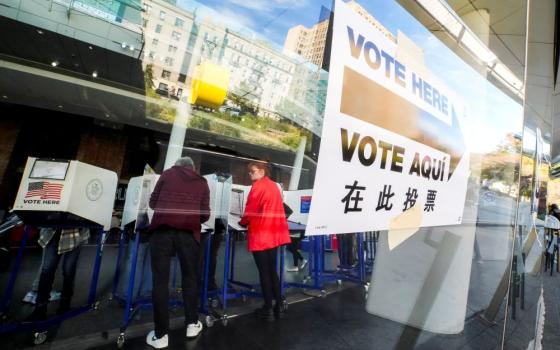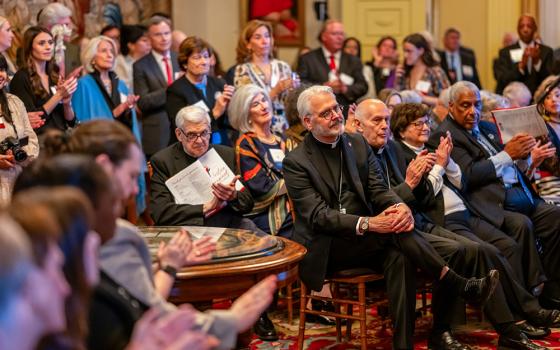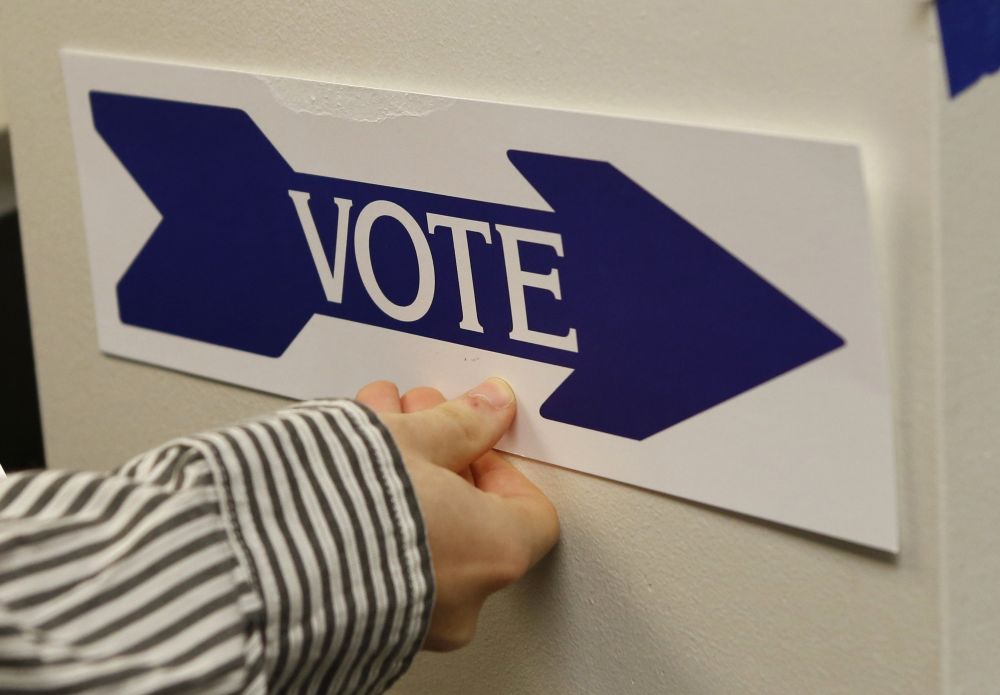
An election worker puts up a sign at a polling station in McLean, Va. (OSV News/Reuters/Kevin Lamarque)

by Sr. Emily TeKolste
Contributor
On Sundays, a local community group in Terre Haute, Indiana, where I live, gathers at a park for a potluck picnic. We invite anyone in the area to come for a meal and some community time. A few months ago, we were in the midst of our normal meal when a sudden commotion broke out around the table and the water cooler was thrown to the ground.
We quickly saw that a puppy had gotten his leash tangled around the table, gotten excited about something, and knocked some items off the table. The puppy's owner quickly dropped his food, took his puppy away, and loudly scolded the puppy while those of us still under the shelter simply picked up the water.
The man calmed down and came back, but he was clearly deeply troubled. "I ruined everything," he said, and "He’s got to learn." The man is homeless, and it's hard for him to keep track of what day it is and when to come for food at the park. He said he hadn't eaten in 10 days. A few people in the group spent some time with him, assuring him that we welcomed both him and the dog, that nothing was ruined.
About a month later, during a local political event, I saw the dog owner walking through a different park, all his belongings in a shopping cart. At this event, they were serving a simple bean meal. I stepped away, chased him down, and offered to get him some beans. This time, he shared that his dad had just died and that he was facing all kinds of claims from his family that he only came around for the money, all while grieving because he hadn't been told his dad was dead until after he'd been cremated. I hugged him, talked with him, let him cry, and made sure he got some food.
Sometimes I see the man around town; he is still unhoused. His gentleness made an impression on me.
I spent the last seven years working for Network Catholic social justice lobby, in the world of federal policy. For nearly five of those seven years, I lived in Terre Haute. Though I didn't walk the halls of power regularly like many of my coworkers, living in Indiana helped me stay connected to the very reason for my political engagement: people like the unhoused man who came to our community meal.
Thanks to the communities I've been a part of and their faithfulness to the work, I've been able to join the Sunday picnics when I can and step away when I need to. This helps me stay connected to real people and their real stories. I've heard firsthand from people whose only income was food stamps — because nobody can get disability for having cancer. I've listened as people share that their Social Security doesn't cover their basic needs anymore, as rent, utilities and grocery costs keep going up. These aren't theoretical problems; they're the experience of too many people who are forced to endure.
Advertisement
As Fr. Richard Rohr wrote in his most recent book, The Tears of Things: Prophetic Wisdom for an Age of Outreach, "God's message and messengers — and often the hearers — all tend to be outliers to 'the way everybody thinks.' Thus, when we respect the loved and rejected outsider, the 'little ones' become the indication that we are on a tangent of divine love and not just our inherited and natural love of family, sameness, greatness, and ego advantage."
I recently transitioned from my work with Network to a short-term role. As that comes to an end in the next couple of weeks, I'm beginning to ponder what might come next. Rohr's descriptions of the prophets ground me, inspire me and challenge me.
I imagine this is what Catholic social teaching means by the principle of subsidiarity: We have to be in relationship with and listen to the people who are most impacted by any decision. Subsidiarity complements solidarity because it challenges us to move beyond a "savior complex" of being the experts and to allow ourselves to get mixed up in the messiness of another person's life.
The man's story and spirit stay with me because I see his humanity beyond the stigma he endures as someone who is facing homelessness. I see a piece of myself in him, and I want something better for him than what he's forced to endure.
Whether or not I stay in political ministry in my next role, whether or not I stay in Terre Haute, the life of Christ and the life of the prophets call me to take his spirit with me into my work and my political choices forever.
During this election season, Network has been encouraging Catholics and all people of goodwill to "See. Love. Vote." What do you see and who do you love as you head to the voting booth?