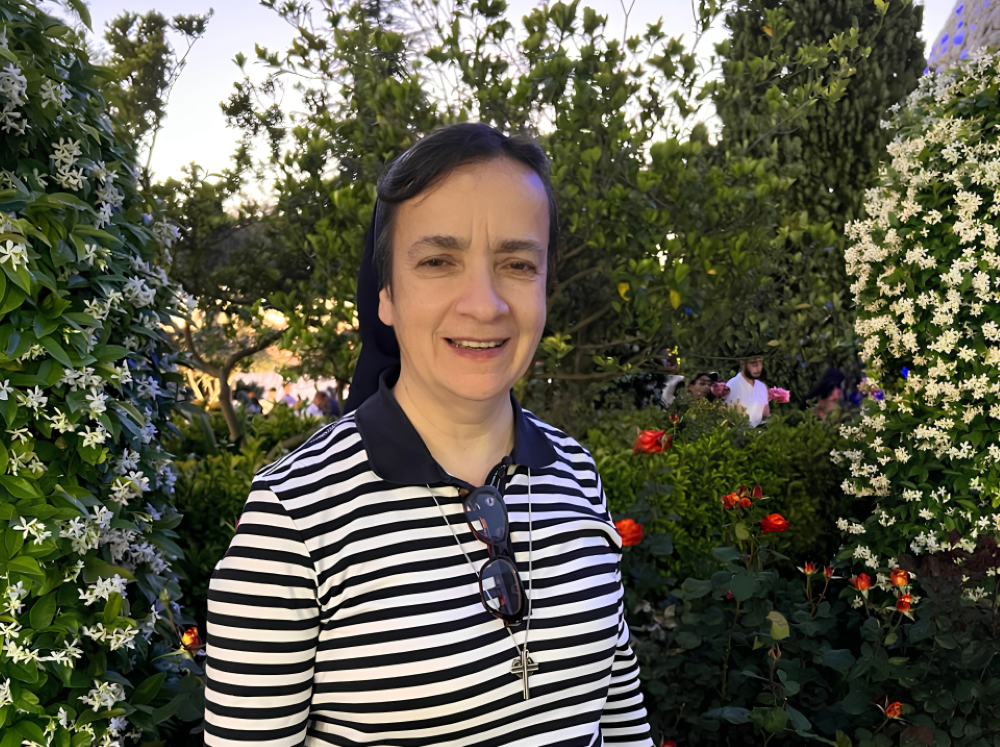
Sr. Antoinette Assaf serves as the mission development office director in Lebanon for the Good Shepherd Sisters International Foundation, which supports vulnerable women and children in impoverished countries around the world. (Courtesy of Antoinette Assaf)
by Sr. Joyce Meyer
International Liaison, Global Sisters Report
Sr. Antoinette Assaf serves as the mission development office director in Lebanon for the Good Shepherd Sisters International Foundation, or GSIF, which supports vulnerable women and children in impoverished countries around the world.
Assaf spoke to Global Sisters Report about how the foundation continues to support ministries despite the ongoing war with Israel, how the various crises in Lebanon are affecting its people and how emergency assistance and development funding go hand in hand.
GSR: How many Good Shepherd sisters are in the Lebanon community? And are they all Lebanese or some from other countries? And where are you located?
Assaf: In Lebanon and Syria, we are one province, and our number is 34. Most of us are located in Lebanon, and we are Lebanese and Syrian.
In your part of the Good Shepherd International Foundation Annual Report, you began with a question: "In a crisis that is lasting for years, do you choose emergency response or development or both?"
Yes, and my answer is that in Lebanon with the help of the GSIF we choose both. For us, "A person is of more value than the world." St. John Chrysostom said: "Feed the hungry, and then talk to him of God." We cannot talk about development, or preaching, if people are hungry or thirsty. They need to pass this stage, then they will be open to receive the good news, (both) personal and spiritual development.
That is a powerful statement and value. Could you describe what is happening in Lebanon now?
We are enduring a layered crisis: economic collapse — for instance, the Lebanese pound has lost 98% of its value. Our money is useless. There are thousands of families displaced by repetitive wars. There is insecurity and almost total collapse of basic services like education and healthcare, and food insecurity is everywhere.
Young girls and women are especially exposed. Their education is interrupted, there is pressure for early marriages to relieve families of some of the children. Some marriages are even taking place in shelters. Gender-based violence is increasing. There are no safe spaces for girls.
Healthcare is nearly shut down. Emergency care only, just enough only to keep people alive. There is little space for development now because of the many dangers, but we sisters refuse to choose emergency over development. We keep making efforts for both.
The description is dire. It must be very complicated to keep doing those two pieces, emergency and development at the same time. How do you do it?
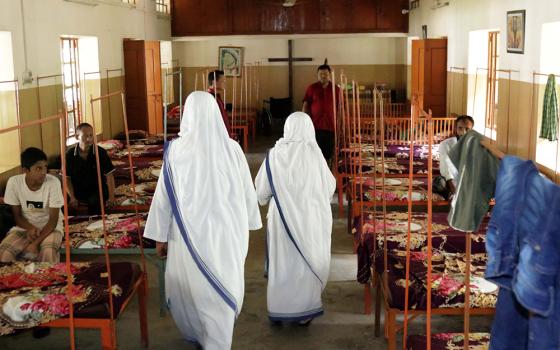
On the emergency side, we have rapid protection services through a church network so that newly displaced families arriving in our area can be oriented to shelters.
We provide basic needs to them with food baskets, medicines, milk and diapers for babies, and we are especially attentive to the needs of the elderly.
We also manage gender-based violence by intervening in family situations and then we provide social and psychological services to the young women. If a girl arrives (to a shelter) needing protection, we do not let her leave until there is a next step already in motion. This is where development takes over.
Advertisement
Development is parallel to emergency assistance. We have spaces for vocational training, especially for young girls so they can have economic independence. Included is psychological support, and education continuity when their education has been interrupted — school fees and after-school educational programs. We also have extracurricular activities for children, like cultural and recreational outings for their well-being and emotional development. We also have programs for women to learn skills for economic empowerment. So many have lost their husbands and need to find ways to support themselves and their children.
What kind of support do the sisters have in this multilayered work?
What has helped us is the collaboration of us sisters and lay partners with the Good Shepherd International Foundation staff and the congregation. We co-designed the programs; we have learned monitoring skills and trust-based decision-making. We locals take the lead and GSIF backs us up with funding from many donors, and the planning of the emergency response. It would not work without them.
How do people survive all the trauma?
Resilience. It is amazing how they survive crises and then build capacity for the next crisis to come.
So, share some of the outcomes of this complex work.
We have been able to provide safe spaces in 2025 for 30 families, providing education for more than 1,000 children and young girls. We are accompanying more than 600 families and providing basic needs to over 1,200 households along with healthcare services to more than 7,000 persons.
A story that captures what we do day in and day out is of three families from the south where there is much fighting. They fled the bombing and were living together in one house. There were seven children, one boy and six girls, all following their school online. We provided them with internet connections so they could follow the lectures, and we assisted them with their homework and provided psychological support to overcome the trauma and fear.
The education helped the children to cope with the harsh reality of the war, and they were able to give all their attention and emotions to their studies. They all succeeded at the end of the school year, and it was a very positive escape from the harsh reality of the war.
It must take a lot of resilience for you sisters and your partners as well.
It does, but it is our call. You cannot imagine how joyful we feel when we see that one person is building resilience and going forward. From the Bible, in Acts 20:35, the Apostle Paul quotes a saying of Jesus: "There is more happiness in giving than in receiving."
What would you say to the donors who are helping you?
You are not funding a project. You are funding the capacity of service providers — our sisters and partners — to hold together both emergency and development. The flexibility is resilience for the communities we serve and for us as partners. I just want to thank all of those who are trusting us with the dual program. Now, vulnerable women and girls in Lebanon don't have to wait for stability to build a future. They have started now because of you.