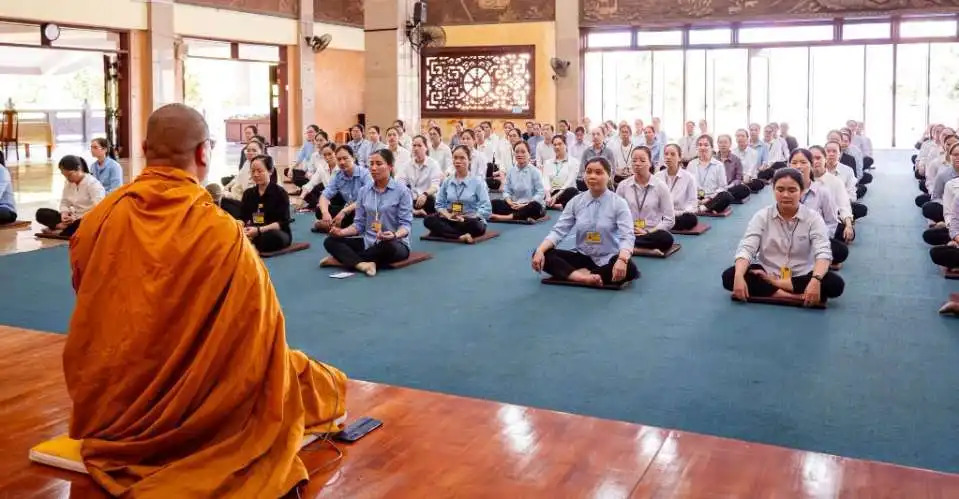
Catholic nuns practice Buddhist meditation at Minh Dang Quang Buddhist Monastery in Ho Chi Minh City on Oct. 26. (Courtesy of Minh Dang Quang Buddhist Monastery)
A visit by about 100 Catholic nuns to a Buddhist temple in Ho Chi Minh City to learn about Buddhist teachings and practices has sparked debate among Vietnamese Catholics over the boundaries of interreligious dialogue.
The nuns from the Theology Institute of the Inter-Congregations of Lovers of the Holy Cross visited Minh Dang Quang Buddhist Monastery on Oct. 26, according to the monastery.
Redemptorist Fr. Peter Dinh Ngoc Lam, a theology lecturer, led the group, along with Sr. Lucy Nguyen Thuy Hoang Oanh.
Venerable Thich Minh Son introduced the participants to basic principles of Buddhist meditation. The nuns practiced seated meditation and also asked questions about Buddhist teachings and monastic life.
The monastery described the encounter as an opportunity "for mutual respect, learning and spiritual experience, aimed at building bridges of understanding between religious traditions."
However, photographs of the visit circulated on social media, resulting in sharply divided reactions within the Catholic community.
Redemptorist Fr. Peter Nguyen Van Khai criticized the nuns' participation, arguing that Catholics should not practice another religion's rituals or spiritual disciplines at its place of worship.
Advertisement
He said that offering incense and meditating before a Buddha statue were inconsistent with Catholic faith and morals, regardless of participants' intentions or explanations.
"Good subjective intentions are not sufficient to justify an action that is objectively incompatible with the faith," Khai said.
Khai cited Pope Leo XIV's 2025 visit to a mosque in Turkey, saying the pope removed his shoes and listened respectfully but declined an invitation to participate in a prayer ritual.
Fr. Joseph Pham Quoc Thuan from Xuan Loc Diocese urged Catholics not to rush to judgment.
He said the visit was part of a theology course in which participants studied and compared Buddhist teachings with their faith.
"The purpose of the visit was clearly defined, not left vague for people to interpret as they wished," Thuan said.
He described the event as an attempt to bridge both religious communities, helping them move beyond suspicion and confrontation toward friendship and understanding.
Thuan also questioned whether Buddhist monks attending a Catholic Mass or visiting a church for a deceased priest's funeral would be considered to have adopted Catholic beliefs.
Fr. Augustino Nguyen Van Du suggested that the controversy might have been avoided if the institute had invited a Buddhist monk to explain meditation in a classroom, or if the nuns had practiced meditation before a crucifix.
Fr. Joseph Ta Duy Tuyen said the key issue was what the nuns actually did during the session and what the practice meant in that context.
If they performed exercises to improve relaxation, concentration, and awareness without engaging in worship, he said, such activities would not, in themselves, constitute a rejection of their faith.
"It is not enough to see someone sitting in a Buddhist temple and conclude that the person is worshipping Buddha," Tuyen said.
For some Catholics, practicing meditation in a Buddhist temple risks blurring religious boundaries. Others see the encounter as an opportunity to understand another tradition without necessarily embracing its religious commitments.
Fr. Joseph Phan said learning about and engaging in dialogue with other religious traditions does not necessarily mean abandoning the faith or Christian identity.
"On the contrary, when approached with knowledge, respect and discernment, such encounters can help us better understand the spiritual values of others while deepening our understanding of our own faith tradition," he told UCA News.