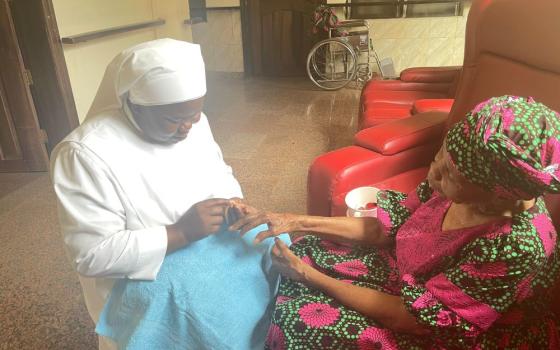
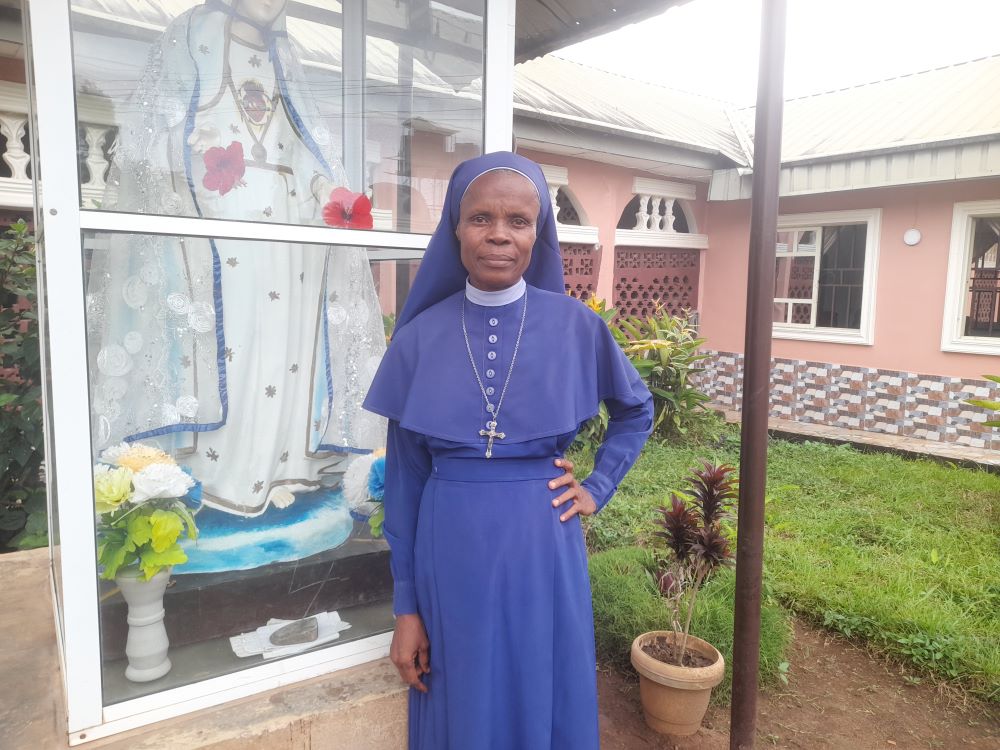
Sr. Agnes Nwoye of the Daughters of Mary Mother of Mercy leads the Motherless Babies Home in Okwelle, Imo State, eastern Nigeria, one of Nigeria's oldest orphanages. (John Chukwu)

by John Chukwu
For more than a decade, Sr. Agnes Nwoye of the Daughters of Mary Mother of Mercy has devoted her life to children who arrived in the world carrying the weight of abandonment. Today, she leads the Motherless Babies Home in Okwelle, Imo State, eastern Nigeria — one of Nigeria's oldest orphanages, founded in 1962 by the late Bishop Anthony Gogo Nwedo. However, her relationship with this ministry began long before she professed her vows.
As a young secondary school student, she spent her holidays in the orphanage, cooking for the children, holding them and discovering, without yet having the language for it, the vocation that would define her life.
Nwoye's journey into religious life did not follow a linear path. She entered the congregation as a cook, quietly working in the kitchen before discerning that her future belonged with the sisters. After professing her vows, she was sent in 1997 to Rome, where she spent years caring for nursery and primary school children. She also assisted the elderly and performed any tasks the congregation required.
It was only later, after the sisters encouraged her to pursue formal studies, that she began academic work that aligned perfectly with the calling she had felt since childhood. She completed studies in abandoned children and sociology, eventually earning a master's degree and deepening both her professional skills and her spiritual commitment.
Her formation took her across continents and communities, each assignment sharpening her understanding of what it means to accompany vulnerable children. In 2012, she returned to Nigeria and was sent to the Guardian Angels Motherless Babies Home in Enugu State, eastern Nigeria, where she spent some months caring for children. She was then transferred to the Holy Family Orphanage and Pro-Life Centre in Anyigba, Kogi State, north-central Nigeria, where she spent nearly a decade supporting young, unmarried pregnant women and single mothers.
Three years ago, she returned to the orphanage in Okwelle, the place where her vocation first took root. Now, as its leader, she carries both its history and its future, drawing on years of training, pastoral experience and a passion that has never dimmed.
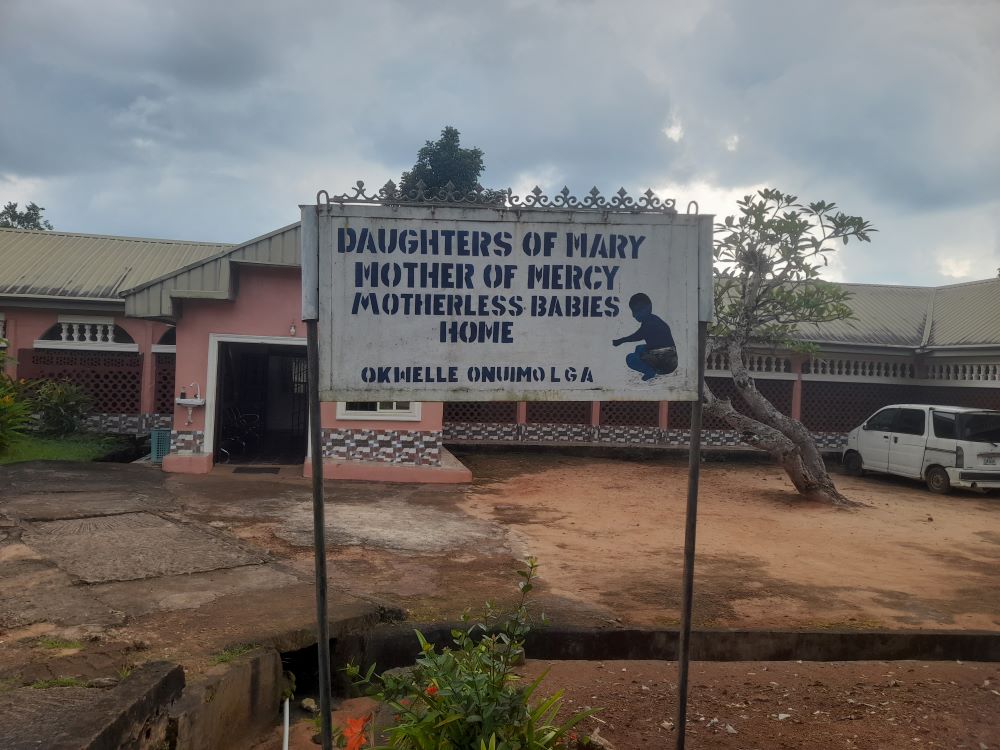
A sign marks the entrance to the Motherless Babies Home, Okwelle, Imo State. The home is one of Nigeria's oldest orphanages and was founded in 1962 by the late Bishop Anthony Gogo Nwedo. (John Chukwu)
In this interview with Global Sisters Report, Nwoye reflects on the joys and struggles of caring for children without families, the moments that nearly pushed her to give up, and the faith that continues to anchor her ministry.
GSR: What moved you to open your heart to abandoned and homeless children?
Nwoye: Growing up, I watched my mother constantly extend kindness to children. We were not rich, but she always cooked and invited children, especially those from the [local] block rosary, to come and eat. That was where my love for children began. I enjoyed being around them, and I told myself that if I ever had the chance to study further, I would learn something that would help me understand and better support them. When I entered the congregation and the sisters later sent me to Rome for my mission, it felt like the beginning of what I had always hoped for.
What do you remember most about those early days, the first child you took in or the first challenge you faced?
It's a long story, but I remember a baby boy left in a carton beside a school gate. We were on our way to morning prayer when we found him. The sisters came immediately, took him in, baptized him and named him Moses. In those days, there were no diapers, so we tore wrappers into pieces to clean him, and washed everything by hand.
I also remember the first baby we received when we opened the orphanage in Kogi. His name was Innocent. His mother had epilepsy, and the community brought him to us. In those early years, we often went into remote villages and rescued children suffering from malnutrition or poverty. We registered them in the hospital and cared for them until they recovered.
There were days I went from shop to shop, begging for food and money. It reminded me of what Mother Teresa of Calcutta did. With the donations I got, I paid hospital bills and used the rest to feed and support the children. Those days were dramatic but filled with joy. Many children had lost their mothers during childbirth; others were abandoned or born to young social mothers still in school. Caring for them, even in hardship, brought deep fulfilment.
Was there ever a moment when a child was so sick you felt completely helpless?
Immediately [after] you mentioned this, I felt cold all over my body. When I was sent to Kogi, there was nothing: no supplies, no support. I could remember on two or three occasions, almost every two or three months, a child would fall critically ill. Often, it was a blood shortage, and hospitals demanded money we didn't have. I held babies as they died in my arms. I followed their small bodies to the graveyard, sometimes in small coffins or cartons. Their relatives rarely came. They will normally say, "It is a little child, you can bury him/her."
How do you handle the psychological and emotional weight of this work?
Honestly, it's God who carries me through. Humanly, I cannot explain how one survives the pain of losing a child you've cared for from a few days old to 1 or 2 years, only to watch life slip away within hours, like the baby we lost recently. The weight can be heavy. Sometimes I call the name of a child who has already passed, or search for something I'm already holding. When it becomes too much, I go into the chapel and cry, or I stay among the children and sing with them. I remind God that He is their father, and He never fails to comfort and strengthen me.
You've been taking care of abandoned children for more than a decade. What keeps you going?
Watching these children grow into someone with a future keeps me going. Many of them could have died if they hadn't been found. Seeing a newborn arrive weak and wrapped in blood, then watching that same child walk within a year, fills me with gratitude. Even though some children struggle with rough behavior because they lack a stable family structure, patience helps me stay with them. Their progress is my strength and my happiness.
What are some of the most pressing struggles you face in terms of resources, support or care for the children?
We face constant shortages, such as food, supplies and reliable support. Feeding 15 or 20 children three times a day is difficult, and some days we can't even provide eggs. Benefactors often promise help and don't follow through. We lack a proper prayer space, steady water and reliable electricity. Our small solar system cannot power everything, and we cannot store food properly. The challenges are overwhelming.
What moments bring you the greatest joy?
My greatest joy is seeing these children grow into their own lives. Some have become reverend sisters, nurses, teachers [or]even priests. One boy, once brought in as a child of mentally ill parents, is now skilled, married and living abroad with his family. Moments like these remind me that our work is not in vain. When they return and call me "Mama," every sacrifice feels worth it.
Was there ever a time you almost felt like giving up on this ministry?
I've never felt like giving up. If anything, I often feel that I should be doing more. I know there are girls and families in deep need who can't reach us, and babies in rural areas suffering in silence. Knowing there are lives we could still save is what keeps me moving forward.
How has taking care of these children, over the years, deepened or changed your faith?
Caring for these children has deepened my faith. They have nothing — no parents, no certainty — yet they survive with such simplicity and trust. Watching them reminds me not to cling too tightly to anything. If God sustains them from birth through every hardship, then I must also trust him more in my own life.
Advertisement