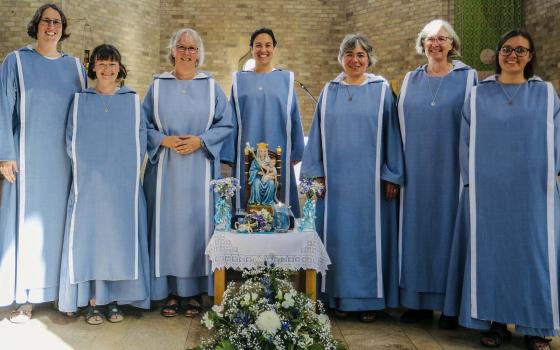
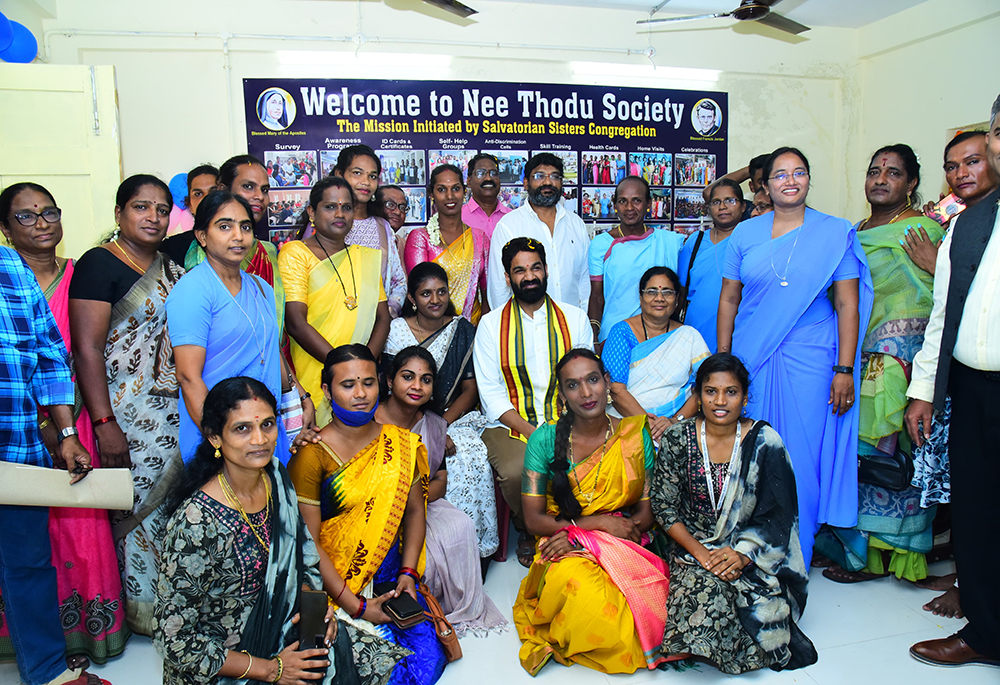
Salvatorian Srs. Amitha Polimetla (standing, fourth from right) and Sudha Rani Sankili with members of the Nee Thodu Society at their Sustainable Livelihood Centre in Visakhapatnam, Andhra Pradesh, southeastern India. (Courtesy of Amitha Polimetla)

by George Kommattam
Sr. Amitha Polimetla, a member of the Sisters of the Divine Savior (Salvatorian Sisters), is the founder of the Nee Thodu Society, a ministry that accompanies transgender persons in India.
Polimetla is from Rudrappaka village in Andhra Pradesh's Krishna district. Her parents were school teachers, and she is one of eight siblings. One of her older sisters is also a Salvatorian sister and currently serves as a general councilor.
As a child, Polimetla was not particularly pious. She describes herself as "a rowdy and troublesome student." Yet during her school and college years, she was inspired by the service of religious sisters.
After completing her bachelor's degree in mathematics, she joined the Salvatorian Sisters in 2004. She professed her vows in 2007 and made her final profession in 2012.
Looking back, she said, "I can only say that my vocation has been God's mystery and God's gift."
Polimetla now lives at the Samipya Salvatorian Convent in Muralinagar, Visakhapatnam, Andhra Pradesh, a southeastern Indian state.
The 42-year-old nun has also completed a master's degree in social work and a doctorate on transgender communities, among the first doctoral studies on the subject in India. Earlier, she was a professor of sociology at St. Joseph's University, Bengaluru.
Polimetla spoke to Global Sisters Report about her ministry, faith and hopes for the future of the transgender community in India.
GSR: Tell us about your ministry among transgender persons.
Polimetla: In November 2022, I founded the Nee Thodu Society as a nongovernmental organization to help transgender persons rejected by their families and marginalized by society.
My mission is to empower them to become part of the social mainstream. We have helped nearly 800 transgender persons in securing documentation and accessing government benefits. Through self-help groups, educational support, livelihood initiatives and awareness programs, we strive to promote dignity, inclusion and self-reliance.
Why did you start this ministry?
I never planned to work with transgender persons. In fact, I was afraid of them. I knew very little about them when I was teaching in Bengaluru.
Two experiences changed everything. The first was an encounter with a transgender woman who shared her painful story. The second was seeing transgender persons preparing for begging and sex work while people around them looked at them with fear and contempt.
These experiences troubled me deeply. I kept asking myself: Who are they? Why are they living like this? Why does society reject them?
In 2018, I began my doctorate at Andhra University, Visakhapatnam, focusing on transgender communities in Andhra Pradesh. Many people discouraged me from choosing the topic, but I felt God was leading me in that direction.
As I listened to hundreds of life stories, I realized transgender persons were not the problem. They were victims of rejection and exclusion.
When I completed my doctorate in 2022, I told my superiors, "If I keep this research in a library, no one will read it. If these people are suffering, someone must work for them."
That conviction led to the founding of Nee Thodu Society.
Advertisement
Please tell us more about your first encounter with a transgender person.
The encounter took place in Bengaluru.
One evening, I was walking from college to the convent when a transgender woman approached me. I felt uneasy and fearful.
However, I gathered courage and asked, "How are you?"
Immediately, she began to cry.
She told me she had come from a village. As she grew older and began to exhibit feminine characteristics, her family rejected her. Eventually, she left home and found shelter with the transgender community in Bengaluru.
Then she said something I would never forget. "This is the first time in my life that someone has asked me how I am."
I was stunned.
Before leaving, I told her, "Let us meet tomorrow." Unfortunately, I never found her again despite searching for her.
But her tears haunted me. Looking back, I am convinced that encounter was God's plan. It changed my life's direction, and the society was born.
How does Indian society treat transgender persons? What are their challenges?
India's 2011 census revealed the country has nearly 500,000 transgender people, including more than 43,000 in Andhra Pradesh.
The country recognized them as the third gender in 2014, but many continue to face family rejection, educational exclusion, unemployment, homelessness and social stigma.
Family rejection is a serious challenge, often leading to educational disruption, poverty and social isolation.
Without education, jobs become limited. Many migrate to cities, find shelter with similar persons, and survive through begging or sex work.
In northern India, people consider them a blessing and welcome them for housewarmings, inaugurations, weddings and other functions. But when the ceremony is over, they are chased away. Most consider them a public nuisance and treat them with contempt.
How do you ensure them a secure and dignified life?
We help them move from survival to self-reliance. Our programs, such as livelihood training, education and finding them jobs, help build a secure future for transgender persons.
I am glad to see families change their attitude towards transgender people. Parents who once struggled to accept their children now proudly tell others that they have respectful jobs.
We follow a simple process: survey, documentation, empowerment and inclusion.
We visit transgender communities and conduct surveys to understand their needs. We then help them obtain identity documents, health cards and access government welfare programs.
Empowerment is another focus. Through our Sustainable Livelihood Centre in Visakhapatnam, transgender persons receive training in tailoring and other livelihood skills.
We have formed eight self-help groups that encourage savings and financial planning. We also provide scholarships and educational support for transgender students.
So far, 33 transgender persons have secured jobs.
We also conduct awareness programs for students and parents. In six districts of Andhra Pradesh, we have promoted sensitization initiatives and established school-based Nee Thodu Cells to prevent them from dropping out because of discrimination.
In collaboration with the Visakhapatnam Police Department, we have started a canteen that employs transgender persons.
We're planning a center to provide temporary shelter, counseling and support.
Any memorable experiences?
In 2024, I addressed more than 600 religious superiors at their national conference in Bengaluru. It encouraged several congregations to explore similar ministries in their own regions.
Another unforgettable experience was in 2022 when our superior general and her councilors visited our province. I invited 10 transgender persons to our convent to receive identity cards we had helped them obtain. After the card distribution, some shared their stories.
One said that she was alive because of me. "If the sister had not come into my life, I would have committed suicide," she said.
She continued: "Our families rejected us. Society rejected us. But this nun comes to us every day. We have never seen Mother Teresa, but for us she is our Mother Teresa."
She then pleaded with our general to keep me with them.
The hall fell silent. Many, including the general, were in tears.
It was then that I realized how much this ministry meant to them.
Do you have the full support of your congregation?
Initially, there was hesitation. No one agreed when I proposed transgender persons for my doctoral research or when I suggested starting an NGO to help them.
The general's visitation was a turning point. The general told me that God had a special plan for me.
She then announced that our congregation would adopt transgender ministry as one of its missions.
What is your vision for the future of the Nee Thodu Society and the transgender community in India?
My greatest dream is to close down the Nee Thodu Society.
People are often surprised when I say that. But I hope for the day when transgender persons will no longer need an organization like ours because they are fully accepted by their families and society.
Most transgender persons do not want charity. They want love. They want their parents to accept them, their siblings to stand beside them, and society to treat them with dignity.
Until that day comes, we will continue to be with them.