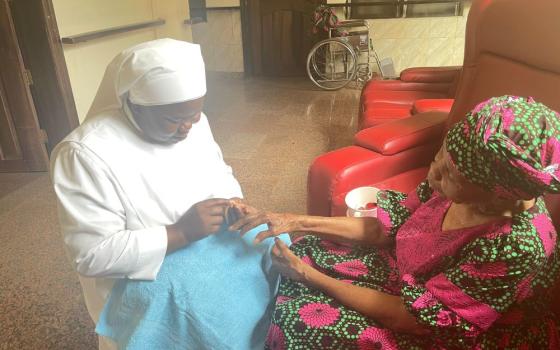
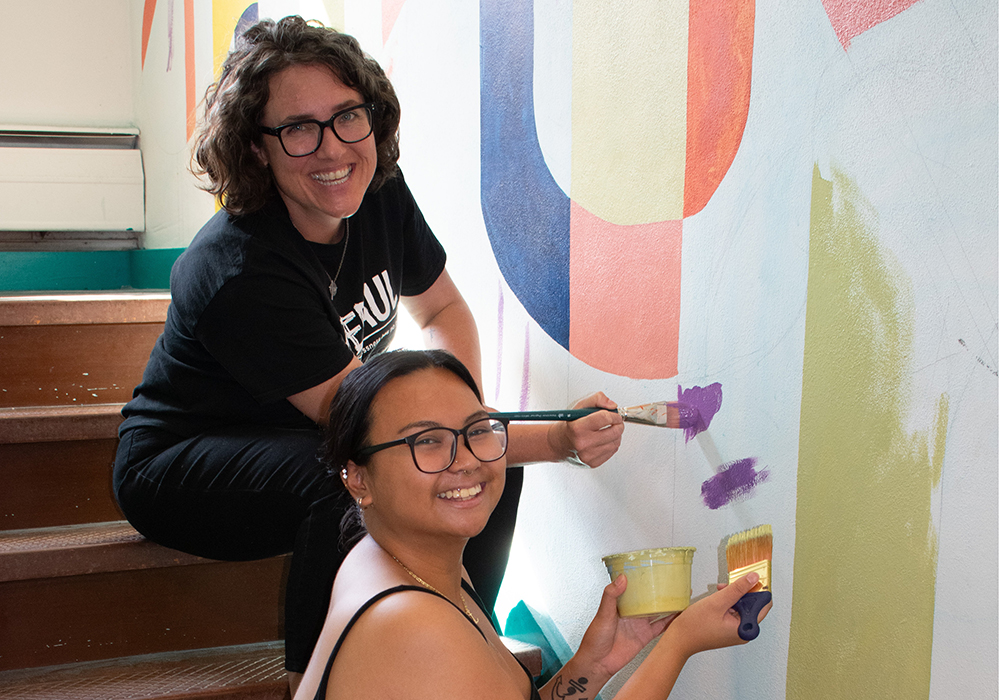
St. Joseph Sr. Bethany Welch paints with one of the transitional housing residents. (Courtesy of Cathie Meighan)
Sr. Bethany Welch first met the Sisters of St. Joseph of Philadelphia while serving in the AmeriCorps in 2003. She wasn't Catholic then, but she admired the sisters' commitment to serving and living amongst the poor, particularly in an era when the diocese was closing many of its inner-city parishes. Later, after becoming Catholic, she entered the Sisters of St. Joseph in 2020 and professed first vows in 2024.
Her time as an AmeriCorps volunteer turned out to be working at a Catholic parish trying to start a community center, and this idea of expanding what a parish could do with their land captivated her. Welch's work has been focused on urban revitalization, particularly on the adaptive reuse of church property, both before and after entering the order. "How do we steward those properties to serve the Gospel?" she asks.
Before entering the Sisters of St. Joseph of Philadelphia, she founded and ran the Aquinas Center, a community center located in a former convent in a disadvantaged part of Philadelphia. As a sister, she ran a transitional housing program — also in a former convent in Philadelphia — that served college students from different universities in the city. She has also served as a consultant for parishes looking to reuse their buildings.
Welch is currently the Justice, Peace and Integrity of Creation coordinator for the Sisters of St. Joseph and is also involved with Tending the Flame, a ministry for younger sisters.
Before entering, she earned a Ph.D. in urban studies and public policy from the University of Delaware, and her dissertation was on adaptive reuse of church property on development work. While she was running the transitional housing program for college students, she also served as a research fellow at the Center for Church Management at the Villanova School of Business, studying how church buildings can be reused to help with the affordable housing crisis.
Global Sisters Report: What are the biggest challenges when it comes to reusing church buildings?
Welch: When I started this I was really enthusiastic, probably because of ignorance. A building closing represents a source of grief. If a school closes and becomes housing for low income senior citizens, it's a good thing for those senior citizens, but not for the young person who went to that school. The biggest challenge is how to honor that previous vision, and attend to that grief.
Our fear of the unknown can get in the way of using that space. It sits empty. People become paralyzed. Sometimes there was a harm, and people can't move forward. Especially in an age of parish collaboratives, a priest might have 8-15 buildings to figure out, and priests don't go to real estate school! There's a sense of overwhelm. It's important to find trusted collaborators. The skillset to manage a housing development is different than running an elementary school.
There's a difference between diocesan and religious order properties. In a diocesan setting, with a portfolio of real estate, the diocese should look at the needs of each neighborhood; those people should have some say in how those buildings are used. There's not one model. One diocese sold a parking lot where they could build up, and used that money for a community center in another neighborhood. You do active discernment.
As a consultant, how do you help parish communities be realistic about the future of their building?
Truth telling is a Gospel virtue. Anticipating that something can work when it can't is not helpful, and when the church has already let people down, it adds hurt.
One parish wanted to wait to decide what to do with their school, but if you don't heat and cool a building, it breaks down. Nature takes buildings back very quickly.
I've seen a parish community be very excited about an idea before they know anything about how buildings work. You need emergency exits. Our charity overtakes logic and reason. The invitation as a sister is to be more realistic with people. Let's vision with people and invite the Holy Spirit and give it back to God. We're collaborating on God's project. Humans get very attached to stuff, which is where that process of Ignatian discernment can be helpful.
It's not helpful to the property values or the neighbors if the building sits, the concrete crumbles, and rodents can get in, or there's criminal activity. Meaning making shouldn't get in the way of good stewardship of the building. That's part of our stewardship as people of God.
You need to ritualize that coming to an end. You need a plaque, or naming. You don't want to miss that step — the ritualization of grief. That's where we see opposition, from that dissonance.
Sometimes there has to be demolition. I try to take a posture of uncertainty and humility. But when you see demolition, there can be a tremendous return to nature and being attentive to Laudato Si'. It doesn't have to just be buildings. Ritualize that moment back to earth: dust to dust.
What was running the transitional housing program for college students like? How is it different from other kinds of transitional housing?
I first got involved when, as a novice, I had a ministry day. I had met homeless students at Rutgers University Camden and Cabrini University. I was always curious: What's available for them? I was there for a year [at the Dax Program, run by Depaul USA], and then the organization asked if I wanted to be a director.
They're relating to an institution of some kind. It's not that the students start unhoused; something happens. There were students who were LGBT and were discriminated against by their families, or students whose families got deported. Students experienced trauma and lose funding or academic scholarships and lose their housing. There were students living in the library, or in their cars. They connected with someone at the university, who made a referral.
If they can graduate college, they might not get caught in the cycle of homelessness. If they get the housing, they can get the job, and then afford housing.
A convent is designed for community living. There were 24 individual bedrooms, common space and a kitchen set up for lots of cooking. There's a lot of benefit of people learning and studying together, but it's challenging; there can be very different backgrounds. And a student said to me, "Before you got here we got to live here and now you have to talk about living here." I said, "We all have chores and a house meeting. We need to respect privacy. If you have conflict, you have to work it out."
The downside is not every convent is suitable for students. And they might be coming back late, or smoking; that creates tension. How do you communicate to the neighborhood that they're all somebody's kid? This is where being a sister was a nice bridge, because my community used to live here. The neighbors would say, "It's not like when the sisters used to live here," and I could say, "Yes, but we believe in this project."
It's not like other transitional housing. There's more acceptance. There's an aspirational quality; you're still believing in somebody's potential.
What is it like to be a younger Sister of St. Joseph today?
I met the sisters in 2003. I was very compelled by their authenticity. They lived alongside people on the margins.
Their ability to do that is a little more limited because of aging. How can I be part of what has been while being part of what is emerging? As long as there's five or six of us, that's enough — that's where we started.
People are drawn to the charism of love. It's a powerful witness to a world that's divided. I'm not concerned about the future — I do fundamentally believe God continues to call women to consecrated life. One of the opportunities is to continue new ways of living our charism. There's challenges, but we're open to new things. It frees me up to not be a first grade teacher. You discern with God and us how to use your gifts and talents. I get to be involved in physical spaces to bring people closer to God.
God designed people to be in community — you see that in the Trinity. God continues to call women who are responding with the wholeness of their body to God.
Advertisement