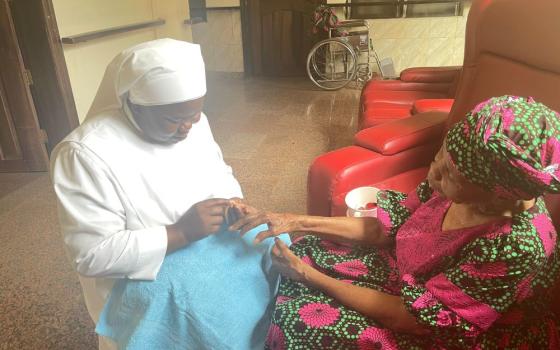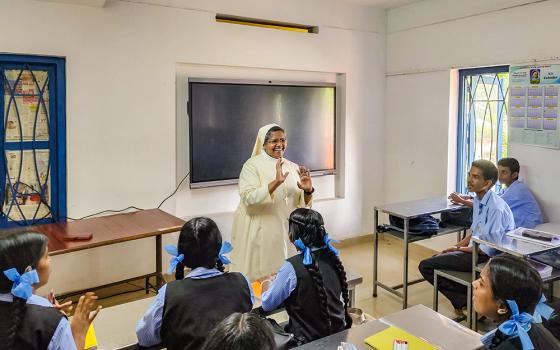
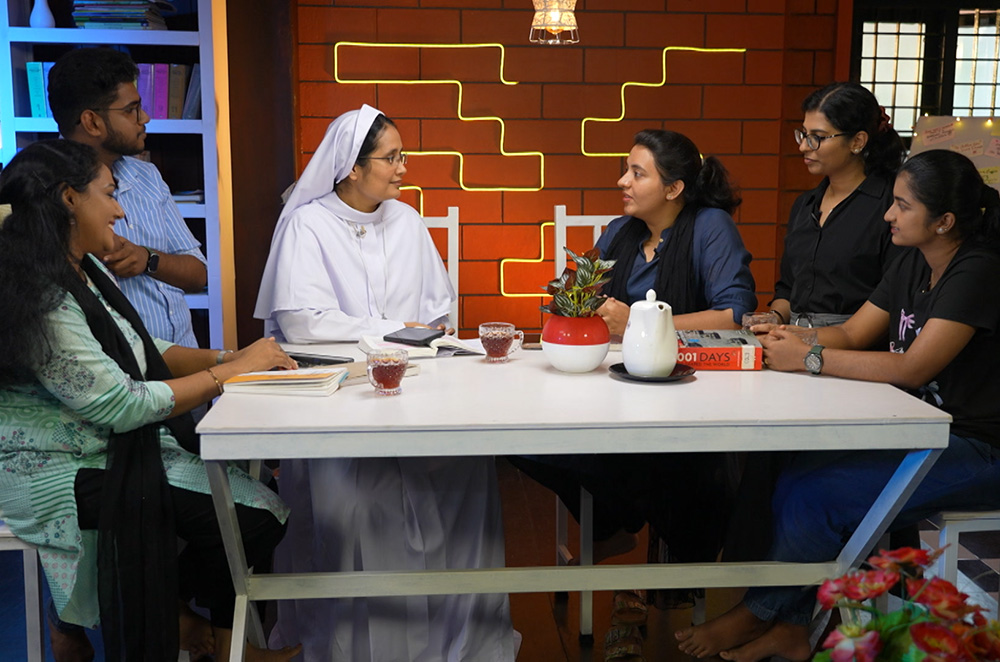
Sr. Christy Babu Cherpanath of the Missionary Sisters of Mary Immaculate with young people during the shooting of the Youth Cafe program produced and aired by Shalom Television in Kerala, southwestern India. (Courtesy of Shalom TV)

by George Kommattam
Sr. Christy Babu Cherpanath once worked as a software engineer at Infosys, one of India's top information technology companies. She left her lucrative career to join the Mary Matha Province of the Missionary Sisters of Mary Immaculate and is now their vocation promoter at their provincial house in Paroppady, a suburb of Kozhikode, a town in the southwestern Indian state of Kerala.
Today, Cherpanath is one of India's young nuns using television, digital media and personal encounters to guide young people toward God.
She is known for her programs on Shalom Television, especially Youth Cafe, a weekly program for youth, and Vocare, a program that shares the inspiring vocation stories of nuns and priests.
Her story has inspired many young people across India and around the world. She spoke with Global Sisters Report about her journey from technology to theology, and how she uses the media to help young people discover faith, purpose and healing.
GSR: You had a promising career as a software engineer at Infosys. What made you leave that behind and join religious life?
Cherpanath: I worked at Infosys as an engineer for nine years in Mysore, Bengaluru, and Thiruvananthapuram [the capital city of Kerala]. Life seemed perfect — a good job, recognition and comfort. But deep inside, I felt an emptiness.
During my prayer time in a chapel, I began to sense God calling me to something greater. I realized that true peace does not come from achievements but from surrendering to God's will. At 29, I decided to follow that call.
I left Infosys and joined the Missionary Sisters of Mary Immaculate at Kulathuvayal, [the congregation's birthplace], in 2020. I professed my vows three years later. Leaving my career was not a loss but a leap into love. In Christ, I found my true joy and purpose. Today, I live with a joy and freedom that no success in the world could ever give me.
Advertisement
What was it like to transition from corporate life to the convent?
It was both challenging and beautiful. Religious life taught me simplicity and silence, very different from the busy IT world. But I also found a new kind of freedom. I realized that when you say yes to God, he gives you a peace the world cannot offer.
I had been active in the Jesus Youth movement for more than 15 years, and that community helped me discern my vocation. Their support and prayer made my transition easier.
Tell us about your television program, Youth Cafe, on Shalom TV.
Youth Cafe is a weekly youth-oriented program on Shalom Television, one of the most popular Catholic channels in India and abroad. My program is designed for young people who want to understand faith in a simple, honest way.
We talk about real-life issues like pornography, masturbation, dating, family prayer, cohabitation and interfaith marriage — topics that young Catholics often struggle with but rarely discuss openly.
Many young people tell me, "Sister, after catechism classes, we had no one to guide us." So, I try to be that voice, not as a preacher, but as a sister who understands the emotions, struggles and dreams of her siblings. We've aired more than 15 episodes, and I receive messages daily from viewers who say the program has helped them find direction and hope.
You speak about sensitive issues. How do you approach these topics on television?
Honestly, I'm not a natural media person. I was afraid of the camera at first! But I believe God called me to speak to youth, and the Holy Spirit gives me the courage.
I don't judge or lecture. I share my own experiences and real stories. I remind them that every human heart is searching for love, but true love and lasting joy are found only in Jesus.
I often quote St. Augustine: "To fall in love with God is the greatest romance; to seek him, the greatest adventure; to find him, the greatest human achievement." That message resonates deeply with the youth.
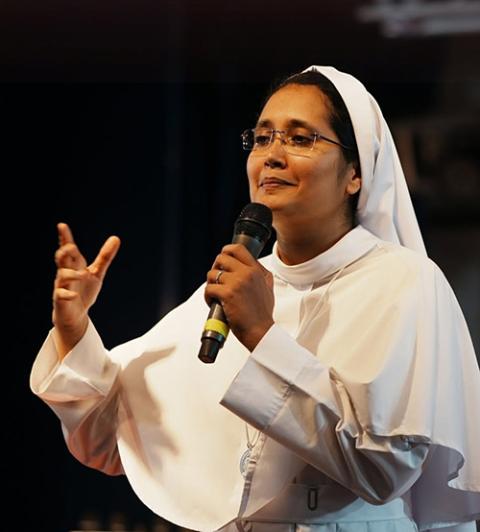
Sr. Christy Babu, a member of the Missionary Sisters of Mary Immaculate, preaches during a youth program in Kerala, a southwestern Indian state. (Courtesy of Christy Babu Cherpanath)
Can you share a memorable moment from your ministry?
Many moments touch me deeply. After one episode, a young man called to say, "Sister, our family started praying together for the first time. My parents never taught us to pray at home, but you convinced me [of] the need for family prayers." That moved me to tears.
Another youth asked for help to overcome masturbation. He was struggling with this habit for many years and was unable to get out of it. I guided him gently, encouraging confession, prayer and God's mercy. He later wrote to say he felt free for the first time in years.
A young woman from Kerala, well-educated and confused about her vocation, contacted me after watching Vocare. Now I'm accompanying her in her discernment process. Moments like these remind me why God placed me in this mission. Now I am helping many girls find their vocation, including doctors, IT professionals and chartered accountants.
How does the media help you reach young people today?
The media is one of the most powerful tools for evangelization today. Without it, my reach would have been limited to a few youth camps. Now, through television and social media, I can speak to thousands, even beyond India.
I receive calls and messages from youth in different countries. They share their struggles and ask for prayers. Parents also watch the programs to understand their children better.
The media has also opened doors for me to conduct youth camps, retreats and parent sessions across Kerala. Every week, I'm invited to different parishes, and many come just because they saw me on Shalom TV. Truly, the media has expanded my mission field.
What happens during your youth camps and classes?
Camps help me connect personally with young people. I don't conduct them like a lecture; it's more of a conversation where I share my own failures, doubts and real-life stories. It helps them to open up.
I use simple examples. I tell them, "If you buy an iPhone, you don't hide it in a cupboard. You use it for its purpose. God created you with a purpose, too. The Bible is our user manual."
Many youths today feel lost or without ambition. I tell them that connecting with God gives real meaning. By the end of the session, we pray together, and many say they experienced peace for the first time.
How do you help young people face challenges?
The first rule is never [to] judge them. Young people fall, but we must help them rise again.
I always feel Jesus saying, "Don't judge my children." So, I listen, share real stories of healing, and lead them toward prayer, confession and the sacraments. I remind them that God loves them unconditionally and walks with them even in their darkest moments. When they believe that, they become stronger.
Once, I met a young traveler on a train from Kochi to Kozhikode. He looked cheerful and adventurous, talking to everyone. But when the journey ended, he came to me and said, "Sister, I need counseling. My life is full of addictions and pain."
I spoke with him, encouraged confession, and advised him to attend a retreat. Months later, he called me to say he had changed and was rebuilding his life. That's the power of God's grace.

Sr. Christy Babu Cherpanath, a member of the Missionary Sisters of Mary Immaculate, with young people during a youth camp in Kerala, a southwestern Indian state. (Courtesy of Christy Babu Cherpanath)
What gives you joy in working with youth?
My greatest joy is seeing them return to God, to the lap of the Father. Many come from broken families, and their pain is not their fault. When they feel accepted and loved, healing begins.
Once, I hugged a Hindu girl who came for counseling, and she said, "Sister, I felt as if God himself embraced me." That moment reminded me that love itself is evangelization.
As a vocation promoter, what trends or challenges do you see among today's youth?
After my first vows, I served as a vocation promoter for two years. I can say that vocations are not decreasing; they are maturing.
Earlier, girls joined religious life right after high school. Now, many come after completing professional degrees as doctors, engineers [and] nurses. This year, our province has seven new candidates, [and] most have master's degrees. One is a doctor.
The biggest challenge is not the lack of vocation, but the lack of family support. They are not getting the atmosphere to nurture their vocation. Many young women hear the call, but their parents hesitate. I always tell them: come, stay with us and discern. If it's God's will, he will make a way.
What inspires you most in your religious life today?
The presence of God inspires me every day. My ministry is important, but what sustains me is prayer. Even when I'm unwell, receiving Jesus in the Eucharist gives me strength. That moment of communion gives me peace beyond words.
I also cherish community life. Every month, I spend one weekend with my sisters in the convent. It keeps me grounded and reminds me that ministry flows from prayer and community.
What message do you want to share with young people?
Your life has meaning. God created you with a purpose. Discover that purpose by knowing Jesus. The world may offer happiness for a moment, but only God gives lasting joy. Read the Bible, it's your life's manual. When you connect with God, you'll find peace, freedom and your true self.