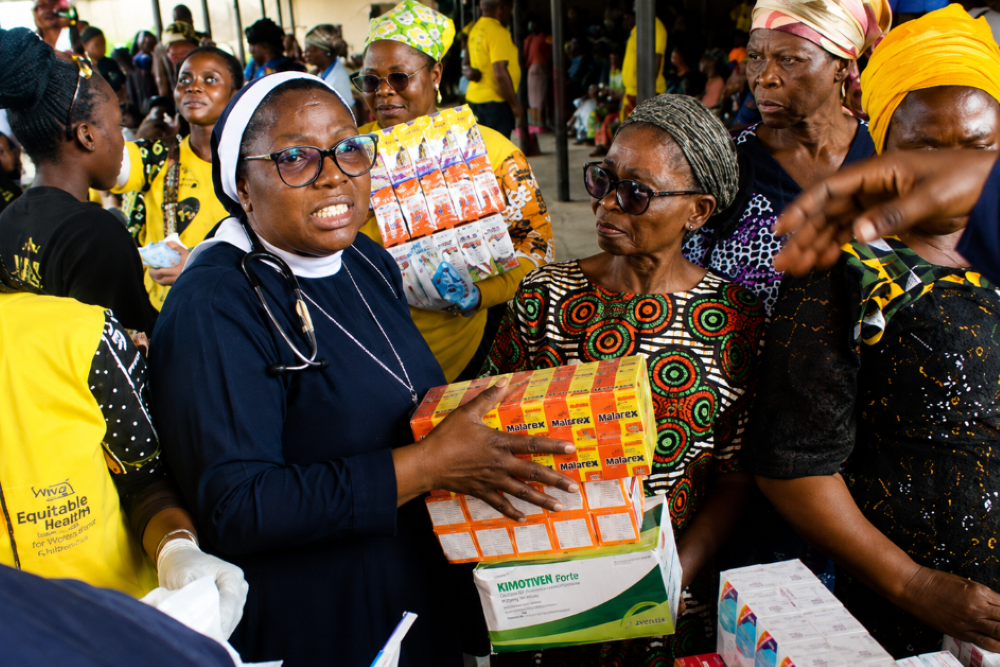
Sr. Dr. Margaret Ogunkuade, a Sister of St. Michael the Archangel, distributes nutrients and medications during a community health outreach in Ketu, Nigeria. (Courtesy of Margaret Ogunkuade)
by John Chukwu
Sr. Dr. Margaret Oluwafunmilayo Ogunkuade has spent much of her religious life bringing together two vocations she believes God placed in her heart from childhood: serving him as a Catholic sister and caring for others as a medical doctor.
A member of the Sisters of St. Michael the Archangel, Ogunkuade serves as the congregation's health coordinator, overseeing the healthcare needs of the sisters, coordinating medical outreaches and health education programs, and managing the congregation's newly established health insurance scheme.
Professionally, she is a consultant obstetrician and gynecologist at the University College Hospital, Ibadan, Nigeria, where she also lectures at the University of Ibadan. She additionally provides specialist care at Michaelian Catholic Hospital in Moniya, where she lives in community with fellow sisters engaged in the congregation's healthcare ministry.
Raised in southwestern Nigeria, Ogunkuade grew up in a deeply Catholic family whose active involvement in parish life helped shape her vocation. By secondary school, her participation in the Legion of Mary, Catholic youth activities and student leadership had strengthened her desire to dedicate her life to God.
Although she initially explored religious life with the Missionary Sisters of Our Lady of Apostles, she eventually discerned a call to the Sisters of St. Michael the Archangel because she hoped to serve within Nigeria, close to her family and among the people she felt called to accompany. She entered the congregation in 1995, made her first profession on Aug. 6, 1998, and her perpetual profession on Nov. 4, 2006.
Looking back, Ogunkuade sees both medicine and religious life as parts of a single calling. While her medical training equips her to diagnose and treat patients, she believes her vocation as a religious sister enables her to accompany them with compassion, dignity and hope. Through hospital work, medical outreaches and community health initiatives, she continues to serve some of Nigeria's most underserved communities, convinced that caring for both body and spirit remains central to her congregation's mission.
GSR: What first inspired you to dedicate your religious life to caring for people through medicine?
Ogunkuade: I have always been passionate about healthcare and remained determined despite the long and demanding years of medical training. My resolve became even stronger during medical school when two young priests of the Catholic Diocese of Ekiti passed away. I believed that, had our healthcare system been stronger, those deaths might have been prevented. At the wake of one of the priests, I promised God I would persevere until I completed my training. That promise sustained me throughout medical school.
The Sisters of St. Michael the Archangel have long served communities with limited access to healthcare. How does the congregation's charism shape the way you approach this ministry?
The core charism of our congregation is evangelization through inculturation. As Sisters of St. Michael the Archangel, we are formed to become part of the communities we serve. Our vows of poverty, chastity and obedience are lived through generous service to God's people. As a consultant obstetrician and gynecologist, I serve in rural and church-owned healthcare facilities where many people cannot afford specialist care. By offering my professional expertise there, I help make quality healthcare more accessible. In this way, lives are touched and hearts are drawn closer to Christ.
What does a typical medical outreach look like, and what are the most common health needs you encounter?
Our newly established Michaelian Catholic Hospital in Moniya, Ibadan, reflects this ministry well. A typical outreach begins with community mobilization, inviting adults, children, the elderly and infants from surrounding communities. Our multidisciplinary team includes doctors, nurses, laboratory scientists, pharmacists, psychologists, media personnel and evangelization teams, who also conduct house-to-house visits to invite people personally.
The outreach provides medical screening, laboratory investigations, clinical consultations, free medications, counseling, health education, referrals for specialized care and structured follow-up for patients who require continued treatment.
The common health needs encountered during most of the outreaches include (though not limited to this) malaria, diabetes, hypertensive disorders, chest infections, infertility cases, cancers and cancer-related illnesses, psychiatry issues and psychosocial issues such as marital disharmonies.
Can you share a patient or an experience from your outreach work that has stayed with you over the years and helped shape your understanding of this ministry?
One experience that profoundly demonstrated God's healing presence occurred during my time at our hospital in Akure. A man was admitted with severe burns from a gas explosion. Managing his condition in a resource-limited setting was challenging, but through God's grace and the dedication of everyone involved, he recovered completely. After experiencing the sisters' compassionate care, he requested baptism and was received into the Catholic Church. That experience strengthened my conviction that physical healing can become a doorway to spiritual transformation.
As both a medical doctor and a religious sister, how do your professional training and your faith complement one another when caring for patients?
To me, these are not two separate careers but two dimensions of one divine vocation. Medicine equips me with the knowledge to diagnose and treat complex obstetric and gynecological conditions, while my faith teaches me to approach every patient with the compassion of Christ. I trust that God perfects the healing my human hands begin.
What have been some of your greatest challenges, and how have you and your congregation continued serving despite them?
Providing quality healthcare in underserved communities presents daily challenges. The grace of God, complete trust in his divine providence and a spirit of generous self-giving have sustained us throughout.
Advertisement
Beyond the limitations of infrastructure and resources, one of our greatest challenges is overcoming deeply rooted cultural myths and fears surrounding healthcare. Many people delay seeking medical attention until their conditions have become severe.
We continue to address these challenges through community education, patient counseling, and by ensuring that our hospitals remain welcoming places where people experience compassion, respect and hope.
After years of accompanying people in vulnerable communities, what have your patients taught you about faith, dignity and resilience?
My patients, especially expectant mothers who travel long distances under difficult circumstances to receive care, have been among my greatest teachers. They have shown me that human dignity is never diminished by poverty. Their unwavering trust in God has taught me that genuine faith is found in the quiet courage to trust him, even when every human support seems inadequate.
Has there ever been a moment in your ministry when you questioned whether you could continue? If so, what happened, and what gave you the strength to keep serving?
Yes. Completing my residency training at the University College Hospital while fulfilling my responsibilities in community life and overseeing the congregation's healthcare ministry brought moments of physical and emotional exhaustion. During those difficult times, I often recalled the promise I made to God at the wake of the two young priests. I also drew strength from prayer, the encouragement of my fellow sisters, and the enduring vision of our founding father, Bishop Michael Olatunji Fagun. These renewed my sense of purpose and gave me the strength to continue.
Looking back over your years in healthcare ministry, how has this apostolate transformed you personally and spiritually?
This apostolate has profoundly transformed me. As an obstetrician, I have come to appreciate how fragile and miraculous human life truly is. I have learned that while I can diagnose and treat, it is ultimately God who gives life and grants healing. Spiritually, medicine has become an altar of sacrifice and prayer. Today, I encounter Christ in the labor ward, in the classroom, and in the faces of every patient and every sister entrusted to my care.