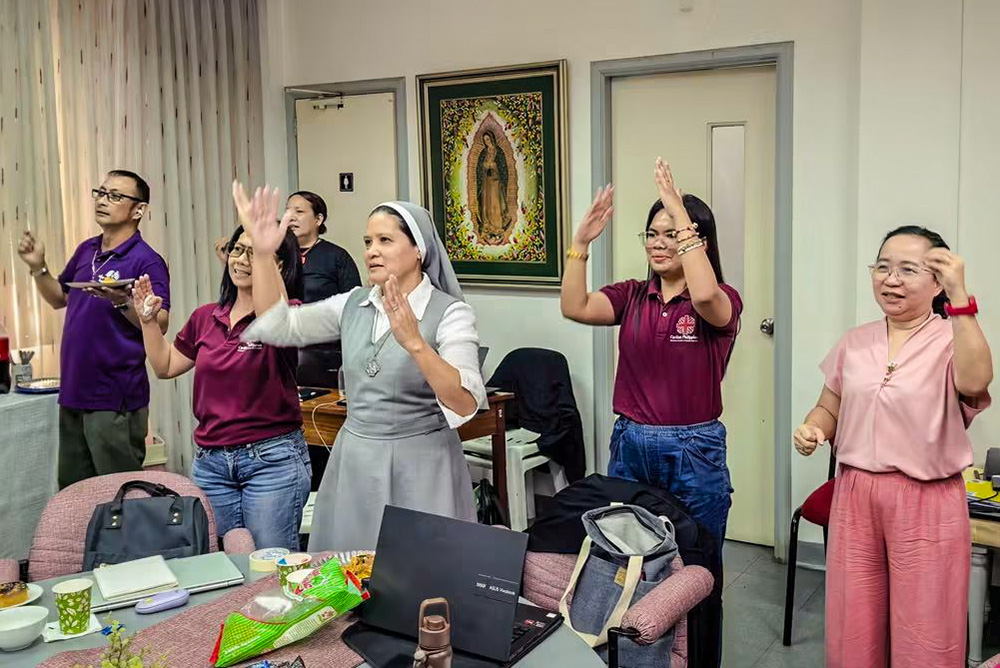
Sr. Ingkie Veloz Taboclaon leads a quick stretch and dance to keep the energy up during a Caritas Philippines workshop. (Facebook/Courtesy of Ingkie Veloz Taboclaon)

by Oliver Samson
Religious life has taken Sr. Ingkie Veloz Taboclaon from mission communities and drug rehabilitation work to leadership within her congregation and service with Caritas Philippines. A psychologist by training, she has accompanied people recovering from addiction, cared for the vulnerable and helped form communities rooted in faith and compassion.
As the first Filipina to lead the Sisters of Charity of Our Lady of Good and Perpetual Help in the Philippines, she oversaw the spiritual and pastoral life of the congregation's Philippine Mission from 2022 to 2024, working closely with Caritas Philippines to advance social justice initiatives, disaster response efforts and community development programs. She now serves as administrator of the Caritas Philippines Development Center.
In an interview with Global Sisters Report, Taboclaon reflected on her vocation, the evolving role of women religious, Caritas' mission of hope, and the church's response to today's social challenges.
GSR: Could you briefly explain the mission of your congregation in the Philippines and the communities it serves?
Taboclaon: Our congregation's mission in the Philippines focuses on catechesis, pastoral ministry and community outreach. We first arrived in Laoag City, Ilocos, before expanding our mission to Fairview, Quezon City, and later to Calubcob, Silang, Cavite, where we continue to serve local communities through evangelization, faith formation and various pastoral services.
As a former leader of the Philippine Mission, what were your primary responsibilities, and what did this role mean to you personally?
My primary responsibility was to accompany and supervise the members of our congregation, ensuring that each sister faithfully carried out the ministry entrusted to her — whether in pastoral work, professional service, studies or religious formation.
I also coordinated the work of the community, oversaw the activities and expenditures of the bursar and helped ensure the effective administration of the mission. Above all, I was responsible for the spiritual and physical well-being of every member by offering encouragement, guidance, correction and compassionate care according to each person's needs.
Personally, this role was both a privilege and a profound responsibility. It gave me the opportunity to serve my sisters with dedication, foster unity within the community, and support each member in living out our congregation's mission and vocation.
Looking back at your previous ministries and assignments, which experiences have shaped you the most? How do they influence the way you lead today?
My pastoral ministries in mission areas, both in the Philippines and abroad, have shaped me the most.
Among these, one experience that continues to touch my heart was serving as a caregiver during one of my overseas assignments. That ministry taught me compassion, patience and the importance of recognizing the dignity and vulnerability of every person.
These experiences have greatly influenced the way I lead today. They have helped me become more caring, understanding and attentive to the needs of others. They remind me to accompany people with empathy — whether in the workplace, within the convent community or in the many encounters I have throughout my journey.
You have spent years working in drug rehabilitation. How did you become involved in this ministry?
I spent several months working in drug rehabilitation as part of my professional training. Since my academic background is in psychology, this ministry allowed me to apply my knowledge in a meaningful way. It became an opportunity to listen, accompany and offer compassionate support to individuals on their journey toward healing and recovery.
Advertisement
What realities have you encountered among people recovering from drug dependence that the public often misunderstands?
One reality I encountered is that many people recovering from drug dependence genuinely want to change, but they struggle because of deep emotional wounds, trauma, family problems or a lack of support. Recovery is not simply a matter of willpower. It is a gradual process that requires patience, proper guidance and a supportive community.
How do you see religious life evolving in the Philippines today?
I believe religious life in the Philippines continues to evolve in response to the changing needs of society. While we face challenges such as fewer religious vocations, rapid social change and the growing influence of technology, these realities also invite us to renew our mission and discover new ways of proclaiming the Gospel.
By remaining faithful to our charism while responding creatively to the signs of the times, I believe religious life will continue to be a source of hope and inspiration for many.
What are the greatest challenges facing women religious and their ministries today?
One of the greatest challenges is responding to the changing needs of society while remaining faithful to our vocation and charism. Many congregations are experiencing fewer vocations and an aging membership, placing greater demands on those who continue in active ministry.
Another challenge is that many women religious work outside the convent to help support the financial needs of their communities. This requires balancing professional responsibilities, community life, prayer and ministry. While this balance can be demanding, it is essential for sustaining both our personal well-being and our religious vocation.
Despite these challenges, I believe they also provide opportunities to witness God's love through compassionate service.
Caritas is often the church's first responder during crises. How do you see the role of Caritas extending beyond emergency relief to restoring hope and empowering communities for the long term?
I believe the role of Caritas Philippines goes far beyond providing emergency relief. While responding to immediate needs is essential, its mission also includes helping individuals and communities recover, rebuild and become more self-reliant.
Caritas restores hope by accompanying people throughout the recovery process — not only through material assistance but also by promoting human dignity, strengthening livelihoods, supporting education and encouraging community participation. It empowers communities through programs that develop skills, promote sustainable livelihoods and build resilience.
Personally, I have been actively involved in our Caritas Philippines Development Center, where we welcome different groups for training, seminars, retreats and other formation activities. Through this ministry, we strive to ensure that every participant experiences genuine hospitality, respect and care. Although our role may not always be on the front lines of emergency response, we contribute by creating a supportive environment where people can learn, reflect, grow and be renewed.
As a ministry of the church, Caritas also offers pastoral care and reminds people that they are not alone in their struggles. By combining compassionate service with long-term development, Caritas helps individuals and communities regain hope, restore their dignity and build a more secure and sustainable future.
Drawing from your experience in Caritas and your previous ministries, what social issues in the Philippines concern you most today, and where do you believe the church can make the greatest difference?
Many social issues concern me, including poverty, human trafficking, unemployment and limited access to quality education. At this time, however, I believe corruption is among the most urgent because it affects every aspect of society and prevents resources from reaching those who need them most.
Through Caritas Philippines, we continue to promote good governance, accountability and transparency.
Personally, I support these efforts because I believe honest and responsible leadership is essential for genuine social development. This conviction also inspired me to participate in peaceful rallies calling for an end to corruption and greater accountability in public service.
I believe the church can make the greatest difference by forming consciences, promoting justice and encouraging both citizens and leaders to work together for the common good.
In your view, what role can the church play in Philippine society that government institutions cannot?
The church plays a unique role because its mission is to form consciences, nurture faith and uphold the dignity of every human person. The church is not separate from society or government because the church is the people. Its members are also citizens who contribute to building the nation.
While government institutions are responsible for making and implementing laws and providing public services, the church offers moral and spiritual guidance, accompanies the poor and marginalized, and helps form people of integrity and compassion. The church also serves as a prophetic voice by promoting justice, peace, accountability and the common good, encouraging both leaders and citizens to fulfill their responsibilities with honesty and respect for human dignity.
By helping form responsible and faithful citizens, the church contributes to building a more just, compassionate and hope-filled society.
How can the church better respond to issues such as addiction, poverty and social exclusion?
The church can respond more effectively by being present among those who are suffering and accompanying them with compassion rather than judgment. Beyond providing immediate assistance, it should continue investing in education, values formation, livelihood programs, counseling, and community-based initiatives that help people regain their dignity and become self-reliant.
The church cannot do this work alone. By collaborating with families, government agencies, civil society and other organizations, it can create more opportunities for healing, recovery and lasting social transformation. Above all, the church should remain a welcoming community where every person feels valued, accepted and loved, regardless of their circumstances.
Why is the presence of religious communities still important in today's society?
The presence of religious communities remains important because they are living witnesses of faith, hope and love in today's world. Through lives of prayer, service and community, they remind people that life is not only about material success but also about compassion, solidarity and a relationship with God.
In a world that is often divided and fast-paced, religious communities offer a visible witness that it is still possible to live lives of selfless service, simplicity, and commitment to the common good. Their mission continues to inspire others to build a more just, compassionate and caring society.