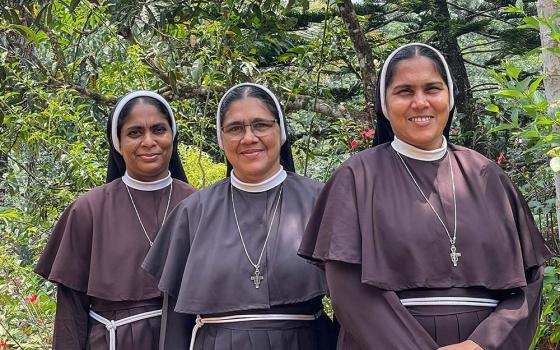
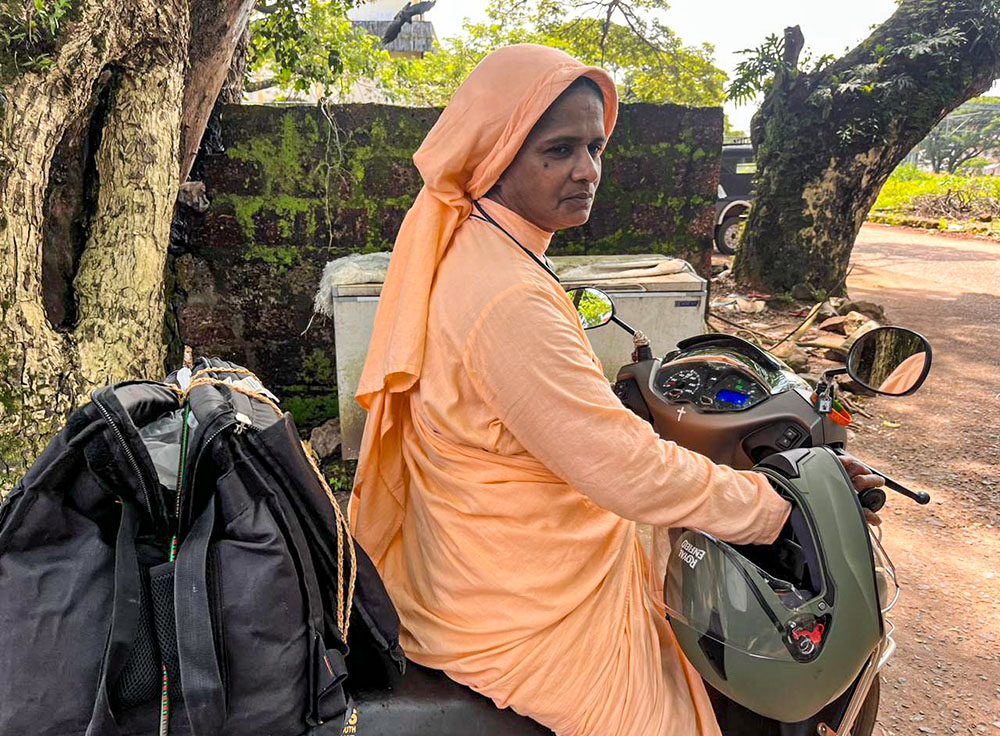
Good Samaritan Sr. Jaya Anto Mangalath brings food and essential supplies to women living on the streets of Kanhangad town in the southwestern Indian state of Kerala. (Courtesy of Jaya Anto Mangalath)
by George Kommattam
Good Samaritan Sr. Jaya Anto Mangalath holds the national record for the most blood donations by a woman in India. The Talent Record Book recognized her in March 2024 when she gave blood for the 117th time.
Mangalath was born in Alappuzha, Kerala state, as the 11th of 12 children. She told Global Sisters Report that her family is deeply compassionate to the poor, and that the spirit of mercy and charity at home shaped her life of service.
Mangalath, who began donating blood in 1987 at the age of 18, has received numerous awards for voluntary blood donation and social service. In 2023, the Kerala State Blood Transfusion Council honored her for blood donation, she said.
Mangalath has a master's degree in psychology and social work. She has served the homeless, widows, the elderly and the destitute in the districts of Kannur and Kasaragod for the past 32 years.
In this interview with Global Sisters Report, she shared about her journey of blood donation, religious vocation and commitment to people living on the margins.
GSR: What made you start donating blood?
Mangalath: I began donating blood when I was a college student. Our college hosted a blood donation camp, and its coordinator was a sister. She explained to us the need for blood and how one simple act could save lives. Her words inspired me deeply and encouraged me to become a donor.
I still remember my first donation. I was a little afraid as I lay on the bed. But when I saw my blood flowing into a bag, the fear disappeared. Instead, I experienced a deep joy and peace when I realized that I could help someone in need. I decided to continue donating blood regularly. I do so every three months.
Was it easy to continue the practice when you joined the convent?
Yes, it was easy. My superiors were aware of my interest in blood donation and always supported me. Usually, we donate when there is a request, but I would voluntarily go to the blood bank and donate even when there is no demand.
Whether in Andhra Pradesh or Kerala, I faced no difficulty in continuing this practice. My superiors considered it a meaningful way of serving others with compassion.
Have you faced any health problems from regular blood donation?
Nothing so far. In fact, it has made me more aware of my own health. I am approaching 60, and by God's grace, I do not have diabetes, high blood pressure or any major illness.
While my donation helps others, I feel it also purifies my own blood. It gives me inexplicable joy and deep inner satisfaction.
What would you say to people who are afraid to donate blood?
From my experience, I can confidently tell them that there is nothing to fear. When we donate blood, we offer life to another person or help sustain someone's life. It is a simple act of love.
As a member of several blood donor groups, I often receive requests for blood. Whenever such messages come, I first encourage the patient's healthy family members to share blood. I help them overcome their fear. If someone is afraid, I explain to them the importance and benefits of blood donation.
Advertisement
Are you happy after receiving many awards?
I am not overly excited about the awards. I believe whatever I am today is by God's grace. Compared to God's reward, no human award is greater. I accept awards with gratitude. I believe that good deeds done for God will receive their true reward from him.
When I receive an award for blood donation, I am happy because it inspires others to donate blood.
You left teaching to do social work. Why?
After my religious profession in 1990, I started as a teacher and counselor in our schools in Eluru [Andhra Pradesh state].
During that time, I heard painful stories of people in Kasaragod suffering from the spraying of endosulfan on crops. Many families suffered health hazards without proper guidance or support to receive government aid. I was moved by their plight and felt called to serve them through counseling and social service.
I came to Kasaragod [some 630 miles southwest of Eluru] in 1994. I stayed in Kanhangad because it is centrally located and allowed me to reach people easily.
I have served widows, street children, the homeless and the abandoned, providing food and taking them to shelters. I also helped them complete application forms to receive government aid.
I try to give at least one meal daily to someone living on the streets. For this, others support me with funds.
What else do you do there?
I am a social worker. When I am not engaged in blood donation activities, I go to the streets, homes and public places to meet the lonely and forsaken. I bring those in distress to my rented home or accompany them to shelters where they get care and protection.
I also help people with mental health struggles and those affected by alcoholism. My service is simple: listen, offer a kind word or just be present. I try to restore dignity and hope to people who feel forgotten.
You spoke of alcoholism. How serious is it in the area?
I have seen addiction destroying families. I serve as the state secretary of the Kerala Prohibition Council [an organization that follows the teachings of Mahatma Gandhi], dedicated to fighting alcoholism.
Alcoholism is the root cause of suffering, domestic violence, neglected children driven to the streets and poverty. Much of the pain I encountered in society was connected to this addiction.
What do you do to counter it?
I organize awareness classes, guide families toward treatment centers, and encourage those struggling with addiction to seek help. I also participate in campaigns and public awareness rallies promoting a healthier society.
I believe society must seriously address addiction. While governments warn people about drinking, liquor outlets continue to expand. We need policies and social awareness that truly protect families and future generations.
What are other challenges you face?
Fund scarcity is a big issue. At times, I have no money to provide food, medicines or even transportation to take the needy to hospitals.
But I do experience God's providence through people. When I request help, people generously help me to continue my service.
In the beginning, some people linked to certain political groups thought I had come for religious conversion. Within a few months, they understood my true intention. Today, many of them are my supporters.