
Sr. Mary John Mananzan, a Missionary Benedictine nun and feminist theologian, poses for a portrait. She stood with workers facing police violence during the 1975 La Tondeña strike, the first major protest against the martial law of Philippine dictator Ferdinand Marcos. (Manilen Grace Armea)
Sr. Mary John Mananzan, a Missionary Benedictine nun and feminist theologian, stood with workers facing police violence during the 1975 La Tondeña strike, the first major protest against martial law imposed by Philippine dictator Ferdinand Marcos in 1972.
Mananzan, now 87, recalls that her fight against martial law half a century ago pushed her to become a social activist. Since then, she has become one of the Filipino church's most outspoken critics of patriarchy, clericalism, sexual abuse, and other issues of inequality and abuse of power in her society.
She previously chaired the Association of Major Religious Superiors of the Philippines and is a leading proponent of Asian feminist theology of liberation. She collaborates with various organizations dedicated to addressing gender issues and promoting women's concerns and co-founded the Gabriela Women's Party, one of the most prominent women's alliances in the Philippines. While serving as president of Manila's St. Scholastica's College, she founded the Institute of Women's Studies, a center dedicated to empowering women through education and advocacy.
In 2011, she was named one of the 100 most inspiring people in the world by a New York-based organization called Women Deliver, marking the centenary of International Women's Day. She is currently the directress of St. Scholastica's Academy in Pampanga, a province in central Luzon.
In an interview with Global Sisters Report, Mananzan discusses her journey, the issues plaguing the church and society, and her hopes for the future.
GSR: You are a feminist, a theologian, an activist and a Benedictine nun. How do you balance these roles?
Mananzan: Thomas Merton says contemplation is the foundation where prophecy develops. For me, prophecy is activism. My contemplation, my prayer, is the soil in which my activism grows. Sometimes, people think they are opposites — that if you are praying, you shouldn't care about the world, and if you are constantly out on the streets, you forget to pray. But that's not true at all.
Sometimes people tell me that I'm radical. And I say, "Yes, I am." It is because the word radical comes from the Latin radix (root). That means I'm rooted. I love to analyze issues at their root and aim to transform society from its roots.
Do you encounter contradictions when addressing religious and political issues?
For me, there are no dichotomies. Everything is part of my life; everything flows through it. As I told you, everything starts from the root, which is contemplation — that is my prayer life. I never sacrifice it for anything.
Even if I participate in a political rally, I ensure that I am back in time for evening prayer. I don't go out until I have finished my morning prayer. My dedication to prayer gives me the strength and inspiration to do what is necessary to change the world.

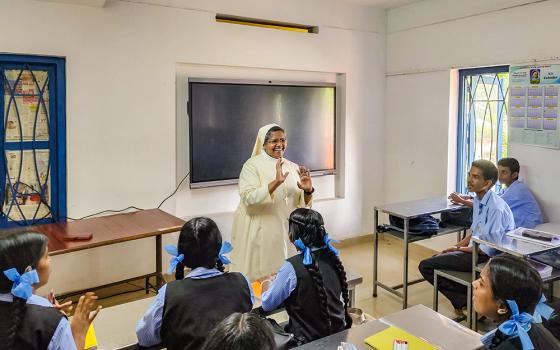
Missionary Benedictine Sr. Mary John Mananzan, a feminist theologian and activist, is the directress of St. Scholastica's Academy in Pampanga, a province in central Luzon, Philippines. (Manilen Grace Armea)
I am not ashamed to say that I do political work. I am a part of the city, so I am involved in transforming it. I was there on EDSA (an acronym for the circular road around Manila — Epifanio de los Santos Avenue), where the People Power Revolution of 1986 took place and overthrew Ferdinand Marcos Sr.'s dictatorship.
There were millions of people on the street. Not many who experienced it are still around. It was a euphoric moment — unbelievable. I even brought my mother, who was 89 at the time. Back then, you couldn't see the end of the crowd. The atmosphere was festive. We managed to remove a dictator peacefully without bloodshed. That's what they call people power.
I am involved in everything that can improve people's lives, and there is absolutely no contradiction in my life.
You have gone on record saying that the La Tondeña strike opened your "whole being." Can you elaborate?
My baptism by fire was during the La Tondeña strike. We, 21 nuns, joined to support the workers while the police tried to intimidate them. Witnessing the courage of the workers, despite being beaten and exhausted, was unforgettable. It taught me about solidarity and inspired lifelong activism.
Prayer gives courage. Courage is infectious. Seeing others act bravely inspires you to do the same. We never sought unnecessary danger, but when needed, faith sustains action.
How should the church, specifically the Filipino church, address social inequality?
We have many documents from church leaders condemning social inequality. However, I have yet to see the official church fully support those who are oppressed and suffering. Still, genuine efforts are underway. For example, the Association of Major Religious Superiors, of which I was once a chairperson, regularly issues statements whenever human rights violations occur.
The church has the moral authority to stand against anything that violates human rights, against poverty and corruption, which is essentially linked to politics. Corruption has become the most serious disease among Filipinos.
Like I said, we have a prophetic role. What did the prophets do? They denounced injustice and corruption. And they often stood opposed to the religious leaders of their time, like the Pharisees. Prophets challenged the powers of their day. Activists today are similar to the prophets of the past. I would say the church's role today is to be prophetic: to speak, to show and to give moral guidance on what is happening in society.
Why do we see so few Asian theologians speaking about these issues?
There are voices, like the Ecumenical Association of Third World Theologians. I was its executive director for four years. We used to hold Asian, African and Latin American consultations, followed by a general consultation each year.
It happens less now, but there are Asian theologians, including women theologians. The work continues quietly. Even if less is published, journals still show theologizing activity.
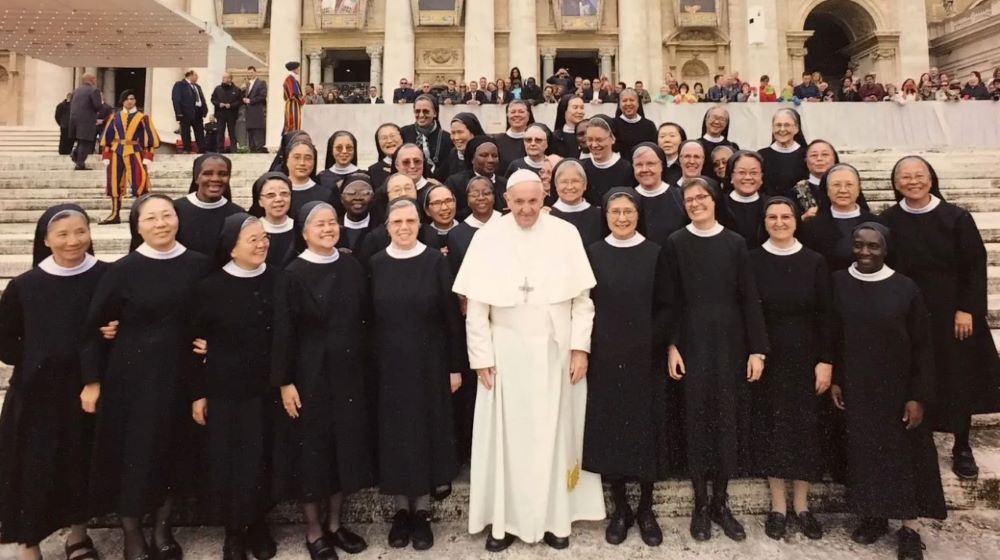
Sr. Mary John Mananzan and other women religious at the Vatican during a visit with Pope Francis (Manilen Grace Armea)
Theologizing is unavoidable; it just may not be as visible. We need revival. Today's issues — extrajudicial killings, corruption — require theological analysis. Women religious can dissect, reflect and provide moral guidance on these pressing matters.
But many women religious remain silent about the abuse of women in the church.
I wouldn't say we're completely silent. When I was active, the Conference of Major Religious Superiors of the Philippines regularly issued statements on current issues, especially women's oppression. We also advocated for the inclusion of women's studies in all higher education institutions.
I founded the Institute of Women's Studies over 30 years ago, providing education to grassroots and middle-class women, including courses on violence against women. There's also an annual campaign against violence from November 24 to December. 8, supported by groups like the Gabriela Women's Party.
The issue isn't a lack of awareness but a lack of action. Local government officials here in the Philippines often see domestic violence as "private," but authorities need to step in. Sadly, cases continue, like a woman who came to us for safety just the other day after her partner threw a plate at her.
Do nuns in the Philippines live a safe life from persecution?
In the Philippines, Catholics generally don't face persecution. No one is killed just because they are a nun. However, I am not immune to red-tagging (being labeled as a communist and prosecuted). You won't be killed just for being a nun, but you could be targeted if you're an activist, because they might think you're a communist and should be killed.
But as a sister, I believe we have some institutional support that prevents them from killing me easily. The difference is in being a layperson. That's what hurts — the fact that because you are a nun, you won't be killed, but a layperson might be.
Advertisement
What do you think about ordaining women in the Catholic Church?
It's time to confront this issue. Philosophically, it's a straightforward syllogism: men and women are equal in God's eyes. Yet, the church claims that men can be ordained while women cannot, which contradicts that premise. I hope someday a pope will finally declare, "It's time we ordain women."
Does clericalism play a part in this injustice?
Clericalism must be abolished. Laypeople make up the majority of the church, yet priests dominate. Priests must be willing to relinquish power and share leadership.
The church must practice what it preaches. Synodality highlights listening to those who are marginalized, and women are marginalized, too. Men should openly support women's ordination. In ecumenical settings, I've observed women pastors and bishops leading naturally. If we claim equality, then denying women full ministry is unjust.
What do you think of the future of women religious in Asia?
The number of vocations is declining, but innovative forms of religious life can inspire young people. Communities immersed among people, even in Muslim areas, may revive interest. Living among the grassroots is the future.
I wouldn't advise young girls to join the convent as I did. I'd suggest they experience life first and even have a boyfriend if they want. However, each person's journey to a vocation is unique; you can't just copy someone else's. So enter right away and see for yourself whether this is really the life for you.