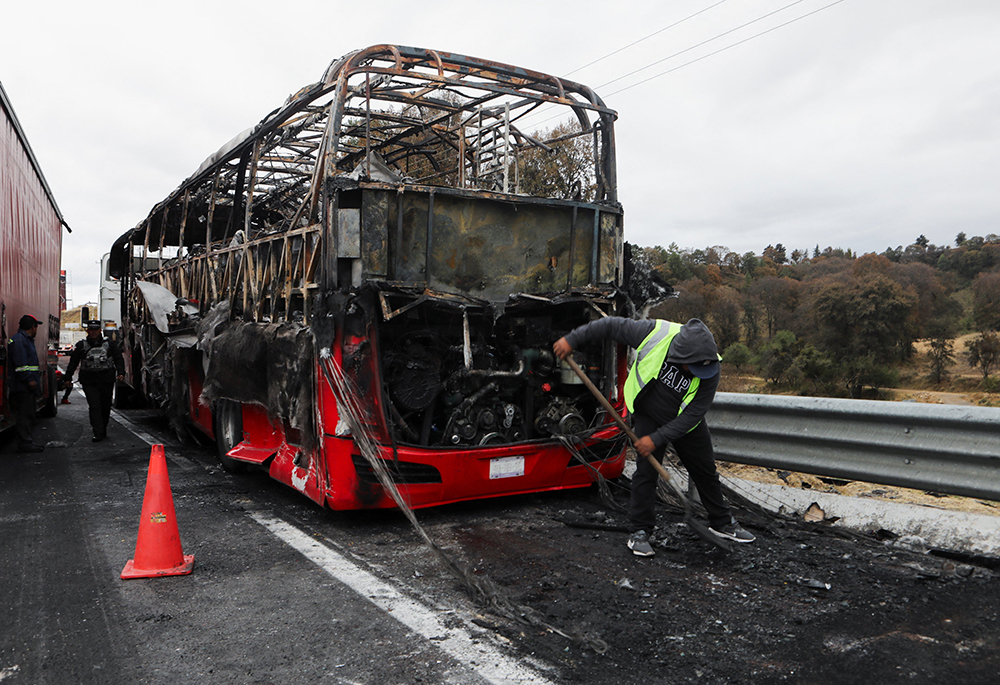
A burned bus is seen Feb. 22, 2026, at the site of a highway in Santa Rita Tlahuapan, Mexico, that connects Mexico City with the state of Puebla. Members of organized crime in several states put up roadblocks and carried out arson attacks after a military operation in which Mexican drug lord Nemesio Oseguera Cervantes, known as "El Mencho," was killed in Tapalpa in Mexico's Jalisco state. (OSV News/Reuters/Paola Garcia)

by Rhina Guidos
Sisters in Mexico say they are praying for peace in their country after more than 60 people died during and after the Feb. 22 capture of a drug lord whose death sparked alarming violence.
Buses, cars and buildings were set on fire in central-western Mexico after news that Nemesio "El Mencho" Oseguera Cervantes, leader of the Jalisco New Generation Cartel, had died on the way to the hospital. Tourists reported an explosion that resulted in a cloud of black smoke that lingered for hours over the skyline of the resort city of Puerto Vallarta. Roadblocks set up by cartels, and some road closures by the government, brought transportation around much of Mexico to a halt.
A sister told Global Sisters Report that because of a road closure she couldn't drive home Sunday, Feb. 22, after visiting a religious community in southern Mexico, far from where the operation took place. She suspected that a lack of electricity and problems with the internet that day were related to the operation.
Violence continued Feb. 22 in and around Jalisco, the state where the military operation took place. Jalisco is home to cities popular with tourists such as Guadalajara, a cultural center, and Puerto Vallarta, a beach hot spot. Airlines suspended flights in and out of nearby airports, leaving tourists scared and stranded but some companies resumed flights Feb. 24.
Cartels, however, operate in various parts of the country and officials worry violence may spread as factions compete for power and vie to take the drug lord's spot.
Religious communities in the Jalisco region hunkered down, waiting for the government to regain control of their streets.
Advertisement
The country's bishops urged Catholic Church members in the region to stay home, exercise caution and listen to directions from local authorities, warning against spreading rumors and unnecessary alarm.
Though not all parts of Mexico, with a population of more than 130 million, were equally affected, there is widespread apprehension. Not since COVID-19, a sister in Mexico City told GSR Feb. 23, have people in the country been so concerned about leaving their homes.
"We're back to 'stay home to save your life'," she said. (Sisters interviewed for this story will remain unnamed out of concern for their safety.)
While schools remain open in places such as Mexico City, more soldiers than normal patrol the streets and there is a sense of hypervigilance, of "anxiety and uncertainty," the sister said.
"But there's also a sense of solidarity, unity, of praying together for peace," she added.
A lot seems normal, though it's probably not like that the closer you get to places like Jalisco, Michoacan, Guanajuato, "the epicenter of goings-on," she said, but the nearby Basilica of Our Lady of Guadalupe in Mexico City is open.
Some parents and children called the sister late Sunday to ask whether the school, where she is the principal, would open a day after the violence.
"I told them 'We will work until authorities tell us otherwise,' " she said.
Mexico's President Claudia Sheinbaum said Feb. 23 that almost all normal activities in the country had resumed and roadblocks set up by cartels had all but disappeared.
The Confederation of Latin American Religious, in a Feb. 24 statement, said the battle against drugs can't be focused solely on fighting the cartels and urged fighting the markets in some countries that sustain the flow of drugs, as well as the economic systems that hide their gains.
"Where there is indifferent consumption, there is complicity; where profit takes precedence over life, the chain of violence is fed," CLAR said. "An ethical and binding international commitment is required that equally involves producer and consumer countries, attacks the economic and cultural roots of crime/business, and places human dignity at the center above all other interests. Only a global, cultural, and spiritual conversion can break this cycle of death."