
(GSR graphic/Olivia Bardo)

"Evolving Religious Life," a continuing series from Global Sisters Report, explores how Catholic sisters are adapting to the realities of congregations in transition and new forms of religious life. While we write often about these trends, this particular series will focus more closely on sisters' hopes for the future.

There have long been lay employees in sisters' offices, handling administrative work such as insurance coverage and overseeing payroll. But more and more laypeople can now be found in the executive suites, wielding authority once reserved only for vowed religious.
Since 2022, Jennifer Hunter has been the chief operating officer of the Adrian Dominicans, a new position created when she stepped into the role after years of overseeing campus services. At the same time, Sara Stoddard's title changed from director of finance to chief financial officer.
While Stoddard said their work hasn't changed much, their responsibilities and authority have, as has their standing with the leadership team.
"You're more at the table. They look to you," she said. "But they're very supportive, they're not second-guessing your decisions."
There are so many congregations putting laypeople in executive positions that the Leadership Conference of Women Religious has created a network where they can experience some formation and find each other for mutual support.
LCWR executive director Sr. Carol Zinn said the Zoom calls for the network regularly attract up to 60 participants.
"What they haven't had experience in is working in this culture of religious life," she said. "So what we've found is that some formation for these professionals is a very big need."
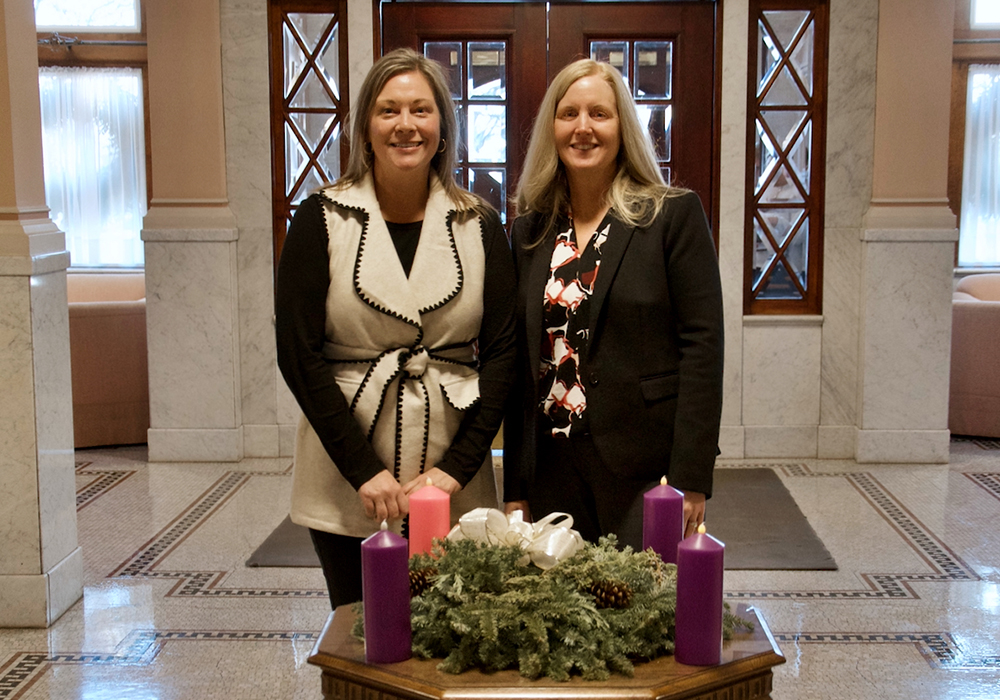
Jennifer Hunter, left, and Sara Stoddard are pictured in the lobby of the Adrian Dominican motherhouse Dec. 17, 2025. Hunter is the congregation's chief operating officer and Stoddard is the chief financial officer. (GSR photo/Dan Stockman)
Jenifer Belt, chief operating officer for the Sylvania Franciscans, said the network has been a blessing as she experiences such a unique role.
"You think what we do is such a niche, but then you realize" there are many others in similar positions, she said. "I'm so grateful a forum was created. We cover everything from the mundane to the sublime."
In at least one respect, congregations hiring non-vowed employees for executive roles within the congregation is nothing new: Communities with their own infirmaries or skilled-nursing facilities for their sisters needed to hire health care administrators decades ago as regulations and government funding became more and more complex. Financial oversight of the congregation has also been moving into laypeople's hands for a long time.
But now they're being joined by chief executive officers or chief operating officers and all of them are being relied on by the leadership team for their expertise and advice.
"These executive leaders report directly to the canonical leaders," Zinn said. "But everything that goes on … is ultimately the responsibility of the canonically elected leaders."
Part of the family
Belt became COO on Feb. 3, 2020 — six weeks before the campus went on lockdown for the COVID-19 pandemic.
Before taking the position, Belt had been an attorney for the congregation for more than 20 years, so she was well known to the leadership. Working at the same law firm as an employment lawyer was Mechelle Zarou, who in 2022 became the order's chief people and culture officer, overseeing human resources and the congregation's work with immigrants. She is also legal counsel for the order's university.
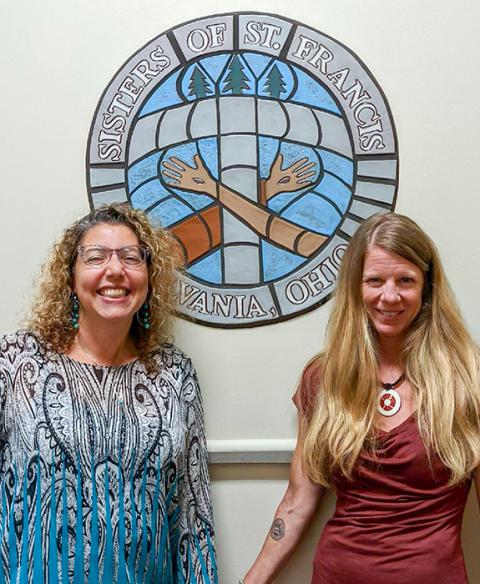
Mechelle Zarou, left, chief people and culture officer for the Sylvania Franciscans, and Jeni Belt, chief operating officer for the congregation (Courtesy of the Sylvania Franciscans)
"Once you get in with the sisters, you want to do all you can to help them," Zarou said.
Belt has also taken on a new responsibility: Congregational leadership knows completion is on the horizon, and asked Belt to consider getting a degree in canon law so she can help them plan their legacy, making sure the beautiful, wooded campus and all the congregation stands for is protected into the future. She is in her third of four years of study.
Developing and implementing the plan "will require me to create certain legal structures that stand up from both a civil law and a canon law viewpoint," Belt said. Before she could even start her studies, she had to take 27 credit hours of undergraduate theology courses.
Key for any layperson in an executive role, she said, is communication.
"I have a weekly check-in with the congregational minister, and I keep a running list of everything she might be interested in knowing," Belt said. "Sisters don't like to be surprised."
Zarou said a big change going from being an attorney in a law firm to working for sisters was moving away from a focus on money.
"They [sisters] have no concept of billable hours. I billed on six-minute increments, so when they talk to me, they say, 'How many billable hours was that, Mechelle?' They get a big kick out of it," she said. And where the first email of her day in the past was about the firm's finances and the clients paying them, "Here the first email every day is a prayer request. … Instead of money, it became about how do we help people and who do we pray for?"
Advertisement
Frank Castillo is the chief operating officer for the Sisters of St. Joseph of St. Augustine, Florida, where he is so loved that — since he cannot be a Sister of St. Joseph — they call him their "Mister of St. Joseph."
"They tell you in the human resources field to never talk about the organization as a family, because they're not, but for this organization, that's not the case," Castillo said. "It's been a tremendous honor working for them."
Sr. Kathleen Carr, the congregation's general superior, said Castillo oversaw human resources and finances for about seven years before they created the COO position for him about a year ago.
"Frank's gifts just continued to grow and bloom," she said. "We have absolutely gifted laypeople who have walked the journey with us and grown in our charism."
Castillo helped guide the congregation as it considered selling its historic campus and building a new facility elsewhere, and also as they changed to their new plan of selling the campus but remaining there in a new facility they will build.
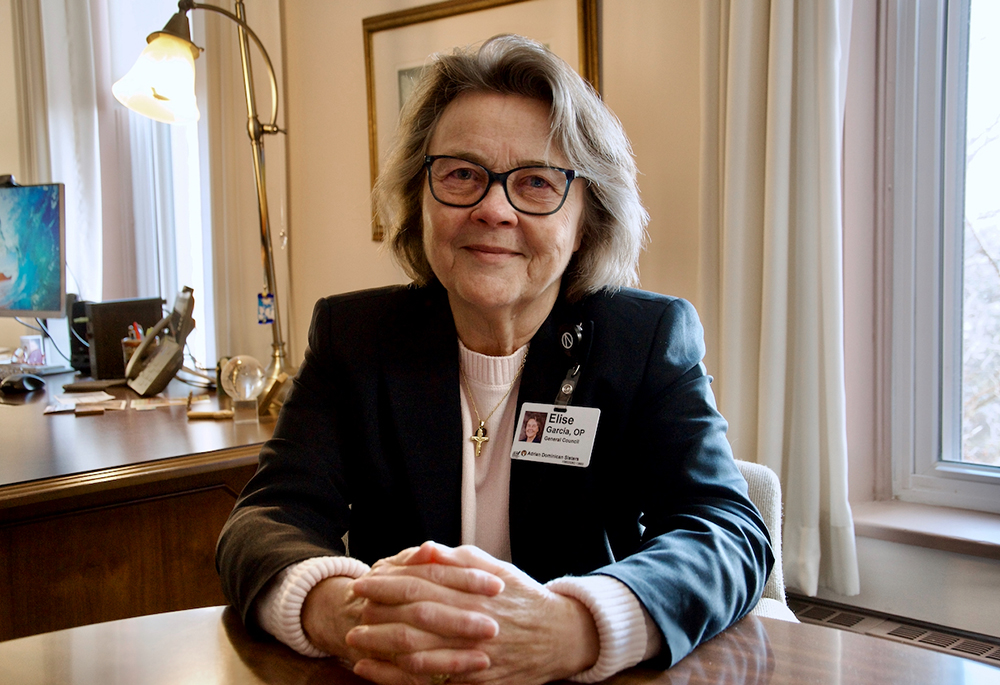
Sr. Elise Garcia, prioress of the Adrian Dominicans, speaks in her office Dec. 17, 2025, about the laypeople in executive positions at the congregation, which include a chief financial officer and a chief operations officer. (GSR photo/Dan Stockman)
Trend affects both big and small congregations
Sr. Elise Garcia, prioress of the Adrian Dominicans, said many sisters find it difficult to let go of roles they have always held.
"Congregations have been reluctant to bring in lay leaders to these positions," she said. "But it's a real gift to have these incredible, dedicated women in these pivotal leadership roles in our congregation. We couldn't do it without them."
Smaller congregations, with populations of aging sisters, often cannot find sisters in their ranks with both the expertise and physical ability to fill those jobs anymore. But Garcia said it is not only small congregations struggling: While the Adrian Dominicans currently have 350 sisters, their median age is 84 and more than 200 of them have retired to the motherhouse.
"Even though we're a very large congregation, we still have the same demographics as every other congregation," she said. "[Laypeople] are filling positions we no longer have an abundance of candidates among sisters to fill."
Zinn said one thing driving the change is the requirements for executive positions have changed.
"The skills needed today are very different than 10 years ago, let alone 30 years ago," she said. "The needs of the members and the skills of the members to respond to those needs have shifted. … What our members are finding is they need to welcome in lay professionals who have the skillset to best serve the institute so the institute can serve the needs of the world."
And while most lay executives serve the side of the congregation that is technically a civil corporation, they learn quickly that it is not run like a business.
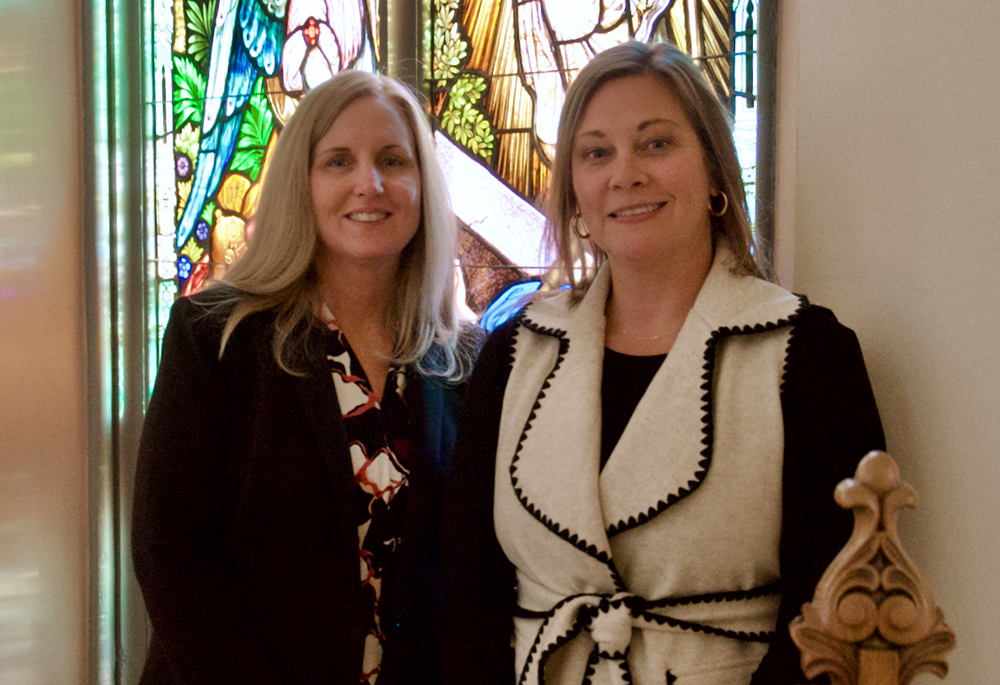
Sara Stoddard, left, and Jennifer Hunter in the chapel of the Adrian Dominican motherhouse Dec. 17, 2025. Hunter is the congregation's chief operating officer and Stoddard is the chief financial officer. (GSR photo/Dan Stockman)
Sisters are good stewards of their money, Stoddard said, but usually doing what's right takes precedence over everything else.
"Some decisions are very different than what you would make" even in the nonprofit world, she said. "You go out to the outside world and it's like, 'Whoa, how does that even fly?' "
Castillo has experienced that, as well.
"There's been times I've walked into their office and said, 'Here's what we should do,' and they say, 'That's not how we do it,' " he said. "But there's such power and simplicity in that phrase. And they teach me why they do it differently."
Executives coming from the outside world also have to get used to how sisters make decisions.
"For religious institutes, the discernment process is a critical part of what they go through in deciding things," Castillo said.
For Zarou, it was not making a decision that took getting used to.
"Such a foreign thing to say we're going to stop and think about this. What a concept!" she said. "And sometimes we'd end a meeting without a decision," which in her old life was unheard of.
Zinn said another driver of the trend is that many people in the corporate world want to serve in a role with meaning and value. And those who spoke to GSR agreed.
"It isn't just a job for us," Hunter said. "We have grown to love this work and the congregation we serve. The sisters are part of our family."
Castillo said it's also the inspiration that comes with the role.
"I work for my heroes," he said. "They're incredible. They're visionary."
Stoddard said the experience has changed her.
"This is a part of me and it's shaped me into who I am," she said. "I'm proud of that."