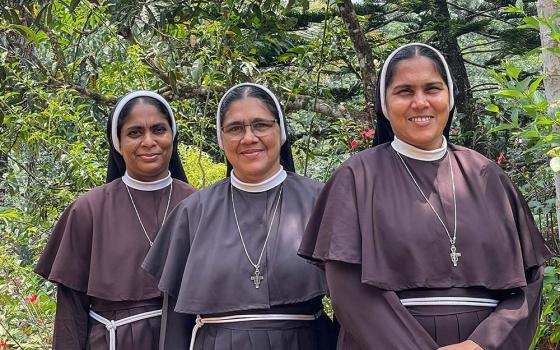
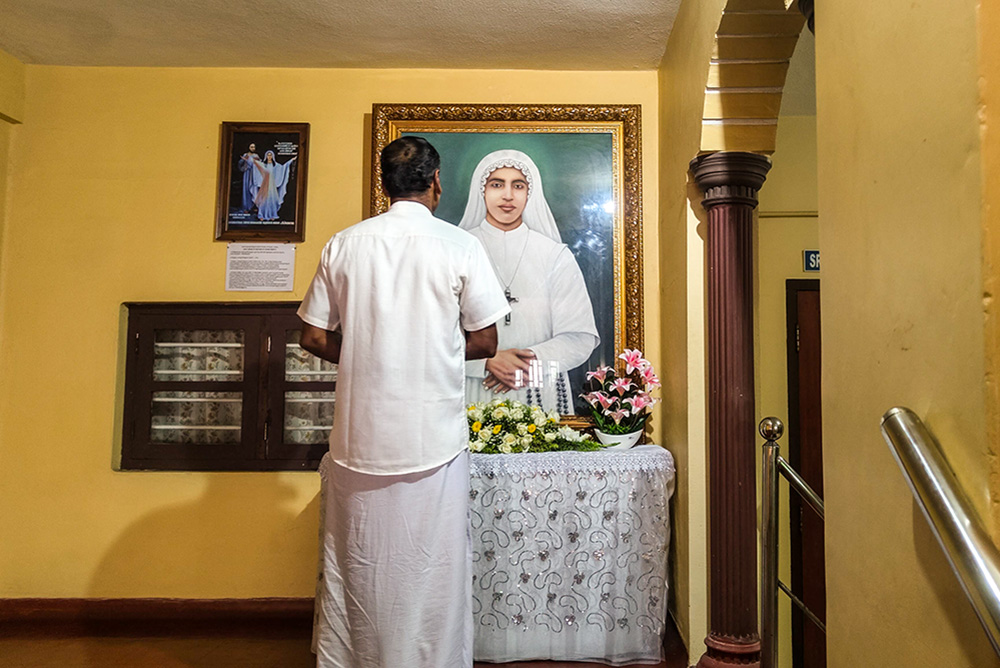
A man prays before a portrait of Venerable Sr. Maria Celine Kannanaikal at the provincial house of the Ursulines of Mary Immaculate in Payyambalam, a suburb of Kannur town in the southwestern Indian state of Kerala. (George Kommattam)
by George Kommattam
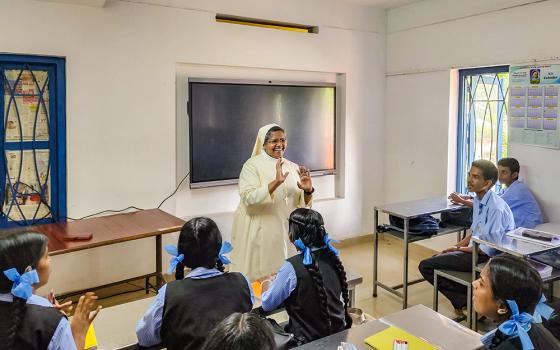
Each morning, Helna Manoharan, a Hindu primary school teacher, begins her workday praying at the tomb of Venerable Maria Celine Kannanaikal in Kannur, a town in the southwestern Indian state of Kerala.
She then spends a few minutes in the Ursuline Convent before walking to her classroom at Ursuline Senior Secondary School on the same campus.
"I started the visit after hearing Sr. Maria Celine's story from colleagues and nuns at the school. I have become her staunch devotee now," the 54-year-old woman told Global Sisters Report in July.
Manoharan is among hundreds of people visiting the nun's tomb at the Ursuline Provincial House near the Payyambalam beach in Kannur.
Maria Celine, as she is popularly known, died on July 25, 1957, just 35 days after her first profession.
For decades, she was relatively unknown outside her congregation, the Ursulines of Mary Immaculate, until some miscreants vandalized the parish cemetery where the nuns are buried. "The graves of 18 sisters were destroyed, except Maria Celine's," said Sr. Leema Manchiyil, a member of the Ursulines of Mary Immaculate.
Then-Bishop Varghese Chakkalakal of Kannur saw it as a sign of Maria Celine's holiness and asked the nuns to share her story. The congregation subsequently published Maria Celine's biography and distributed prayer cards.
In 2007, the Kannur Diocese formally opened her cause for canonization, granting her the "servant of God" title in 2018, the first in the four-stage canonization process.
Following the diocesan investigation, the documentation was sent to the Vatican's Dicastery for the Causes of Saints.
Maria Celine's remains were exhumed in 2012 and reinterred inside the convent chapel, making her tomb more accessible to pilgrims, said Manchiyil, vice postulator of the canonization cause.
In 2022, Pope Francis recognized Maria Celine's heroic virtues and declared her venerable.
Manchiyil said devotion to Maria Celine has spread beyond her congregation seven decades after her death.
"People of all faiths visit her tomb, seeking her intercession," Manchiyil told GSR.
Advertisement
Manoharan said she visits the nun's tomb not for favors, but for peace. "Although I am a Hindu, I believe Sister Maria Celine gives me strength," said the teacher, whose husband is a cancer patient. "She, too, had endured much suffering, so I feel she understands my problems."
Manchiyil said Maria Celine was born Feb. 13, 1931, in Kundannoor, a village in Kerala's Thrissur district. She worked as a teacher before joining the Ursulines in 1954 and entered the novitiate later that year.
Manchiyil added that Maria Celine endured prolonged illness during her novitiate, but remained deeply committed to prayer, obedience and devotion to the Eucharist.
"We receive many testimonies of favors," Manchiyil said. "People speak about healings, peace in their families, and answers to prayer. But the church follows a rigorous process. We are waiting for miracles that can be verified medically and scientifically."
Maria Celine requires one medically verified miracle for her beatification, the penultimate stage in the canonization process.
Many pilgrims stop at Maria Celine's tomb while traveling to Vilakkannur, some 25 miles northeast of Kannur, where India's first Vatican-recognized Eucharistic miracle happened on Nov. 15, 2013. "Others come after hearing about her from various sources," Manchiyil said.
She said more than 200 people visit the chapel on weekends and public holidays.
Annie Joshy, a social worker in Kannur, said she has seen devotion to the once-unknown nun grow steadily over the years.
"People come from different parts of Kerala and Karnataka. The number increased especially after her remains were transferred to the chapel," the 74-year-old Catholic woman told GSR.
Among the visitors on July 25, the 69th anniversary of Maria Celine's death, was Cera Puthur, a schoolgirl from Kundannoor, Maria Celine's birthplace.
"I heard about Sr. Maria Celine from my parents and, more recently, through social media," said Puthur, who visited with her two younger brothers.
Sr. Vinaya Purayidathil, the Ursulines' Kannur provincial, said the congregation has not actively promoted the devotion. "Word of mouth has spread her story, and people keep coming. Every year more people participate in her death anniversary," she said.
Jayasurya P.V. Sreevalsam, a former Kannur municipal councilor and a Hindu, said devotion to Maria Celine has crossed religious boundaries.
"People from every background come here. There is no religion for holiness. Holy people continue to attract others. They don't need publicity," he told GSR.
Prasanthi Rajan, a 54-year-old Hindu laboratory assistant at the Ursuline school, said she started praying at Maria Celine's tomb after doctors warned that a severe infection in her leg might require amputation.
"I was admitted to a hospital. After more tests, the doctors told me the surgery was no longer necessary. I believe my condition improved after praying to Maria Celine," she said.
Rajan publicly shared her testimony on the anniversary of Maria Celine's death.
After four months confined to a bed, she returned to work earlier this year. She continues to visit the tomb regularly, often accompanied by her husband.
"We simply have faith in her, and it's growing day by day," she told GSR.