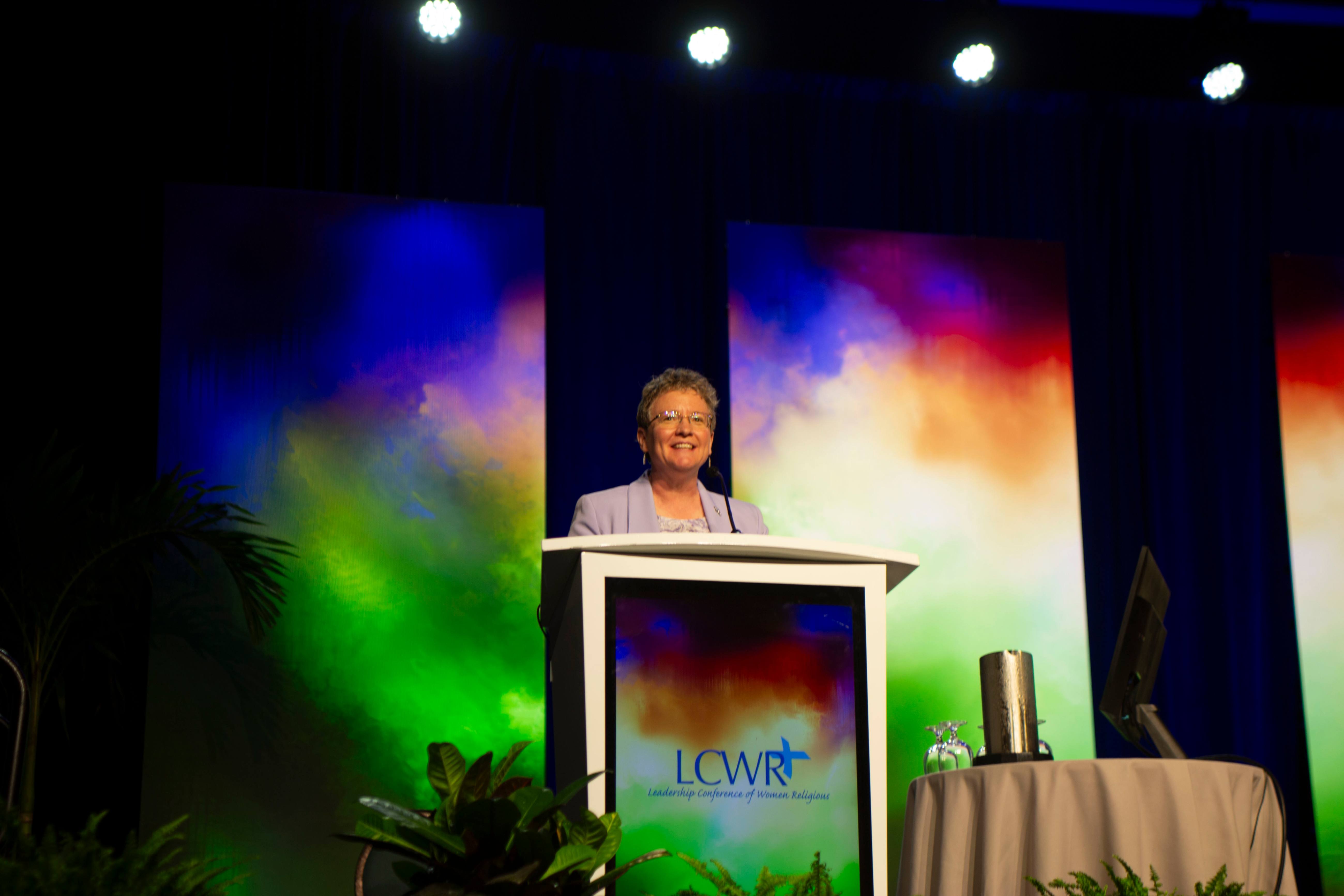
Sr. Vicky Larson, outgoing president of LCWR, gives the presidential address Aug. 12 at the group's assembly in Orlando, Florida. (GSR/Helga Leija)

by Sr. Helga Leija
"If melody reveals the beauty of our distinct voices, harmony reveals what becomes possible when those voices meet."
Sr. Vicky Larson, now the former president of the Leadership Conference of Women Religious, offered that image Aug. 12 in her presidential address, reflecting on synodality at the conference's 70th anniversary celebration in Orlando, Florida. Earlier, Xavière Missionary Sr. Nathalie Becquart had described synodality as a "cultural migration."
The two images, migration and harmony, point to the same reality. The church is being asked to leave behind familiar patterns of relating and learn how to receive the gifts of others.
Becquart, who is undersecretary of the Synod of Bishops at the Vatican, described synodality as a "cultural migration." The church, she said, is being invited to move from a culture marked by clericalism, hierarchicalism and institutional self-sufficiency toward a culture of listening, co-responsibility, discernment and genuine exchange.
A migration requires leaving what is familiar in order to move toward something not yet fully known. It can be disorienting. We carry with us the habits, assumptions and ways of relating that belonged to the place we left.
That may help explain why synodality can be difficult. We have known certain ways of being church for a very long time. We know who speaks, who teaches, who decides and who listens. Moving beyond those patterns requires more than changing structures. It requires a change in culture and, ultimately, a change in ourselves.
For Becquart, the theological heart of this new way of being church is the exchange of gifts. We need one another because "no single voice, tradition or charism exhausts the fullness of the revelation." And quoting from the final document on synodality, she said that "each charism brings something irreplaceable to our understanding of Christ and the Gospel."
In her address, Larson — of the Presentation Sisters of South Dakota — described each charism as a musical note. Being a skilled musician, she explained that each note has its own beauty, but that we need melody and harmony as well. She said that harmony does not mean that every instrument plays the same note. In fact, if everyone played the same note all the time, we would lose much of what makes music beautiful. Harmony depends upon difference. The instruments retain their particular sounds while becoming part of something larger than themselves.
This is precisely what it means to recognize charisms as gifts. My charism as a Benedictine is not diminished because another charism is different from mine. And my vocation is not complete simply because I recognize the gifts I have received. I also need to recognize the gifts in others.
Larson also spoke of St. Benedict's invitation to listen "with the ear of the heart." Such listening requires more than hearing words. It asks us to become quiet enough to receive what another person is offering. She recalled the teaching of Trappist monk Thomas Keating that "God's first language is silence."
Listening is a very important skill in a church that is still learning synodality. We can create many opportunities for people to speak and still fail to become a listening church. We can hear one another without really listening.
Listening, Larson said, "requires us to quiet the noisy chatter of the ego," the part of us that is already preparing a response, defending a position or deciding the other person is wrong.
Larson spoke of listening for resonance, as musicians do when they tune their instruments or blend their voices. But she also spoke of listening for dissonance, and that may be a little bit harder because dissonance is uncomfortable, it does not sound quite right. Yet in music, dissonance can create a tension that leads somewhere. In community too, disagreements open the door to see things from another person's perspective.
Advertisement
Synodality is asking us to listen carefully to what dissonant notes might be telling us. That requires what Larson called retraining our "communal muscle memory." Communities, like individuals, develop habits. We learn how to respond to change, disagreement, loss and uncertainty. We can become accustomed to doing things in a particular way simply because that is how they have always been done. But entering into a new era may require new ways of listening.
Larson knows what this kind of change means in her own community. Her congregation has had to let go of sponsored ministries, its motherhouse and, most painfully, its beloved chapel. Those were places and ministries that had shaped the community and held generations of memories. Letting them go meant grieving their past while making room for the future.
They are now restoring the grounds of their former motherhouse with native prairie grasses and, where the chapel was, they are creating the Presentation Peace Circle for future generations to enjoy. Those changes offer an example of how a community can make hard decisions by listening to both resonance and dissonance.
Becquart described religious communities as laboratories for the kind of synodal living the church needs. Religious life brings together people of different ages, personalities, cultures, gifts and perspectives and asks them to learn how to live and discern together.
Religious life has never existed simply for its own sake, she said; its purpose is the transformation of those who profess religious vows and of the people they are called to serve.
Along the same lines, Larson spoke of listening together to the cry of the world. In a world marked by polarization, inequality, migration, climate change and political division, learning to listen across differences has consequences beyond religious life. It requires us to hear not only the world around us, but also one another.
Larson's image of music gives us a way to imagine what this kind of listening looks like. I see religious men and women as musicians, each with our own voice and part to play and God is the composer. To play together, we have to listen carefully to one another, stay in tune, keep the tempo and pay attention to the silences. The music is not ours to create alone. Our task is to listen well enough to play our part in the way the composer intended.
That is what synodality asks of the church: that we learn to listen well enough to play together. When we do, the music can become something none of us could make alone, a harmony that reflects the beauty God intended from the beginning.