(GSR graphic/Olivia Bardo)

by Rhina Guidos
(GSR logo/Olivia Bardo)
Monica Zeballos considers her exit from religious life as a good ending. After discerning that it wasn't her calling, she left the community of sisters who had been part of her life for three years in Peru on the best of terms. She was without a home or job, and her family gave her shelter and food. If her family hadn't helped her, she wouldn't have survived, she said, because "once you leave [religious life], you leave with nothing."
It's different when you are young and a novice, she said — you can start again. That's often not the case with some of the women she saw exit religious communities, including some who had taken final vows and had been sisters for decades.
"Some said, 'I want to leave. Bye,' " Zeballos told Global Sisters Report. "But others left because they were told to leave and that's when it was difficult to watch because some don't understand and ask, 'Why do I have to leave when I don't want to?' It's hard."
That was the case for Hortensia López Almán. In her 40s, and after 20 years as a Discalced Carmelite in Spain, she was "pressured into secularization", she said. It was finalized in 2015. López said that, like some who are forced to leave consecrated life after decades, she was a victim of abuse of power, and felt abandoned by those she trusted.
Still donning the habit she had worn for decades, she left. López said. Her only plan in life was to follow her deep spiritual calling and yet she found herself alone with no job and no plan about how to go forward.
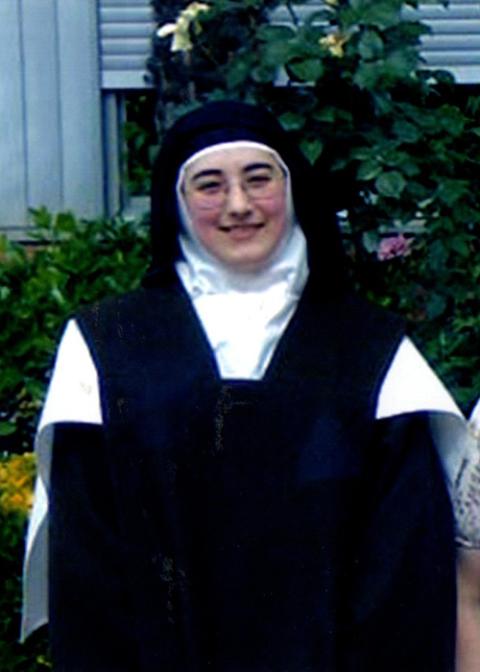
An undated photo shows Sr. Hortensia López Almán in her days as a Discalced Carmelite in Spain. After more than 20 years in the order, López says she was “pressured into secularization” in 2015 by a prioress. (Courtesy of Hortensia López Almán)
That's something she doesn't want women or men who have left religious life, willingly or otherwise, to experience, she said, and it prompted her to found in 2023 Asociación Extramuros (Outside the Walls Association) in Spain. The organization tries to accompany women and men who have left religious life under adverse circumstances. López said her experience — of hurt, abuse, injustice, then rapid-fire adaptation and loneliness — shaped the work she's trying to promote at Extramuros.
"I was in a deep depression for two years. ... It was difficult to adapt to a world I didn't know. I'd been in a cloister for 20 years," she said.
Living in a cloister typically means that nuns don't leave the walls of a convent without permission from a superior, and when they do, it's for limited reasons.
When López went seeking holiness in silence in the late 1990s, Spain was still using the peseta as the national currency. No one was using a cellphone. When she came out in 2014, Spain had adopted the euro, a currency whose value she didn't know how to manage, and monumental technological change had taken place.
"I had no idea how to use a cellphone, or a computer or the internet, nothing," she said.
Imagine stepping into that world of so many different kinds of noise and change after being surrounded for so long by nuns and expansive quiet, she said.
"It was a moment of anxiety and depression," a psychological journey that deepened when, several months after her departure, she accepted that she wasn't going to be allowed to return to a convent and stopped wearing her habit.
"It was as if someone were pulling off my skin, because I didn't take it off voluntarily. It was stripped from me," López said.
As much as others may want to help, there is something about the experience that only those who have had consecrated life taken from them can understand, she said. And when former members of religious life are starting out on that painful journey, those who've felt the pain, like López, want to be there to catch them.
"There's no need to give a thousand explanations, with two words we say to one another, we understand because we've lived it," she said.
Advertisement
Even when leaving religious life isn't traumatic, you find yourself lost, said Katia Luna, a native of Mexico who had joined a religious community in the U.S. After seven years, "it was decided" that she wasn't going to continue. Though she hadn't taken final vows, "I was scared," she said, and thought, "What am I going to do out there?"
Feeling as if you're being called by God and suddenly finding out that a community has decided that's not to be, it's an adjustment, she said. But the immediate worries are about material survival.
Though the Code of Canon Law says, "Those who depart from a religious institute legitimately or have been dismissed from it legitimately can request nothing from the institute for any work done in it," the "institute" is encouraged "to observe equity and the charity of the gospel toward a member who is separated from it."
In Luna's case, the community agreed to give her a small amount to help survive for a little while and gave her a list of places where she could live. It wasn't easy to restart life in her 30s. The few friends she had from college helped her rebuild practically from zero, but it took a long time, psychologically, spiritually and materially, she said.
If she could give the church advice, it would be to provide those who've left, or been asked to leave, help with shelter and religious, spiritual and psychological support to regroup, a process to help them move forward after leaving a life they felt they'd been called to.
That's exactly what Extramuros is trying to do, said López.
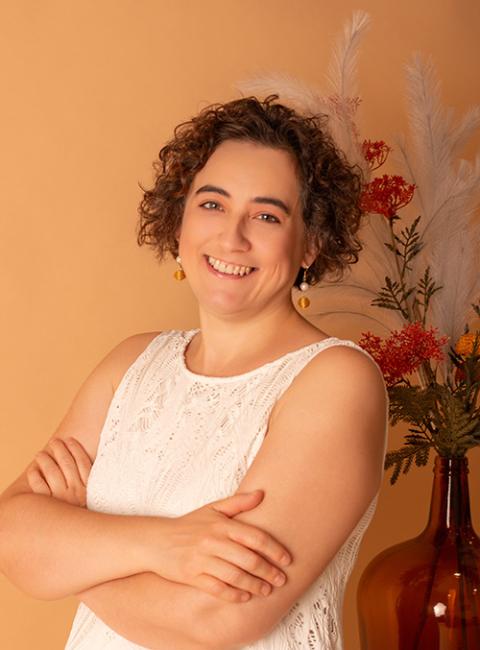
An undated photo shows Hortensia López Almán of Asociación Extramuros in Spain. The organization seeks to help women and men forced to leave consecrated life as they remake their lives. (Courtesy of Hortensia López Almán)
In 2023, Pope Francis wrote the organization a thank you letter for its work and courage. Some bishops, too, have voiced their support. While Extramuros can help by listening, there's no money for psychological, legal and humanitarian resources to help in a comprehensive manner, López said, though now and then they get pro bono assistance for those who need it.
Extramuros has expanded its help — mostly a listening ear, moral support and advice — beyond Spain, tending to former religious in Mexico and other parts of Latin America. The work comes with frustrations, with accusations from some who call them traitors or accuse the group of trying to hurt the church, López said.
"We're not against the church," she said. "Consecrated life has left a deep imprint, in service and giving of ourselves, but the transition to civilian life and to the workforce is not always simple."
Luna said that she was saddened to read about cases involving women religious serving in Europe who'd had their passports confiscated by superiors. The women were expelled from their convents and saw no other option but to turn to prostitution. Something has to be done to help, she said.
"They were women who dedicated many years of their lives to a religious institute, to a mission," she said. "And when they left, they had no resources, nothing and no one to help."
To those who find themselves in that tough spot, she said, she'd tell them it's OK to feel angry because it's hard to understand why you've been forced to leave something that defined your life so deeply. But she also urges others to help them.
After everything that happened, none of the women who spoke to GSR said they ever felt as if it affected their relationship with God. López, who still finds herself in love with St. Teresa of Ávila, whose steps she sought to follow, said she feels as if it's the institution that failed her.
"I haven't lost my faith," said López. "Yes, I went through a crisis, I was very angry with God ... but I tell everyone this: 'Don't let [the experience in] religious life take from you what it didn't give you. It didn't give you faith. It's faith that you took to the convent.' "