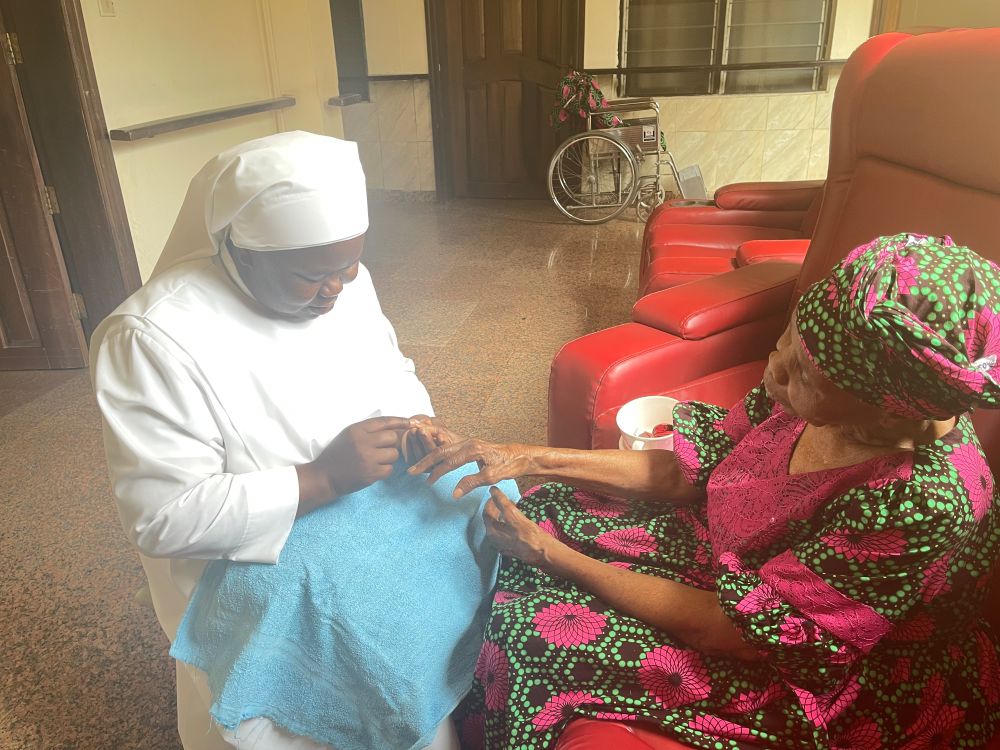
Sr. Gertrude Anozie trims a female resident's nails at the Our Lady of Perpetual Help Home for the Elderly in the Awkunanaw area of Enugu, southeastern Nigeria. (John Chukwu)

by John Chukwu
The elderly residents were having lunch in the dining room when Sr. Mary Jacintha came in. She personally checked on them, asking how they were doing, whether they were satisfied with their food and whether they needed more.
These ordinary moments at the Little Sisters of the Poor's Our Lady of Perpetual Help Home for the Elderly in the Awkunanaw area of Enugu, southeastern Nigeria, reflect the sisters' larger mission: to help elderly people who are poor, sick or abandoned feel that they still have a place to call home.
The home, situated in a serene, well-kept compound, has provided care for elderly people since its establishment in 1975. The first sisters who began the home arrived in Enugu from France and were accompanied by a Nigerian sister. They initially began their work in a small house in Abakpa, a suburb and commercial area of Enugu. Later, they moved the home to Awkunanaw, where residents now have individual rooms and access to food, medical care, religious activities and 24-hour assistance.
The Little Sisters of the Poor care for "the poorest of the poor," said Jacintha, who administers the home. "We accompany them till their last breath," she said. "That is our mission: to take them to the gate of heaven."
A home for those with nowhere else to go
Some elders have family members who cannot care for them, while others have become financially vulnerable, dependent or sick, and are unable to provide their basic needs.
One resident, Ezinna Pascal Nwokocha, 80, arrived from Aba after developing high blood pressure, glaucoma, diabetes and prostate problems. He has lived at the home for 13 years. Nwokocha said the sisters ensure that residents like him receive adequate food and regular medical checkups.
Christiana Nwoko, 90, came to the home after breaking her legs. The sisters ensure that Nwoko's clothes are washed, that she is fed several times a day, and that she receives meat and fish with her meals.
The sisters do not admit every person who wants to live in the home. Prospective residents complete admission and request forms, after which the sisters visit their homes to confirm that they are genuinely poor and cannot care for themselves.
Most of the residents come from communities around Enugu and other parts of southeastern Nigeria. The sisters admit residents even if they are not Catholics. Once admitted, they are provided food, accommodation and medication. "Everything is given free to them till the day they pass on," Jacintha said.
The sisters do not receive salaries for their work and depend on donations to run the home. Paid workers operate around the clock and help with laundry and other practical needs. The sisters, however, remain closely involved in their care.
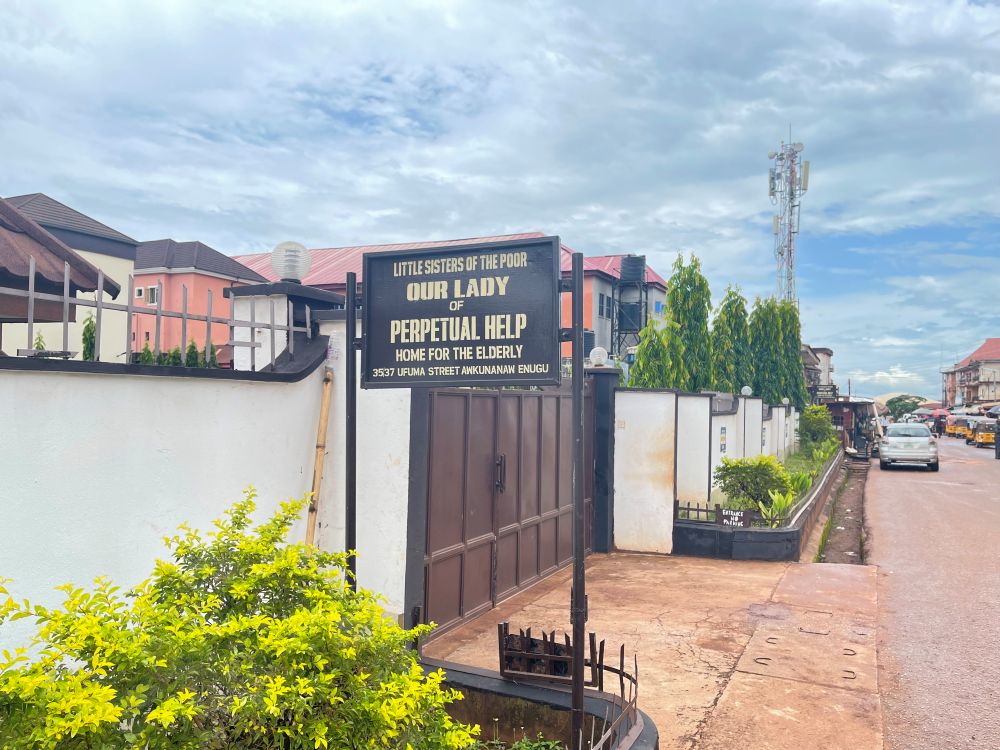
Our Lady of Perpetual Help's Home for the Elderly in the Awkunanaw area of Enugu, southeastern Nigeria, has operated since 1975. (John Chukwu)
Residents living with disabilities are also accommodated in the home. Some are visually impaired; others use wheelchairs or require considerable assistance with daily activities. Jacintha told GSR that the sisters ensure that residents do not feel that old age or disability has "made them useless."
The sisters rise for prayer around 5 a.m. By 6 a.m., they begin helping residents with bathing and preparing for Mass. Breakfast follows. The sisters and workers ensure that the residents who cannot eat receive the assistance they need.
Jacintha said that food is always adapted to residents' health conditions. Those with diabetes, high cholesterol or high blood sugar may receive specially prepared meals.
"Many of them are picky on the food they want to eat," she said. "Today they may want this food, tomorrow, they may not want it."
Beyond food and medicine
Residents have a sitting room where they watch television and take part in activities the sisters call "animation," gatherings involving music, movement and dancing. On the second Sunday of each month, birthdays are celebrated collectively. These activities are particularly important for residents who spend much of their time in their rooms or need help moving around.
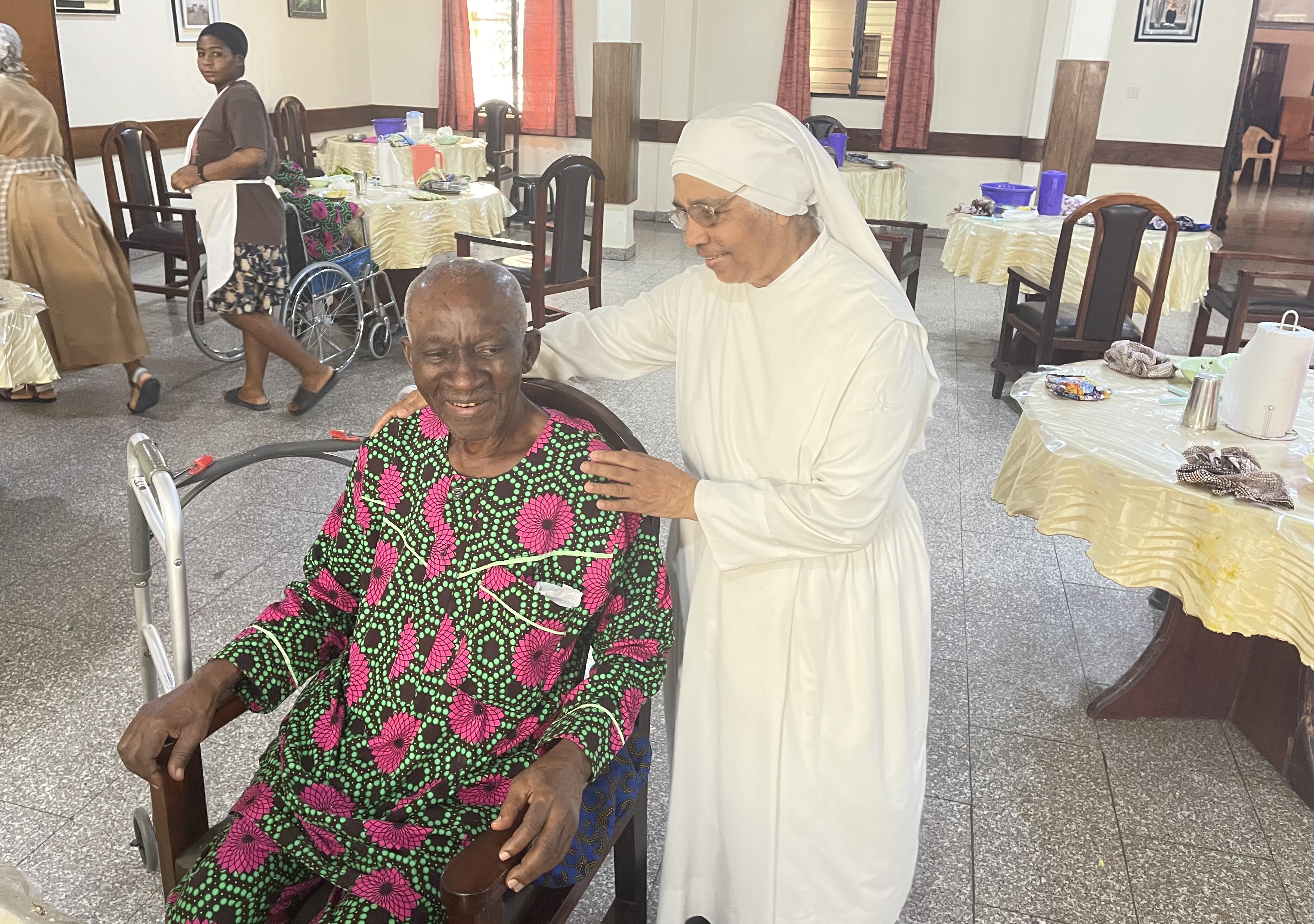
Sr. Mary Jacintha visits with a resident at the Our Lady of Perpetual Help Home for the Elderly in the Awkunanaw area of Enugu, southeastern Nigeria. (John Chukwu)
Sr. Gertrude Anozie, who assists with the men's infirmary and pharmacy, said caregiving means paying attention to small things that can easily be overlooked. She has been at the home for about five months and said each day brings different needs.
"Each day, there is a routine," she said. "The way I took care of them yesterday is not the same way I'll take care of them the next day because their needs differ."
Anozie said residents gradually develop confidence in the sisters because they know that they will attend to their needs. She said the sisters listen to their stories, accompany them when they are sick, and try to preserve familiar routines so that residents do not feel completely separated from their former homes and families.
"When the residents tell us something confidential, we keep it between us," she said.
She recalled how one resident appealed to her never to stop spending time with them. She said the experience reminded her that attention itself can be a form of care.
Preparing for life's final chapter
When residents become seriously ill, the sisters' work becomes more demanding. Anozie said prayer gives her the strength to remain present when an elderly person is difficult to care for, refuses food or appears to have lost the will to continue living.
She told GSR that residents sometimes may become so weak that they refuse to eat. The sisters work closely with doctors to determine ways of providing nourishment, including alternative methods when necessary. They also endeavor to lift the spirits of residents who have become discouraged by illness or disability. "We try all our best to make them find joy in still living," she said.
Caring for the elderly also means preparing them spiritually for death. According to Jacintha, many residents see the home as a place to pray and prepare for the final stage of life.
Advertisement
The sisters pray with them, encourage them and prepare them for sacraments. However, the work can take a toll on the caregivers themselves. Anozie said prayer is important because they cannot give what they do not possess themselves.
"If I'm not spiritually strong," Anozie said, "I cannot give myself wholeheartedly to the elderly work. Because sometimes the work is demanding. Sometimes after taking care of an elderly person, he will just tell you a harsh word. But we keep on taking care of him. So, if my prayer life is not solid, I can get angry and say I won't take care of you again."
The sisters divide responsibilities among themselves, from the infirmaries to the kitchen, pharmacy and laundry. Amid these responsibilities, they step in to help one another when the demands of one assignment become too much.
"We support one another, and in prayer as well, and in work," Anozie said. Jacintha added that the motivation is ultimately rooted in vocation.
The sisters see their work as beyond providing shelter, attempting to preserve dignity at a stage of life when illness, disability, poverty and separation from family can easily make people feel forgotten.
Jacintha believes that society should remember that being old does not reduce a person's worth. "They just need to feel that they are wanted and loved," she said.