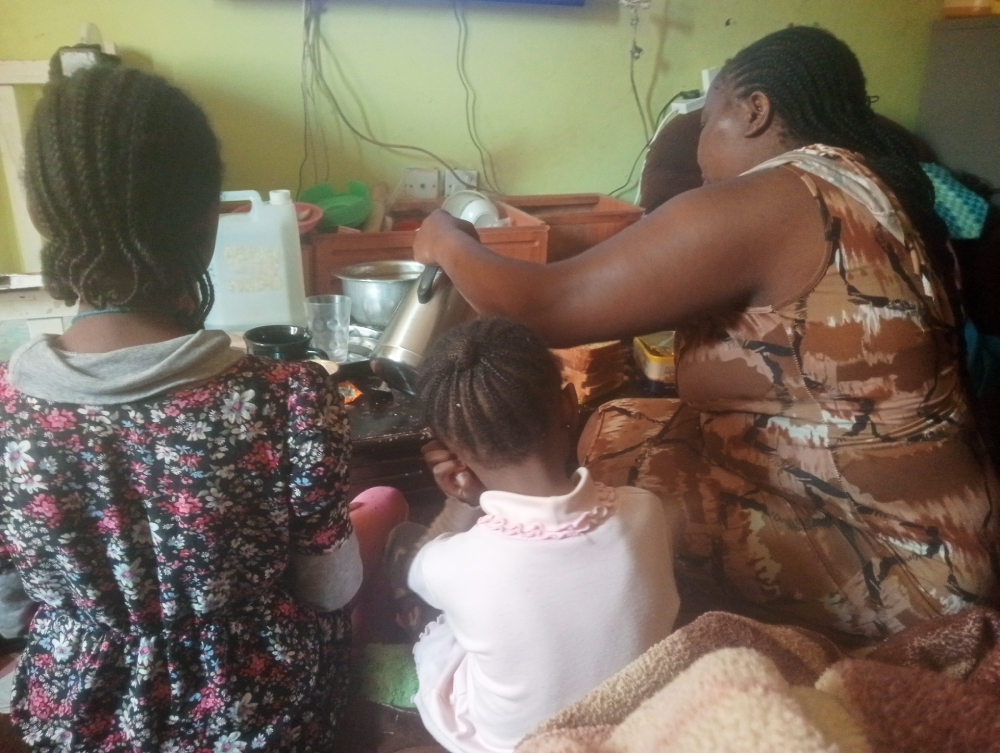
Anne Nduku, 42, is a mother of two daughters aged five and 10. She endured years of abuse from her husband and found shelter in a convent in Kenya. (Charles Njeru)

by Gitonga Njeru
Editor's note: This story is part of Global Sisters Report's yearlong series, "Out of the Shadows: Confronting Violence Against Women," focused on the ways Catholic sisters are responding to this global phenomenon.

(GSR logo/Olivia Bardo)
In the dead of night, the heavy iron gates of a discreet compound on the outskirts of Nairobi creak open just wide enough to let Anne Nduku and her sobbing toddler slip inside.
Bruised, terrified and clutching a single bag of belongings, she has spent her last coins on a motorbike taxi to escape a husband who threatened to kill her.
She did not go to a police station, where she feared dismissive desk officers, nor did she seek out a state-run refuge because none exist in her county. Instead, she sought the sanctuary of a Catholic convent.
Nduku, 42, is a mother of two daughters aged five and 10.
"My husband has been beating me up for many years," Nduku told GSR. "At one time, he choked me. Another time, I received a black eye. I also had a broken jaw this year. A month ago, I decided enough is enough. He continues calling me, but I do not want his advances."
All across Kenya, a silent but devastating epidemic of gender-based violence continues to tear through many households. According to data from the Kenya National Bureau of Statistics, an estimated 40% of Kenyan women ages 15 to 49 have experienced physical violence.
Despite these staggering numbers, the infrastructure to protect these women is dangerously thin.
Faced with a shortage of formal, state-funded safe houses, many vulnerable women escaping domestic terror are encountering a harsh reality. Those who attempt to report their abusers often face immense stigma from neighbors and intense pressure from the extended family to persevere for the sake of cultural tradition. They also remain silent to avoid further retaliation from their partners.
Nduku told GSR that her neighbors gossiped about her and avoided greeting her and her children. "I feared for my life that one day he would beat me to death, so I am much happier now," she said. "I eat and sleep better, but I may not stay in this shelter for long. But for now, I am in contempt."
According to the sisters coordinating the ministry, at least 10 Catholic convents across Kenya have stepped into the breach, turning their peaceful residences into informal safe havens by opening their doors to survivors. Among those leading this intervention are the Assumption Sisters of Nairobi and the Little Sisters of St. Francis.
The sisters operate outside of Kenya's formal shelter system to evade bureaucracy and protect the anonymity of those in their care, redefining the boundaries of their religious ministries.
Sr. Margaret Wahungu, the superior general of the Assumption Sisters of Nairobi, said they will most likely continue helping women such as Ndugu as there is a great need.
"We cannot preach the gospel of peace and turn a blind eye to women being broken in their own homes," she said.
"When a person arrives at our doorstep at 3 a.m. bleeding, our first vow is not to rules or protocols. It is to human dignity."
Within their convent walls, sisters provide unconditional sanctuary, temporary shelter, clean clothes and hot meals. But their care goes deeper than basic sustenance.
Advertisement
The sisters offer intensive emotional and psychological counseling, legal literacy support and guidance on navigating the fraught process of rebuilding a life from scratch.
For the women who find their way to these sanctuaries, the convents offer the only immediate refuge available in a society that frequently looks the other way.
"I thought my life was over," said a 25-year-old woman, who opted to remain anonymous for her safety. A mother of two, she spent three weeks recovering at a convent run by the Little Sisters of St. Francis after enduring endless beatings by her husband.
She said her parents pressured her to go back to him because he had paid a dowry. The police then told her it was a domestic matter. "They wanted a bribe to proceed with the case," she said. "It was only the sisters who looked at both my physical and emotional wounds and told me I was human, that I didn't deserve to be beaten."
The shelter ministry is coordinated through the J.J. McCarthy Centre in Nairobi, where sisters oversee the network of safe houses and related services.
Their work, however, is fraught with immense risk. Operating these informal shelters requires absolute discretion.
"The victims are housed in community homes far away and safe from further harm," Wahungu explained.
Convents must carefully manage their visibility to prevent enraged husbands from tracking down their wives and sparking community backlash or violent confrontations.
The sisters deliberately do not advertise their safe houses. Knowledge of their availability spreads through trusted grassroots networks, church chaplains and local human rights advocates.
"We try to be as discreet as possible," said Sr. Mary Kamau, a member of the Assumption Sisters. "We house them not just in Nairobi but in different parts of the country."
Furthermore, running these safe spaces can place a financial strain on the congregations who do not receive any state funding.
The sisters rely almost entirely on modest church donations and community goodwill and must stretch their meager congregational resources to buy food, medical supplies and baby formula for the survivors.
"It is a heavy cross, but it is one we carry gladly," said another anonymous sister, who is involved in the coordination of a Nairobi-based safe house.
"The challenge is that the demand is overwhelming. For every woman we take in, we know there are many who cannot reach us, or who don’t know we are here," she said.
Beyond immediate protection, the sisters focus heavily on the long-term rehabilitation of survivors. They also actively assist women to safely reconnect with supportive relatives who are willing to shield them from abusive partners.
According to Wahungu, the sisters provide vocational guidance for those who cannot return to their communities, helping them acquire basic business or tailoring skills to gain financial independence.
As dawn breaks over the Nairobi convent, the young mother who arrived in terror the night before sits in a quiet courtyard, watching her child play with a set of wooden blocks provided by the sisters. For the first time in years, a burden has been lifted from her shoulders.