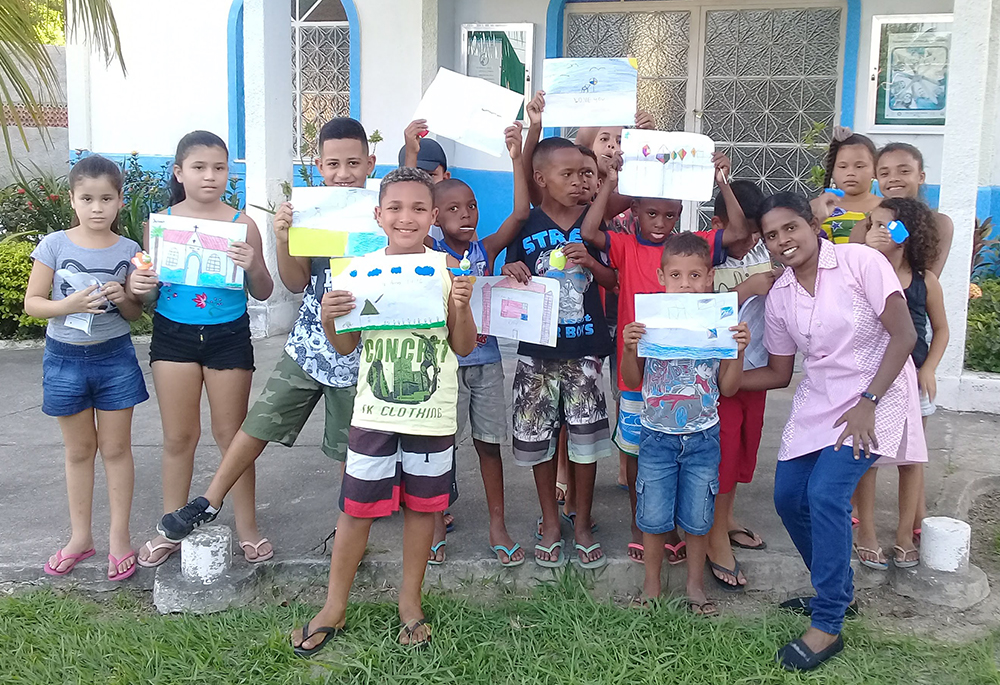
Sr. Sheeba Raja Pandian poses with a group of children during an art therapy session. (Courtesy of Sheeba Raja Pandian)

by Sr. Sheeba Raja Pandian
The heart of the charism of my congregation, the Missionary Sisters of the Immaculate Heart of Mary, is to go to the peripheries where Christ is not yet known. In September 2017, immediately after making my final vows, I was sent from my home country of India to my new mission in Brazil.
I spent three intense months in Brazil living alongside 35 priests and sisters from all corners of the world. Together we studied Portuguese and attended cultural seminars to prepare our hearts for the Brazilian reality. Once I felt confident enough, I traveled to Nova Iguaçu, Rio de Janeiro — a region the locals call the Baixada. My neighborhood was Marapicu, a "red zone" heavily impacted by drug trafficking, addiction and constant violence.
Our congregation does not run formal institutions there, and I had to seek out ways to insert myself into the community. Furthermore, I could not teach in schools — even though I held a bachelor of education degree and was a trained teacher — as the process for foreign certificate equivalence takes years. Therefore, I had to find a different path of presence.
The wounded healer
My turning point came in December 2017. I was participating in a Christmas novena with our Comunidades Eclesiais de Base (Basic Ecclesial Communities), visiting local families. While walking down the street after a prayer meeting, gunshots suddenly rang out. It was the first time in my life I had ever witnessed such raw violence; one young man was shooting while another tried to protect himself. I stood frozen until the parishioners pulled me to the ground, shouting at me to keep my head down.
I could not sleep for a week, and a deep-seated fear gripped me whenever I heard loud noises. Yet, it was through this vulnerability that God opened my heart and allowed me to feel the collective pain, fear and chronic anxiety that the children, women and youth of Marapicu lived with every single day.
After talking with a friend, I began asking Nossa Senhora Aparecida (Our Lady of Aparecida) to protect me every time I step outside. I have been doing this for almost 10 years and often arrive at a location just after the gunfire has ceased, or I manage to leave the interior areas right before trouble starts. Whenever local people hear news of violence in the neighborhood, they immediately send me messages warning me not to go out on my bicycle.
Surrounded by this community of care, I found healing through yoga and mindfulness and started conducting yoga classes for the women on our church campus. The response was beautiful; many shared how these exercises helped them recover from their own stress, significantly improving their well-being.
Through these sessions, I discovered a deep, inner gift for active listening. Desiring to extend this service, I reached out to a local drug rehabilitation center and introduced art sessions combined with spiritual reflections, drawing from an art course I had taken back in India.
The therapeutic power of art became clear almost immediately. During one session, a man drew a heavy iron gate. As he shared his drawing, he realized his resistance to staying in the recovery program stemmed from the fact that the center's entrance gate looked exactly like the prison grills from his past. Discovering this unconscious barrier filled him with immense relief. However, during individual listening sessions, I often felt helpless. Residents shared serious mental health struggles that went far beyond spiritual distress. I realized that while listening was valuable, I lacked the knowledge required to truly accompany them through severe psychological conditions.
Healing the smallest hearts: Psychology meets pastoral care
With my congregation's permission, I enrolled in an intensive psychology program in Portuguese. I attended classes in the morning and dedicated my evenings to pastoral ministry. During my third semester, I was selected to volunteer as a psychology intern at AVICRES, a nongovernmental organization dedicated to vulnerable children, including those who had been abandoned, whose parents struggled with addiction, or who had suffered severe sexual abuse. Many of them suffered from chronic sleep disturbances caused by the frequent gunshots in their neighborhoods.
I was overjoyed to introduce them to weekly art therapy and psychological guidance and taught them coping mechanisms through art and stress-relief drawings, helping them process their painful stories.
By the sixth semester, I began interning at the Maranatha Therapeutic Center, a clinical psychology center for men and women. It was located on the periphery, requiring a grueling two-hour daily commute.
Advertisement
Every day, God revealed his face through them. Once, I was shaken to see a 20-year-old young man who was missing a hand. He shared that he had been involved in drug trafficking, and during a violent conflict, he was shot by the police, leading to the amputation. Holding empathy for his trauma, I felt a firm motivation to help him break the cycle of addiction. I worked to provide him and other residents with practical cognitive methods to cope with intense cravings, and we organized vital seminars on the physical and psychological consequences of substance abuse.
The center is located in a dangerous zone heavily impacted by organized crime. Initially, fear kept the parishioners away. However, people later told me, "Sister, after you started organizing programs at the center, we found the courage and the sense of brotherhood to reach out to them."
Every Friday, under the scorching sun or in the pouring rain, I would pedal my bicycle at 1:30 p.m. to reach the center and give my classes. The therapeutic center truly became my second home, and the people in our bairro (neighborhood) affectionately began calling me "the Indian morena [brunette] nun with the bicycle." Every time I went to evangelize the residents, I left the center feeling deeply evangelized by them in return.
Breaking barriers, building community: Providence in the periphery
Back in our local parish, I initiated a free pastoral listening service. As word spread, my schedule filled with people seeking help for anxiety and depression. I began conducting mental health awareness seminars at the local school and the parish. I felt immense joy knowing that I was making a difference. Once a week, I also continued my two-hour art therapy group sessions at the Maranatha center, designing activities like emotion color wheels, mask making, self-compassion collages and recovery roadmaps. During these sessions, I started distributing lollipops. Beyond being a sweet treat, they served a symbolic purpose in rehabilitation, helping to satisfy the intense physical cravings often experienced during early recovery.
Because our religious community did not have a budget for lollipops and art materials, I relied entirely on the generosity of friends and parishioners. This reliance turned out to be a profound blessing, as it actively engaged the wider community. Through this involvement, many parishioners confessed that they previously held deep prejudices against individuals facing addiction. However, helping with the ministry broke down those barriers.
Soon, people were donating food, clothing and hygiene products. With the ongoing encouragement of our supporters, I organized a Christmas program for the center, where every year, a friend’s family donated large cakes, while parishioners and sisters from various congregations provided monetary gifts and hygiene kits. God worked miracles, allowing us to distribute beautiful gifts and celebrate the birth of Jesus together.
An instrument on the peripheries
I am deeply humbled to serve as a small instrument on these geographic and human peripheries — pedaling forward each week, ready to love, serve and restore dignity to those society has forgotten. As Pope Francis reminds us, "To change the world, we must be good to those who cannot repay us."