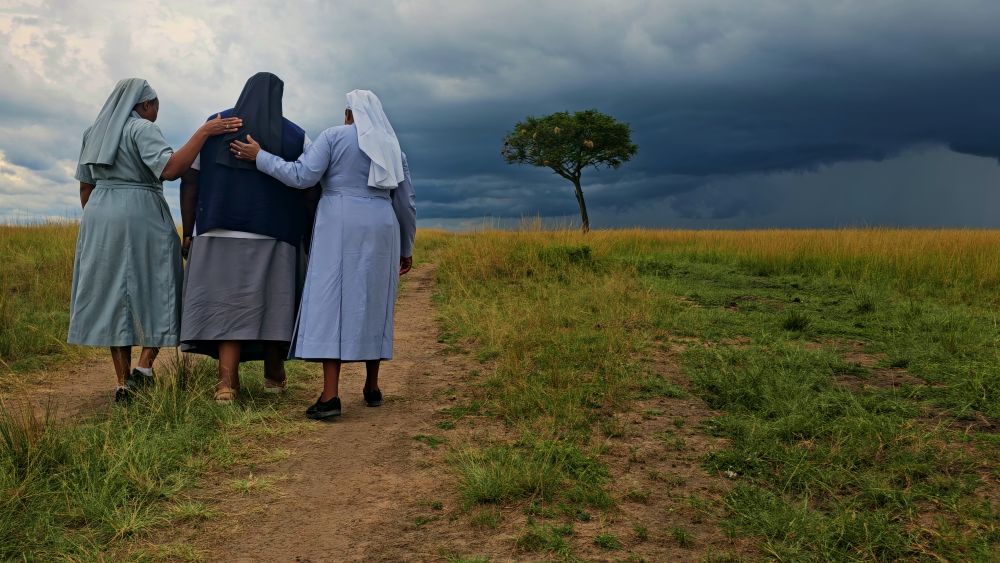
African sisters walk together in a photograph from the documentary "Walking My Sister Home," which examines aging Catholic sisters around the world. (Courtesy of Daydream Productions)

Aging congregations of Catholic sisters are not unique to the United States. Nor are some of the problems those religious communities face.
A one-hour documentary, "Walking My Sister Home," examines the challenge of caring for aging sisters around the world, looking at congregations in Africa, Mexico and the United States. It was made by Emmy Award-winning filmmakers Linda Corley and Joel Kaplan of Daydream Productions and is being released on PBS stations across the country and streaming on PBS.org. The production was funded by the Conrad N. Hilton Foundation, which is also a major funder of Global Sisters Report.
Though many congregations in Africa are seeing growing numbers of vocations, many of those communities themselves are relatively young and have not had elderly sisters. Along with this being a new problem to solve, they lack education on how to care for those sisters and lack money to provide facilities that meet their needs.
"In places like Kenya, they may not know how to identify dementia," Corley told GSR. "So sister is talking to the wall and they think she's possessed. There's a knowledge gap."
In Mexico, the documentary visits a convent where their biggest expense is buying medicine for the elderly sisters. The congregation doesn't own a car, so when a sister needs to go to the doctor, they have to take public transportation.
Another Mexican community was so poor, they were living in a convent that appeared to have been wrecked by an earthquake. Only after a massive fundraising effort were they able to build a new place to live.
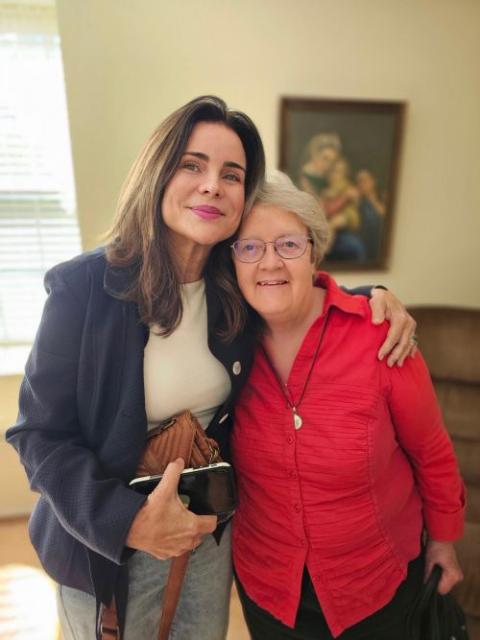
"Walking My Sister Home" co-director Linda Corley, left, poses with Sr. Carol Inkrott of the Franciscan Sisters of Tiffin, Ohio. (Courtesy of Daydream Productions)
In the United States, the filmmakers visit the Sisters of St. Francis of Tiffin, Ohio, which was formed to care for children left orphaned after the Civil War and is now preparing for completion. There are 59 sisters, averaging 82 years old; the youngest sister is 55. Their ministry has always revolved around caring for children and the elderly.
"Their story is beautiful — it's a tragic beauty," Corley said. "It's sad but it's hopeful. It's sweet and inspirational. It makes me very sad."
The National Religious Retirement Office says only about 6% of religious congregations in the United States are adequately funded for retirement.
Sr. Carol Inkrott, one of the Tiffin Franciscans that appears in the film, said it made her stop and contemplate the congregation's journey.
"It was thought provoking because I hadn't thought about it that deeply before," Inkrott told GSR. "[Making the film] caused me to think more deeply about what was happening to us."
Inkrott, who is about to turn 83, joined the order when she was 17.
"I grew up here," she said. "Now, with only a couple of exceptions, we're all gray-haired. It's painful to watch that happening, but it's also a precious experience to be together in all this."
The filmmakers also talk to Sr. Peter Lillian Di Maria of the Carmelite Sisters for the Aged and Infirm in Germantown, New York. Di Maria is director of the Avila Institute of Gerontology — and was key to the documentary being made, Corley said.
Corley met Di Maria more than a decade ago when Corley was a supervising producer on the Lifetime reality series "The Sisterhood: Becoming Nuns." The six-part series followed five young women as they visited three congregations as they discerned whether to join religious life. One of those congregations was Di Maria's, Corley said, and they became fast friends.
Three years ago, Di Maria invited Corley to a session at the Avila Institute where they train sisters to train other sisters on how to care for aging sisters.
"One late night over tea, she said, 'Let's do a documentary on this,' " Corley said.
Advertisement
Through the institute, Corley had already met the sisters from Zambia, Kenya and Mexico, but "a lot of rosaries were said" when it came to choosing one in the United States. With the help of Support Our Aging Religious and the Center for Applied Research in the Apostolate at Georgetown University, she found exactly what she was looking for in the Tiffin Franciscans.
"They're in the heartland, they're all farm girls, they built their own convent," Corley said. They took in children off orphan trains bound for New York and "gave them a good life and a good education and they did this for many, many years."
In a field where every second counts, Corley devoted what would be considered ages to tell the story of what sisters have meant to the United States.
"I dedicated 10 minutes to the history of the American sisters," she said. "These ladies are warriors."
Corley hopes the film will result in more support for aging sisters everywhere.
As Sr. Regina of the Little Servants of Blessed Virgin Mary Conceived Immaculate says in the film: "They have laid the ground for us. So now it's our turn to care for them."