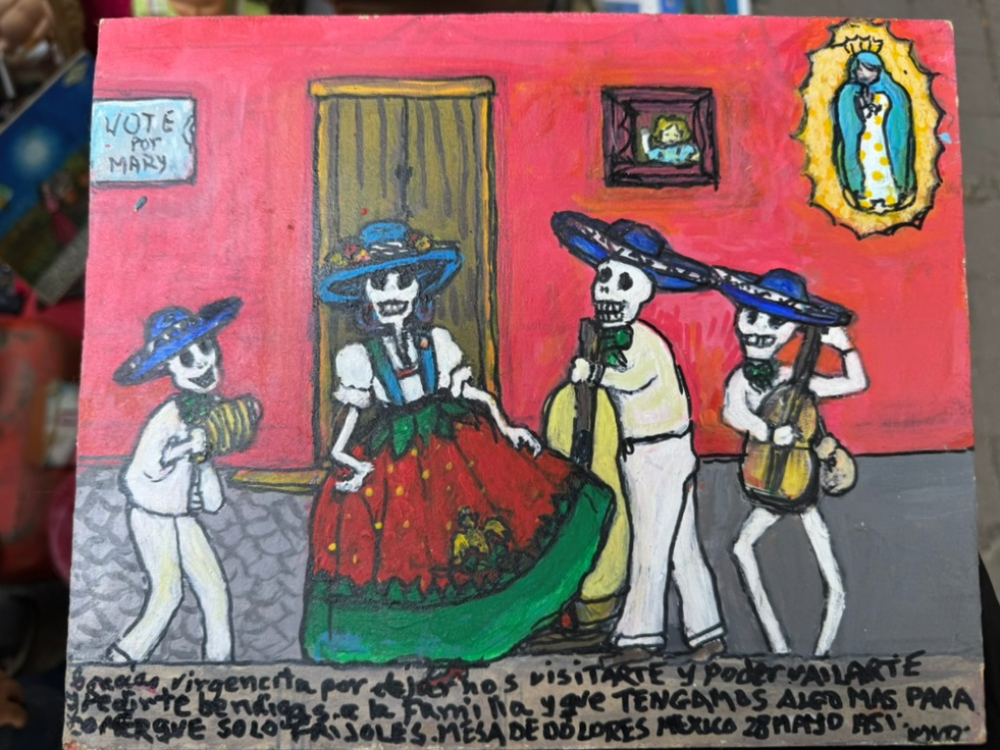
This ex-voto says: "Thank you, Blessed Mother, for allowing us to visit you, to dance for you, and to ask you to bless our family and to give us something more to eat than just beans. Mesa de Dolores, Mexico, May 28, 1951." (GSR photo/Helga Leija)

by Sr. Helga Leija
During my recent trip to Mexico City, I found a few ex-votos in a bazaar or mercadillo. Ex-votos are small, handcrafted paintings commissioned by ordinary people to give thanks for miracles received — healing, protection or answered prayers: powerful expressions of faith deeply rooted in the heart of Mexican culture.
Many who commission these paintings cannot express their gratitude in words alone, so they entrust local artists to create images accompanied by simple prayers, sometimes written with imperfect grammar. These pictures and prayers often reveal a faith that is raw, explicit, and deeply incarnational — a faith made visible in the everyday lives and struggles of people.
After commissioning the ex-votos, people take them to church as offerings of thanksgiving. I find this no different from promises to participate in processions during the Feast of Our Lady of Guadalupe or other popular devotional practices. The ex-votos serve as visible tokens of gratitude and they are to be placed near the altars or shrines.
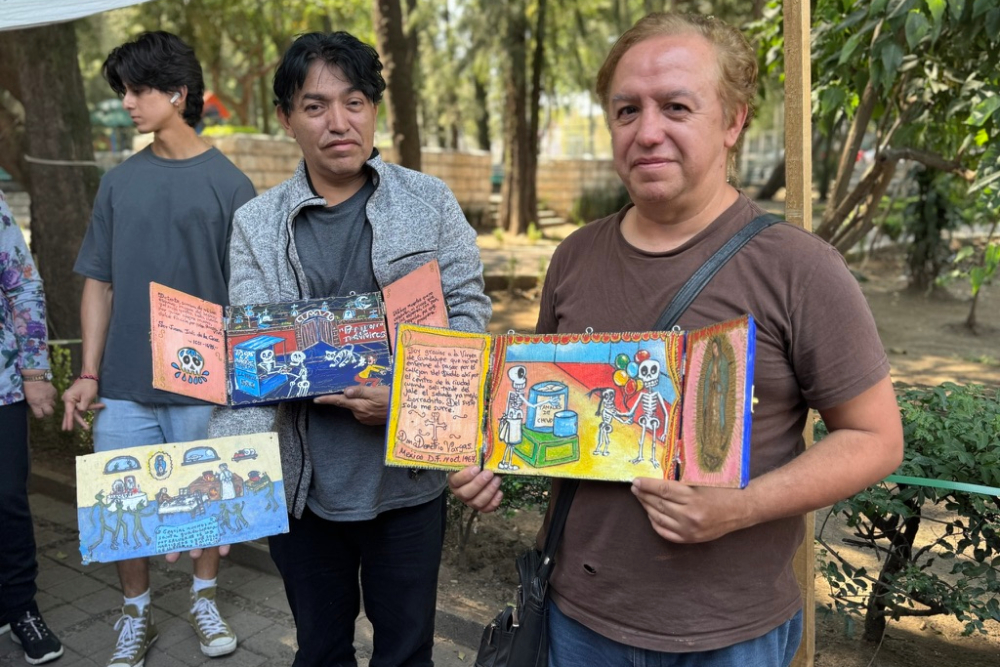
Vendors at a bazaar in Mexico City explain how they rescue ex-votos from trash bins behind churches. (GSR photo/Helga Leija)
Mexican spirituality, especially devotion to Our Lady of Guadalupe, is profoundly incarnational. It is a faith that meets you in the tangible — in a tilma bearing an image, in the scent of roses, in the vibrant colors of an ex-voto, and in the heartfelt cries of a mother praying for her sick child. This is a faith that does not shy away from suffering, pain, or the messy realities of life. Instead, it embraces them fully, making the divine present and accessible here and now.
Perhaps this is why I have difficulty connecting with more abstract spiritual concepts like the "cosmic Christ." I need a faith I can touch, see and feel — a faith that lives and breathes among us. The Virgin of Guadalupe embodies this perfectly. She is not distant or ethereal but a mother who stands with us, wrapped in our culture and history and visible in the marketplace, in the basilica and in the humble ex-votos that line her altars.
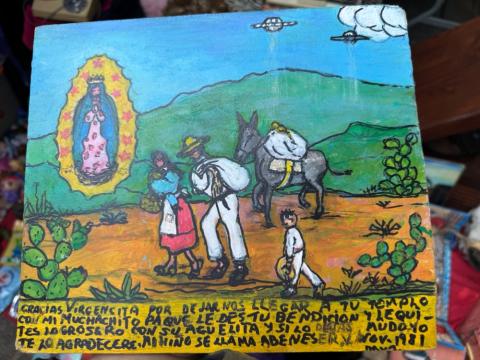
This ex-voto says: "Thank you, Blessed Mother, for letting us come to your temple with my little boy so that you may bless him and make him stop being rude to his grandmother. And if you make him mute, I will thank you. My child’s name is Abenezer. November 1981." (GSR photo/Helga Leija)
Frida Kahlo, one of Mexico's most iconic artists, was deeply inspired by the tradition of ex-votos. She collected over 400 votive paintings and incorporated their styles and imagery into her own work. For Kahlo, ex-votos were personal expressions of pain, healing and devotion — something that resonated with her own struggles and search for meaning.
Yet, it saddens me that many of these ex-votos are sometimes discarded or rejected by church authorities. The ex-votos I found at the bazaar had been rescued by two vendors from behind churches, saving them from being thrown in the trash and forgotten. The vendors told me that some of the miracles or favors expressed in the paintings are considered "sacrilegious" or socially unacceptable. Sometimes they depict a person giving thanks for not being taken by aliens, or a prostitute expressing gratitude for healing from a venereal disease. These often socially unacceptable stories reflect the honest and diverse experiences of faith among the people.
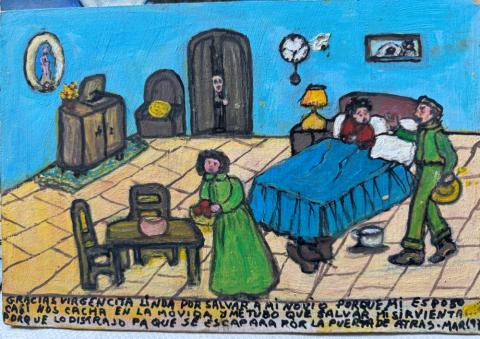
This ex-voto says: "Thank you, Blessed Mother, for saving my boyfriend because my husband almost caught us in the act, and my maid had to save me by distracting him so he could escape through the back door. March 1971." (GSR photo/Helga Leija)
The work of these two vendors preserves not only the physical ex-voto but also the stories and deep faith made visible in each one. They are essentially protecting a part of Mexico's spiritual and cultural heritage.
To dismiss their stories is to disconnect from the vibrant Mexican spirituality that insists on God's presence in the concrete realities of life, including those considered in bad taste. The ex-votos are prayers, examples of living dialogues with the divine that cannot be silenced.
It is important that I do not confine spirituality and devotion to traditional European standards alone. The richness of faith in cultures like Mexico shows me that God's presence is found in many forms — in expressions that may be unfamiliar, unrefined, or even challenging to the institutional norm, but that nevertheless nourish and sustain the soul.
Advertisement
For me, embracing this incarnational faith means honoring the very human ways God reveals himself to us. An honest and unfiltered spirituality embraces both the difficulties in life as well as the simple, real moments that keep us going — like the comforting image of Our Lady of Guadalupe watching over her people, and the colorful ex-votos that tell stories of love and mercy.