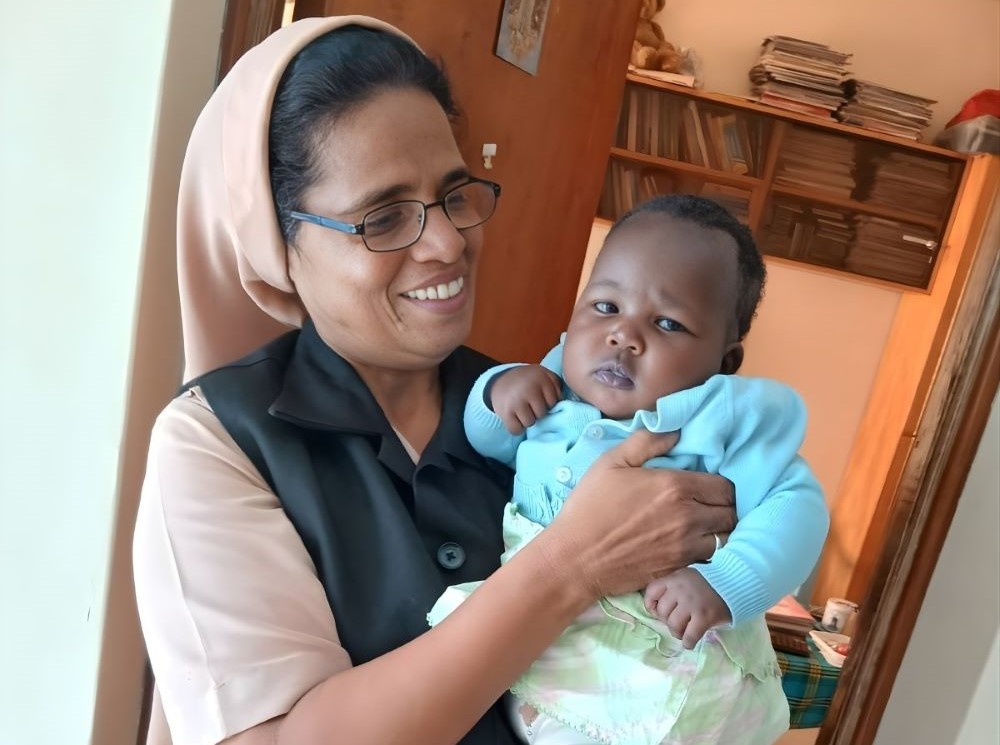
Sr. Alphonsa Parathur, of the Society of Helpers of Mary, poses with a child who was recently welcomed into the Holy Family Children's Home in Nakuru, Kenya. Parathur manages the home. (Courtesy of Alphonsa Parathur)

by Mourine Achieng
The Holy Family Children's Home in Nakuru has been a haven for children in crisis since 2008. At its inception, the home served 10 children and has grown over the years to house 100. Sr. Alphonsa Parathur of the Society of Helpers of Mary, manager of the children's home, told Global Sisters Report that every child's story is heartbreaking.
Most children are brought as infants. Some were abandoned in strategic places, such as hospitals, bus stations, churches and common footpaths. Some cases involve abuse, and other children are orphans. In some cases, mothers offer their children to the home. On rare occasions, the sisters at the home see extreme cases like one newborn girl, who was buried alive. Another child was dumped in a pit latrine and left to die, the sisters said. Now, she's with a foster family and doing well, they said.
Poverty and economic hardship are among the leading factors creating this crisis in Kenya. When parents struggle to provide the basic needs, it can lead some to neglect and abandon their children.
Sometimes, the children are rescued from abusive parents, such as three siblings who were rescued from their home and their physically abusive mother, who neglected her parental duties. The mother was later arrested, and the children have been placed in the children's home while she serves her sentence, according to the sisters.
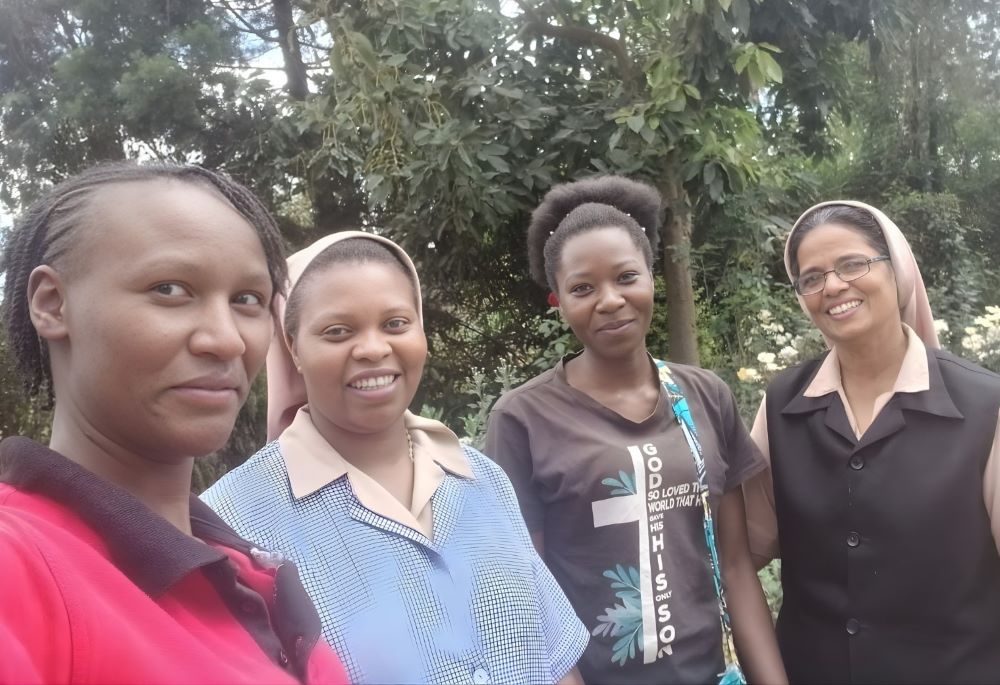
Sr. Alphonsa Parathur (right) and Sr. Verah Mwango (second from left) pose with two former residents of the Holy Family Children's Home. The home in Nakuru, Kenya, accommodates 100 children. (Courtesy of Alphonsa Parathur)
Broken homes are a common factor putting children at risk. One girl's mother remarried and left her under the care of her grandmother. The child was later abandoned at a bus terminal because her grandmother couldn't take care of her, the sisters said.
Despite the children's bleak backgrounds, the home nurtures them by providing their basic needs and educational and medical expenses. They also help the children heal from past traumas.
However, the sisters' mission goes beyond caring for the children in the orphanage. "From the very beginning, we started reintegrating children," Parathur told GSR. "Our ultimate aim is to get children back to a family, whether it’s through adoption, kinship, foster or their birth parents. Our task is to find every child a home."
The sisters' foster care program allows a foster parent to house a child for a year, and is renewable up to three times. The goal is for the foster parent to bond with the child as they prepare to adopt.
The sisters at the children's home also collaborate with adoption agencies. "We're happy when a child finds a home. They put on weight and blossom. When they get a mother, the love and one-on-one care lead to tremendous growth," said Henry Kibet, the social worker for the Holy Family Children's Home.
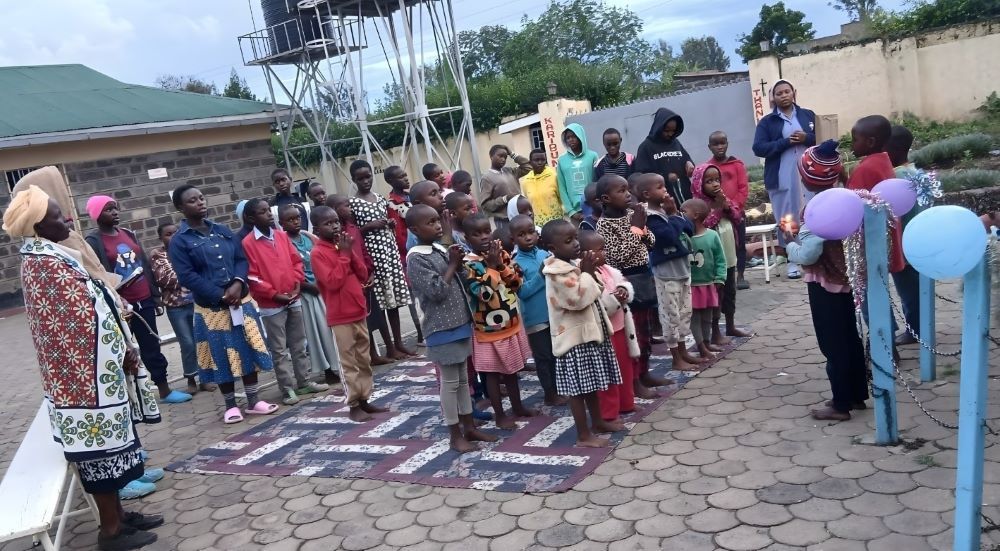
Children at the Holy Family Children's Home in Nakuru, Kenya, pray with Sr. Verah Mwango and other caregivers at the Marian Grotto. (Courtesy of Alphonsa Parathur)
Some children in the home have extended family who are unable to care for them. The home often meets with the children's kin, where the sisters educate relatives on the importance of a child growing up in a family. They also try to convince families to take back children as early as possible, even if only for the holidays.
The sisters also assure children of home-based support, which is supported by school fees.
"This way, more children can get a home. We believe home care is better than institutional care," Parathur said. "When we release them into families, we create room to rescue other children in crisis, care for them, and once they're out of distress, we can release them back to a family."
The sisters visit many homes that children have been reintegrated into every three months to assess how well they're adapting to their new environment.
Reintegration visits focus on assessing the children's safety and living conditions, ensuring that their basic needs are met, they attend school regularly, and there are no signs of abuse or neglect. The visits also aim to evaluate the quality of the relationship between the foster parent and the child. Ultimately, the sisters say, the goal is to ensure the children are safe, well cared for and thriving.
Advertisement
Around Berut village, where the home is located, the sisters have started a women's group to empower women and minimize cases of child neglect. They train women in running small-scale businesses and also offer grants and loans for business projects. The nine women's groups participate in table banking — a group funding system in which members pool their money for members to borrow to fund projects. Table banking supports women's efforts toward equal economic rights, economic empowerment and independence.
When the orphanage has surplus food from donations, they distribute it to the women. Last year, the sisters gave the groups sheep to promote self-reliance.
"Most of our children are from single mothers, which begs the question, where are the fathers? It's rare to find children from two-parent households here," said Sr. Verah Mwango, one of the sisters working at the children's home. "We encourage marriage [between couples] and economically empowering women because a financially stable woman is less likely to abandon her child."