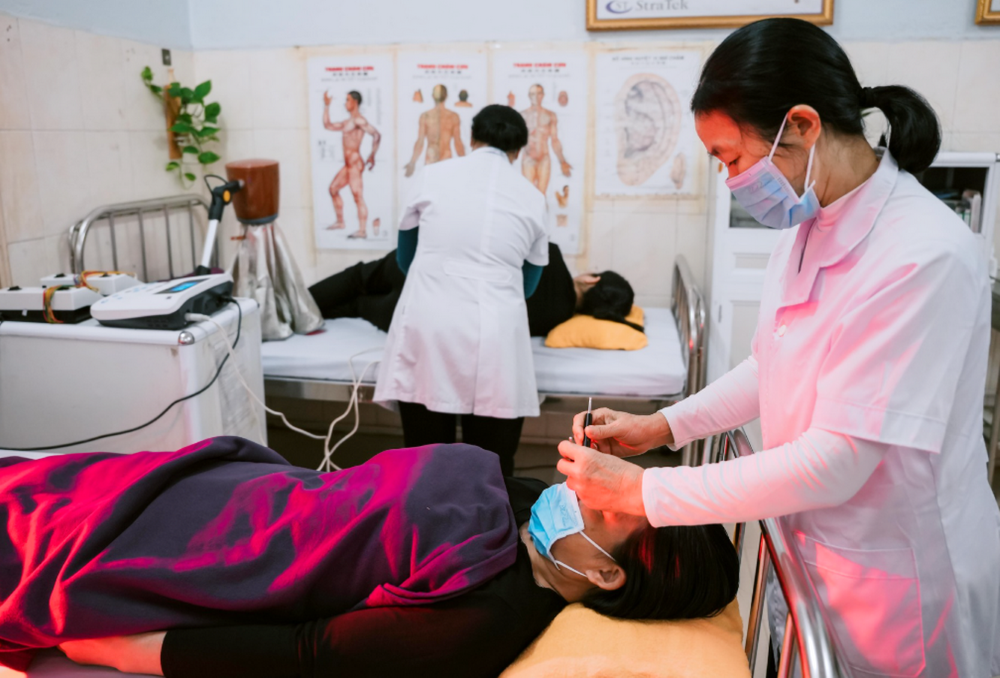
Sr. Anna Huynh Thi Binh receives treatment at Hue Traditional Medicine Hospital on May 23, 2026. (Joachim Pham)
The temperature was pushing nearly 40 degrees Celsius when Sr. Anna Huynh Thi Binh collapsed.
It was midmorning on May 20, and the St. Paul de Chartres nun had already spent hours with her congregation preparing and distributing free meals to some 100 patients and their families at Hue Central Hospital. Witnesses said she suddenly grew dizzy, fell to the floor, and began to convulse.
For months, Binh, 41, had been quietly pushing through insomnia, chronic fatigue and mounting stress to keep her ministry going. Each day began at 4 a.m. — before prayer and Mass — to prepare breakfast and lunch for poor patients. She also visited patients in the wards and managed her community's financial accounts.
"There were times I felt dizzy and had headaches, but I tried to push through," she said from a bed at Hue Traditional Medicine Hospital, where doctors diagnosed her with anemia and physical exhaustion. "I see enduring illness in order to serve others as a sacrifice in religious life."
Her congregation covered medical costs beyond her insurance, but what worried Binh most was not her own health. It was the patients waiting for their daily meal.
"Many are in physical pain and have no money to buy food," she said.
Binh's experience is not exceptional. Across Vietnam, women religious are quietly absorbing the physical cost of a mission that shows no signs of slowing.
In 2025, Vietnam counted 28,493 men and women religious — women accounting for roughly 80% — serving as pillars of the country's Catholic educational, healthcare and charitable works.
In the Hue Archdiocese alone, five women's congregations count 1,688 members, many of them working in hospitals, schools, social welfare centers and remote communities. But as pastoral needs grow and the number of personnel does not, an increasing number of sisters are confronting burnout, chronic illness and psychological strain.
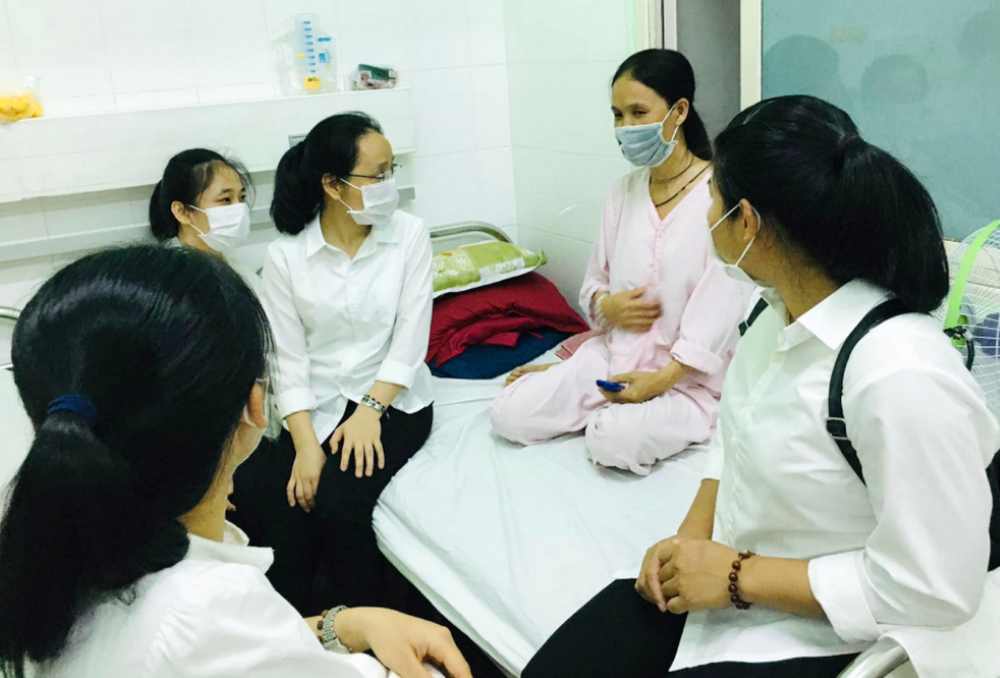
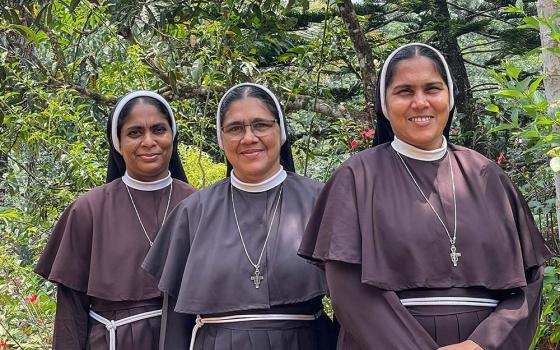
Four Lovers of the Holy Cross nuns visit Sr. Anna Trinh Thi Hong at Hue Central Hospital on May 25, 2026. (Joachim Pham)
Sr. Mary Ly Thi Bich Quyen, vice president of the Conference of Major Superiors in Vietnam, says the dynamic is rooted in something deeper than workload alone.
"Sacrificing oneself to serve others is seen as a value, an ideal to commit to, and the mindset of religious life," she said. But she is quick to add the caveat: "Sacrificing yourself too much is not always good, because we cannot give what we do not have."
Bich Quyen, also the provincial superior of the Sisters of Our Lady of the Missions in Vietnam, says the demand for education, healthcare, charity and care for vulnerable populations in a country of more than 100 million people is enormous — and that sisters rarely complain.
"Many sisters don't voice concerns about their pastoral work, but they consistently put others' needs before their own," she said.
She believes the cultural and spiritual equation of endurance with virtue leaves many sisters ill-equipped to recognize — much less act on — their own needs. "Some community leaders have not yet truly recognized the rest needs of sisters who are overworking, or are not yet ready to help workaholics stop and care for themselves."
The stories accumulate quickly.
Lovers of the Holy Cross of Hue Sr. Anna Trinh Thi Hong felt a sharp pain in her chest one night in April. The pain kept her awake through the night and left her unable to attend morning Mass. Medical tests later revealed a malignant tumor in her left breast.
While receiving treatment at a local hospital, Hong, 53, said what troubles her is not only her illness, but the fear of becoming a financial burden on her congregation — and the grief of being unable to continue her work with the poor.
"Health is very important for sisters because you need health to serve with joy and enthusiasm," she said. "But many sisters get sick after years of heavy, prolonged work."
She described members of her congregation who suffer from cancer, stroke and heart disease — women who spent years cooking, sewing liturgical vestments, making altar bread, or staffing gift shops to raise funds for ministry.
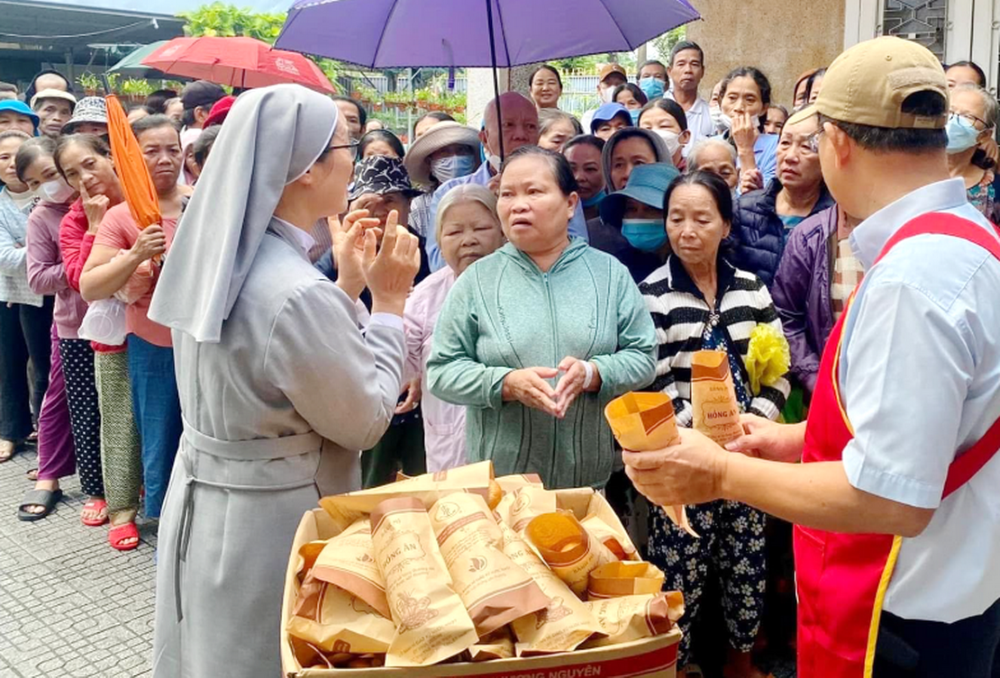
St. Paul de Chartres Sr. Francisca Le Thuy Van (left) and a volunteer distribute bread for breakfast to patients and their relatives at Hue Central Hospital on June 8, 2026. (Joachim Pham)
In exceptional cases, some who become chronically ill are allowed to return temporarily to their families for care*. Even from her hospital bed, Hong worried about her 86-year-old mother living alone.
Daughters of Mary of the Immaculate Conception Sr. Mary Bui Thi Ngoc, 66, spent years running programs supporting orphaned and street children, often working late into the night. She was diagnosed with hypertension and diabetes.
In 2023, while praying with her community one evening, she suddenly grew dizzy and fell. Doctors told her she would likely need medication for the rest of her life.
She had to hand over the leadership of a scholarship program supporting 100 Van Kieu ethnic children — who live in remote villages and are at constant risk of dropping out of school due to poverty, seasonal flooding, or early marriage.
Those treating sisters say they see a pattern.
Sr. Benedictine Nguyen Thi Dien, a physician and former director of church-run Kim Long Charity Clinic, has watched the toll accumulate over years: cardiovascular disease, diabetes, chronic insomnia, degenerative joint disease, cancer.
"Sisters tend to put others' needs before their own," Dien said. "Many come in when the illness is already serious."
She worries about the structural dynamics compounding individual choices. As experienced sisters in healthcare, education and social work grow older, those who remain active absorb more — working longer hours to compensate for the gaps.
"We are increasingly concerned about sisters' health because the workload is growing, but personnel is not keeping pace," she said.
Civil physician Nguyen Thi Nhan, who treats many sisters in Hue, says they are at high risk for burnout — frequently working in extreme weather, skipping meals or going without adequate rest.
Last November, a sister of the Lovers of the Holy Cross died of a stroke at 47, leaving grief across the city's religious communities.
Physical danger extends beyond illness.
Earlier this year, Daughters of Our Lady of the Visitation Sr. Mary Do Thi Xuan Phu fractured her leg after her motorbike skidded on a mountain road while she was delivering clothes and blankets to poor families during heavy rain. It was her third accident while out ministering.
"I still want to continue serving after I recover," she said from her wheelchair.
Across Vietnam's congregations, a slow shift is underway.
Bich Quyen has organized three 10-week sabbatical courses over the past year for more than 100 sisters from various congregations. Participants often arrive carrying the same weight: years of unbroken service, unaddressed burnout, accumulated pastoral pressure.
Initially, some superiors were reluctant to release sisters from their posts, worried about coverage. But as they witnessed the transformation in returning participants, more congregations began to recognize what had been missing.
"Through such a program, sisters receive positive energy for body and spirit, and renew their sense of vocation," Bich Quyen said.
Many congregations have expanded regular health checkups, added exercise and yoga programs, and introduced mental health training. Some have care homes for elderly or chronically ill sisters.
Communities are also being encouraged to cultivate relationships where sisters can comfortably raise personal concerns — including physical and psychological health — with one another and with leadership.
"In the past, a sister's endurance and self-sacrifice were considered virtues," Bich Quyen said. "Today, self-care is also seen as part of the mission."
Advertisement
For the patients who depend on sisters' daily presence, the stakes are concrete and immediate.
Pham Van Quang, 75, is being treated for heart disease at Hue Central Hospital. The free meals sisters bring save him roughly 40,000 dong (US$1.5) each day — not insignificant for a man living on a monthly pension of 4 million dong (US$151).
"If the sisters didn't bring food to me, it would be very difficult," he said.
Le Thi Tinh, who makes her living collecting recyclable materials, remembered sisters wading through floodwaters to deliver food and drinking water to poor families during storm season.
"They always came to help us even when the rain and wind were dangerous," she said, after visiting Hong in the hospital. "Now all we can do is pray for her speedy recovery."
Ngoc has not stopped thinking about returning to the ethnic children she had to leave behind.
"My family has been settled in the United States for many years and I haven't seen them in 10 years," she said. "I consider the community my family, and serving the less fortunate is my joy."
She paused.
"If God still gives me health," she said quietly, "then I still want to serve."
*This sentence has been updated to better reflect the reality in Vietnam, where only a small number of sisters, under special circumstances and with their congregation's permission, return to their families to receive care.