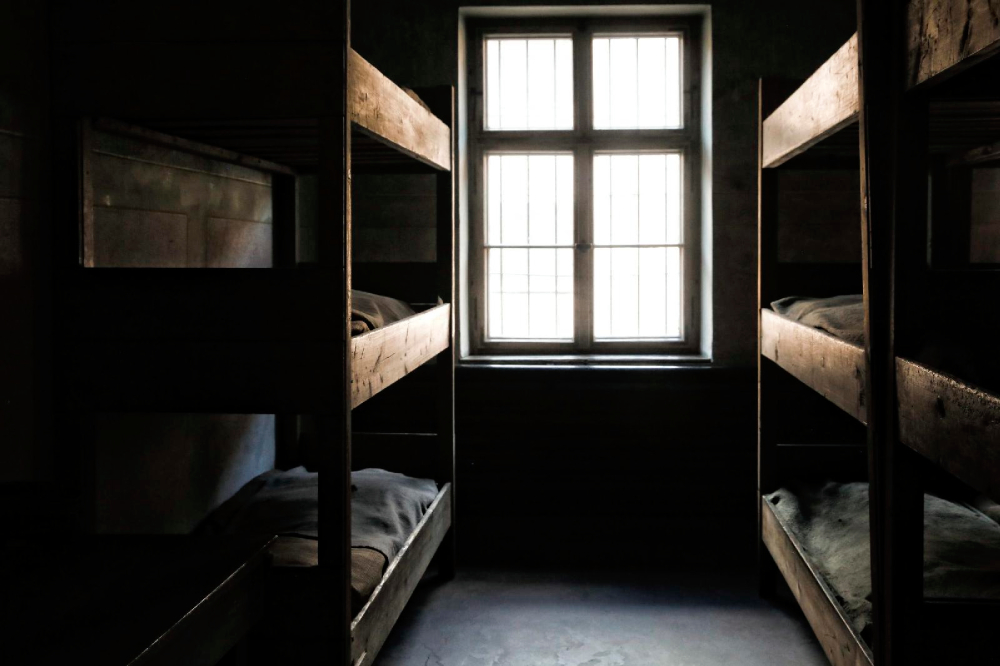
Bunk beds are seen in this Sept. 4, 2015, file photo at the Auschwitz-Birkenau Memorial and State Museum in Oswiecim, Poland. (CNS/Nancy Wiechec)
by Sr. Sue Paweski
Silence.
The commotion of passengers climbing out of coach buses, heading to restrooms, buying bottles of water, chatting about the weather and the drive, finding the guides who introduce themselves. Then, as we begin the long trek to the entrance of the Auschwitz concentration camp, the guide tells us not to speak.
The names of the murdered women, men and children envelop us as we walk through the high-walled path. We see nothing but the cement walls and listen to the litany of the names. Silence falls over us.
We emerge to a barren landscape with barbed wire structures that become the familiar perimeter of Auschwitz. It’s a long walk and the barren surroundings set the tone.
We see brick barracks in neat rows that, from the outside, could be a military barracks. Every structure is built with red brick and dark windows. Neat. Efficient. Inside, narrow aisles display pictures of the murdered: intellectuals, homosexuals, enemies of the Third Reich. Here they waited for torture and execution.
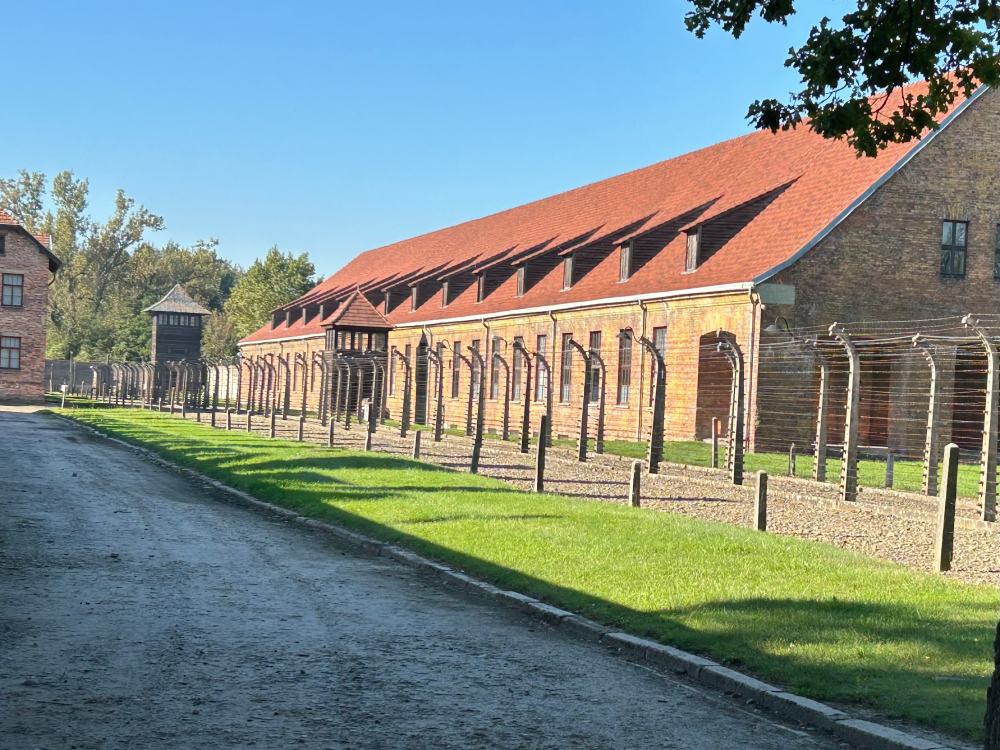
The barracks path at the Auschwitz-Birkenau death camp in Oswiecim, Poland is seen on Oct. 2025. (Sue Paweski)
We trudge down a narrow staircase to the cells of individual prisoners who were tortured and then executed. These people were made to stand for days — yes, days — then brought to their cells, chained to a pole to wait. Wait for the freedom death would bring.
The cell of St. Maximilian Kolbe is there. A Franciscan friar, he and his companions stayed with the people of Kraków as the Nazis advanced. After he was sent to Auschwitz, he begged for Franciszek Gajowniczek's life to be spared and his be taken in exchange. The Nazis complied.
And so it was. Gajowniczek survived and raised a family as a testimony to the act of love that saved his life. The place of Kolbe’s execution is marked, a memorial to all the acts of kindness prisoners showed one another.
Rooms lined with personal effects of our brothers and sisters who were murdered filled the walls. Mountains of shoes — baby shoes that tear at your heart — eye glasses, canes, crutches, prosthetics, Jewish prayer shawls. I could not take photos. It seemed an invasion of whatever was left of these people.
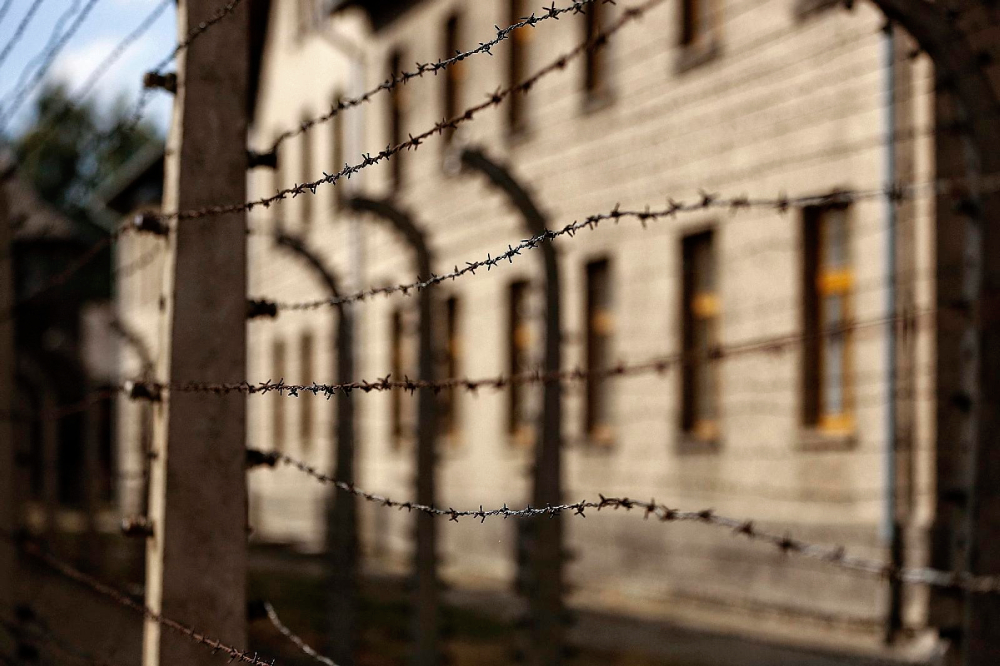
Lines of barbed-wire fencing enclose the Auschwitz-Birkenau Nazi death camp in Oswiecim, Poland, in this Sept. 4, 2015, file photo. (CNS/Nancy Wiechec)
The image that will stay with me forever is the mounds and mounds of hair: braids, long swaths, curls. Next to that area was a loom and a woven rug made from human hair.
The barracks that housed prisoners forced to work were packed with wooden bunk beds, two or more people to a bed. Hygiene was nonexistent. Long slabs of cement with two rows of holes served as latrines in the middle of the barracks. Two minutes were allotted and then the next group of people went. No sanitation.
Our group boarded the bus for the short trip to the death camp, Birkenau. The guide reminded us that the gas “baths” often took as long as 20 minutes before the prisoners died. There are no words to describe standing in that chamber.
We left in relative silence, shaking our heads in disbelief. The pall that hovers over Auschwitz-Birkenau is like a wet-down quilt. You feel it. The presence of the dead who now live in spirit was with us. We saw their photos and knew that it could be us. It could be our children. It could be me.
Advertisement
The parallels are our peril. Labeling the “other” as vermin and a list of horrid names sets the stage for a loss of freedom and liberty, to say nothing of the loss of humanity. The images are seared on my soul. If you think this is an exaggeration, watch documentaries, read, go to Holocaust museums.
To dilute what happened — and is happening in our country — is to welcome the evil that lurks in the pursuit of greed and power.
Let us pray daily for the strength to speak out, to stand with everyone whose dignity is challenged. Now we cannot be silent. We are compelled by the Gospel to stand with our sisters and brothers whose human rights are being stripped from the fabric of their humanity.
Our enemy is silence. We cannot be silent.